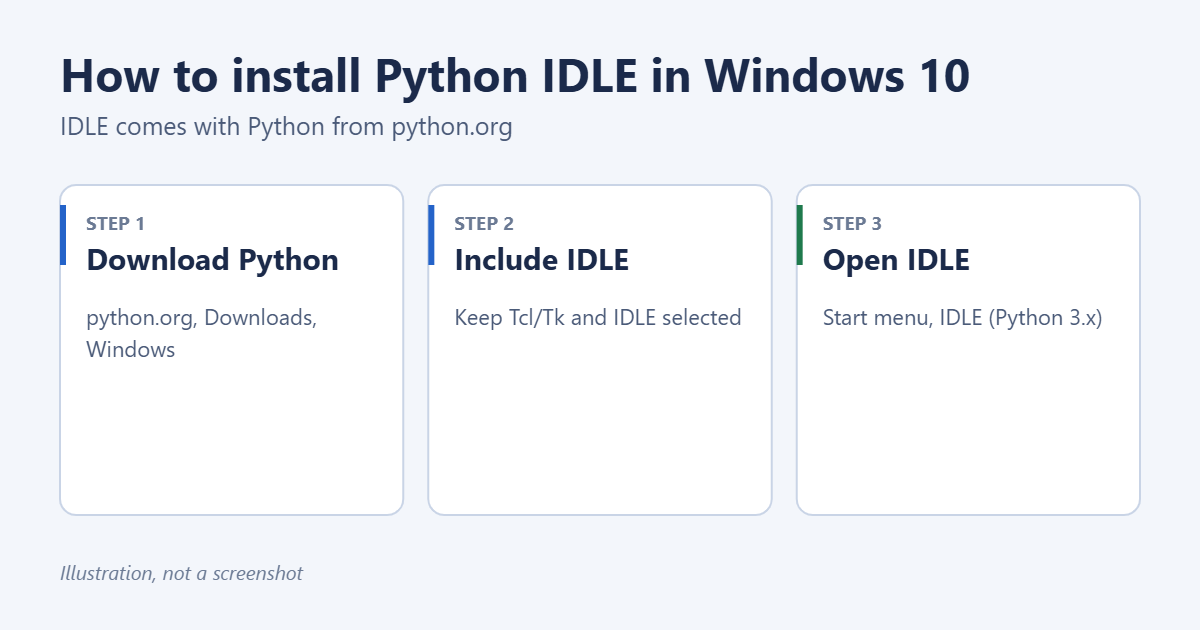
IDLE is the simple code editor that comes with Python, so to install it on Windows 10 you install Python from python.org. Go to python.org’s Windows downloads page, download the latest Python 3 release, run the installer, and keep the tcl/tk and IDLE option selected. When it finishes, open IDLE from the Start menu by searching for IDLE. If you already have Python, you can start IDLE from Command Prompt with py -m idlelib.
Applies to: Windows 10 and Windows 11 with Python 3.13 or 3.14. Python 3.14 supports Windows 10 and newer. Microsoft ended Windows 10 support on October 14, 2025, so a PC without Extended Security Updates no longer receives security fixes; that program runs until October 12, 2027.
What IDLE is
IDLE (Integrated Development and Learning Environment) is a beginner-friendly editor included with the standard Python installation. It has two windows: the Shell, where you type Python commands and see results straight away, and the Editor, where you write and save programs as .py files. It highlights your code in color, auto-indents, and lets you run a program by pressing F5.
Download Python
- Go to python.org/downloads/windows.
- Find the latest stable Python 3 release. For Python 3.14, python.org offers the new Python install manager as the main download, plus direct installers for 64-bit, 32-bit and ARM64 Windows.
- For the simplest setup with IDLE included, download the Windows installer (64-bit). Choose ARM64 only if your PC has an ARM processor.
Avoid the “embeddable package”, which is meant for bundling Python inside other programs and doesn’t include IDLE. The Microsoft Store also offers Python, but some Store versions of Python handle files and paths differently, so python.org is the most predictable choice for learning.
Run the installer with IDLE selected
- Open the downloaded installer.
- Select Add python.exe to PATH at the bottom of the first screen. This lets you run Python from Command Prompt.
- Select Customize installation if you want to confirm the components; otherwise select Install Now, which includes IDLE by default.
- If you chose Customize, make sure tcl/tk and IDLE is selected, along with pip, then select Next and Install.
- Select Yes on the User Account Control prompt, wait for the installation, and select Close.
Using the Python install manager instead
If you installed the Python install manager, open Command Prompt and run py install default to install the latest Python. The manager adds Start menu shortcuts for the versions it installs. If you don’t see an IDLE shortcut, start it with py -m idlelib.
Open IDLE
- Select Start and type IDLE.
- Open IDLE (Python 3.x 64-bit). The IDLE Shell window appears with a
>>>prompt. - Type
print("Hello, world!")and press Enter. Python prints the message, which confirms everything works.
Right-click the IDLE entry in Start and select Pin to taskbar for quick access.
Write and run your first program
- In the IDLE Shell, select File > New File.
- Type a short program, for example:
name = input("What's your name? ")print("Hi, " + name) - Select File > Save, choose a folder, and name the file with a .py ending, such as hello.py.
- Press F5 or select Run > Run Module. The program runs in the Shell window.
Useful IDLE settings
- Bigger text: select Options > Configure IDLE > Fonts and increase the size.
- Dark theme: in Configure IDLE > Highlights, choose IDLE Dark.
- Line numbers: select Options > Show Line Numbers in an editor window.
- Open .py files in IDLE: right-click a .py file in File Explorer and select Edit with IDLE.
Handy IDLE shortcuts
- F5: run the current program.
- Alt + P and Alt + N in the Shell: scroll back and forward through commands you’ve typed, so you don’t have to retype them.
- Tab after typing part of a name: show possible completions.
- Ctrl + ] and Ctrl + [: indent or unindent the selected lines.
- Alt + 3 and Alt + 4: comment out or uncomment the selected lines.
- Ctrl + F6 in the Shell: restart Python, clearing all variables.
Install extra packages for use in IDLE
IDLE uses the Python it came with, so packages you install with pip are available immediately. Open Command Prompt and run, for example, py -m pip install requests. Then type import requests in the IDLE Shell to check it works. If you have more than one Python version, use py -3.14 -m pip install with the version that matches your IDLE window’s title bar.
Troubleshooting
IDLE isn’t in the Start menu
It wasn’t selected during installation. Open Settings > Apps, find Python 3.x, select Modify, then Modify again and select tcl/tk and IDLE. Or run py -m idlelib to check whether IDLE is available.
“python is not recognized” in Command Prompt
Python wasn’t added to PATH. Use the py command instead, which the installer adds separately, or rerun the installer, select Modify, and turn on Add Python to environment variables.
Typing python opens the Microsoft Store
Windows has app execution aliases that point to the Store. Go to Settings > Apps > Apps & features > App execution aliases and turn off the two App Installer entries for python.exe and python3.exe.
IDLE opens and closes immediately
A file in your project folder may have the same name as a Python module, such as random.py or tkinter.py. Rename it and try again.
Frequently asked questions
Is IDLE free?
Yes. IDLE is part of Python, which is free and open source.
Can I install IDLE without Python?
No. IDLE is written in Python and needs it to run. Installing Python from python.org gives you both.
Should I use IDLE or a code editor like Visual Studio Code?
IDLE is ideal for learning and small scripts. For bigger projects, an editor such as Visual Studio Code adds features like Git integration and extensions. You can use both.
Is it the same on Windows 11?
Yes. IDLE comes with Python there too, so follow the steps to install Python on Windows 11.
For a closer look at the Python setup itself, read how to install Python in Windows 10. If you need data science tools later, you can install Anaconda in Windows 10.

Matt Jacobs has been working as an IT consultant for small businesses since receiving his Master’s degree in 2003. While he still does some consulting work, his primary focus now is on creating technology support content for SupportYourTech.com.
His work can be found on many websites and focuses on topics such as Microsoft Office, Apple devices, Android devices, Photoshop, and more.