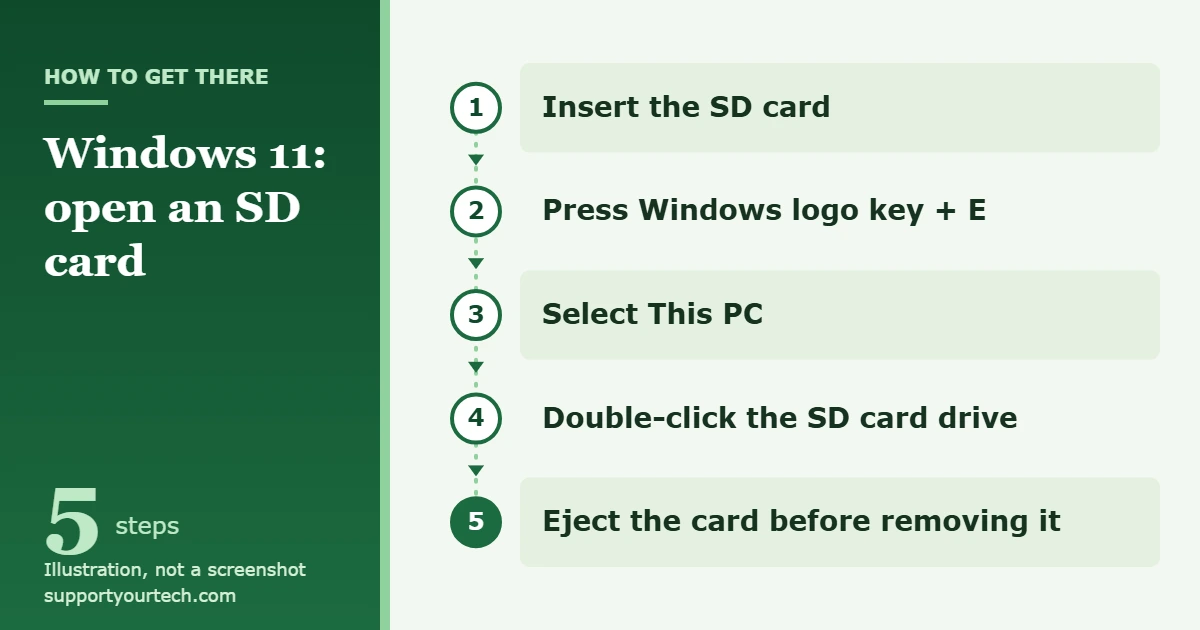
To open an SD card on Windows 11, insert the card into your PC’s card slot or a USB card reader, press Windows logo key + E to open File Explorer, select This PC in the left navigation pane, and double-click the drive that represents the card. Its folders and files open in the same window, ready to view or copy.
Applies to: Windows 11 on a PC with a built-in card slot or a USB card reader. Checked against Microsoft Support on October 7, 2026.
What you need before you start
- A way to connect the card. Many laptops have a card slot on the side or front edge. If your PC has no slot, a USB card reader does the same job: put the card in the reader, then plug the reader into a USB port.
- The right adapter for a small card. A microSD card will not fit a full-size SD slot on its own. Seat it fully in a microSD-to-SD adapter first, or use a reader that has its own microSD slot.
- A gentle hand. A card only fits one way. If it does not slide in easily, take it out, turn it over, and try again instead of pushing harder.
Open the SD card in File Explorer
File Explorer is the Windows app for browsing drives, folders and files. An SD card appears in it as an extra drive, the same way a USB flash drive does.
- Insert the SD card. Push the card into the card slot, or into a card reader that is plugged into a USB port. Give Windows a few seconds to recognize it.
- Open File Explorer. Press Windows logo key + E, or select the File Explorer folder icon on the taskbar or the Start menu. A File Explorer window opens.
- Select This PC. In the left navigation pane, select This PC. The main part of the window now lists every drive connected to the computer.
- Find the card. Look for a drive that was not there before you inserted the card. It normally has its own drive letter, such as D: or E:, and a size close to the capacity printed on the card.
- Double-click the drive. The card opens and shows its folders and files. Double-click a folder to go inside it, or double-click a file to open it in its default app.
If you are not sure which drive is the card, note the drives listed under This PC, pull the card out, and see which one disappears. Then reinsert it. This is safe as long as nothing is being copied to or from the card at that moment.
View and copy the files on the card
Once the card is open, it behaves like any other folder on your PC.
- Change how files are shown. Select View at the top of File Explorer to switch between icons, lists and details. Larger icons make it easier to pick out photos; the details layout shows dates and sizes.
- Copy files to the PC. Select the files you want (press Ctrl + A to select everything in the folder), then select Copy at the top of the window or press Ctrl + C. Go to a folder on your PC, such as Pictures or Documents, and select Paste or press Ctrl + V. The originals stay on the card.
- Move files instead. Use Cut (Ctrl + X) rather than Copy if you want the files taken off the card once they reach the new location.
- Use the right-click menu. Right-click a file or folder to see Cut, Copy, Paste, Rename, Share and Delete. Select Show more options in that menu if a command you expect is missing.
Copying is the safer choice for photos and other files you cannot replace. Check that the copies open properly on the PC before you delete anything from the card.
Remove the card safely when you finish
Pulling a card out while Windows is still writing to it can damage files. Microsoft’s guidance is to tell Windows first, then remove the hardware.
- Wait for any copy or save to finish, and close files that you opened from the card.
- On the taskbar, right-click the Safely Remove Hardware and Eject Media icon. If you do not see it, select Show hidden icons first.
- Select Eject followed by the name of your card or reader.
- When the Safe To Remove Hardware notification appears, take the card out.
If the icon is not on your taskbar at all, right-click the taskbar, select Taskbar settings, expand Other system tray icons, and turn on Safely Remove Hardware and Eject Media. You can also open Settings > Bluetooth & devices > Devices, find the device under Other devices, and select Remove; that route suits a USB card reader, because it removes the reader as a whole. Both methods are described in Microsoft’s article on how to safely remove hardware in Windows, and the same steps appear in our guide to ejecting an external drive or USB device in Windows 11.
If the SD card does not show up in File Explorer
Work through these checks in order. The first few take seconds and solve most cases; the later ones look at how Windows sees the card.
Start with the physical connection
- Remove the card and reinsert it firmly. For a microSD card, make sure it is pushed all the way into its adapter.
- With File Explorer open, press F5 to refresh the window.
- If you use a USB card reader, plug it into a different USB port that is directly on the PC, not on a hub. Microsoft notes that some ports do not supply enough power or have trouble with particular devices.
- Restart the PC with the card removed, then insert it again once Windows has loaded.
- Try the card in another computer, or in the camera or phone it came from. If it fails everywhere, the card is the likely problem. If it only fails on this PC, keep going.
Check the card in Disk Management
Disk Management is a built-in Windows tool that lists every storage device, including ones that File Explorer hides because they have no drive letter. Select Start, type Disk Management, and open the result (our guide to opening Disk Management in Windows 11 lists other ways in). You need an administrator account to make changes there. Find the disk whose size matches your card, then compare what you see with this table.
| What Disk Management shows | What it means | What to do |
|---|---|---|
| A Healthy volume with no drive letter | The card works, but Windows has not given it a letter, so File Explorer cannot list it. | Add a drive letter (steps below). |
| Offline | The disk is connected but not in use. | Right-click the disk and select Online. |
| RAW in place of a file system | Windows cannot read the card’s file system. | Stop if the card holds files you need. Formatting makes it usable again but erases everything. |
| Unallocated | Windows sees no volume on the card. | Only if you know the card is empty, right-click the space and select New Simple Volume. |
| Not Initialized or Unreadable | The disk information is missing or damaged, or the hardware is failing. | Select Action > Rescan Disks, restart, and try another reader before anything else. |
| The card is not listed at all | Windows is not detecting the card or the reader. | Check the reader in Device Manager (below). |
These statuses and fixes come from Microsoft’s page on troubleshooting Disk Management.
Add a drive letter
- In Disk Management, right-click the card’s volume and select Change Drive Letter and Paths.
- Select Add. (If the card already has a letter and you want a different one, select Change.)
- Keep Assign the following drive letter selected, choose a letter from the list, and select OK.
- If Windows asks you to confirm, select Yes.
The card should now appear under This PC. Microsoft documents this procedure in Change a drive letter.
Check the card reader in Device Manager
- Right-click the Start button and select Device Manager.
- Select the arrow next to a category to expand it, and look for a device marked with an exclamation point.
- Right-click that device and select Update driver, then choose the option that searches for a driver automatically.
- If that changes nothing, right-click the device, select Uninstall device, and confirm with Uninstall. Then select Action > Scan for hardware changes, or restart the PC, so that Windows installs the device again.
Microsoft also points out that most driver updates arrive through Windows Update, so install any pending updates as well. The full procedure is in Update drivers manually in Windows.
Windows asks you to format the card
Do not agree to format a card that holds photos or documents you still need. Microsoft’s documentation is direct on this point: formatting a disk erases all the data on it, so it is the wrong step when you are trying to get files back. Close the message, remove the card safely, and try it in the device that recorded the files or in a different reader. Format only when you are sure the contents are backed up or not needed; our guide to formatting an SD card in Windows 11 covers that job.
The card opens, but you cannot save or delete files
Full-size SD cards and microSD adapters can have a small write-protect switch. When it is set to the locked position, the card is protected against changes, so saving to it or deleting from it fails even though the card opens. Eject the card, slide the switch to the other position, and insert it again.
Missing options on a work or school PC
Changing drive letters and reinstalling devices needs an administrator account. If you sign in with a standard account, or your organization manages the PC and restricts removable storage, these tools may ask for an administrator password or be unavailable. Ask your IT support team instead of looking for a way around the restriction.
Frequently asked questions
Why does nothing happen when I insert my SD card?
Windows 11 does not always open a window by itself when you insert a card. That is normal. Open File Explorer with Windows logo key + E and look under This PC. If the card is not listed there, follow the troubleshooting checks above.
Do I need to install a driver to open an SD card?
Usually not. Windows 11 installs what it needs for most built-in slots and USB card readers automatically, and driver updates come through Windows Update. Device Manager is only worth opening when the card does not appear in Disk Management at all.
Can I open a microSD card on a Windows 11 laptop?
Yes. Put the microSD card in a microSD-to-SD adapter and use the laptop’s SD slot, or use a USB reader with a microSD slot. After that the steps are identical, and the card appears as a drive under This PC.
Is it safe to remove the SD card without ejecting it?
It is a risk if anything is still being written to the card. Use the Safely Remove Hardware and Eject Media icon and wait for the Safe To Remove Hardware notification, especially after copying or saving files.
Should I open files from an SD card I found or was given?
Treat an unknown card like an unknown USB drive. Looking at photos and documents is one thing; do not run programs from it, and do not dismiss Windows security warnings just because the files came from a card.
With the card open under This PC, copy what you need to a folder on your PC first, check that the copies open, and then eject the card before you take it out.

Matt Jacobs has been working as an IT consultant for small businesses since receiving his Master’s degree in 2003. While he still does some consulting work, his primary focus now is on creating technology support content for SupportYourTech.com.
His work can be found on many websites and focuses on topics such as Microsoft Office, Apple devices, Android devices, Photoshop, and more.