Last updated on November 17th, 2026 at 03:14 pm
The Bluetooth driver in Windows 10 is reinstalled from Device Manager: expand Bluetooth, right-click your Bluetooth adapter, select Uninstall device, then restart your PC. Windows detects the adapter at startup and installs the driver again automatically.
Try this when Bluetooth has disappeared, shows an error, or has stopped working for every device. If only one pair of headphones or one mouse won’t connect, remove and pair that device again first; that doesn’t touch the driver.
Plug in a wired mouse and save your work
- Plug in a wired mouse or keyboard if you normally use Bluetooth ones. They stop working until the driver is back.
- Save your work. You’ll restart the PC.
- Note your adapter’s name in Device Manager in case you need to download its driver later.
Try updating the driver first
A driver update fixes many Bluetooth problems without a reinstall.
- Right-click Start and select Device Manager. (You can also press Windows + R, type
devmgmt.msc, and press Enter.) - Expand Bluetooth.
- Right-click your Bluetooth adapter and select Update driver. The adapter usually has Bluetooth or Wireless in its name. Paired devices such as headphones are listed there too, but they aren’t the adapter.
- Select Search automatically for drivers and follow the prompts.
- Restart your PC.
If Windows reports the best driver is already installed, uninstall and reinstall it as shown next.
Will I lose my paired Bluetooth devices?
You may need to pair some devices again after reinstalling the adapter. Keep your headphones or mouse nearby, and put them in pairing mode if they don’t reconnect on their own.
Uninstall and reinstall the Bluetooth driver
- In Device Manager, expand Bluetooth.
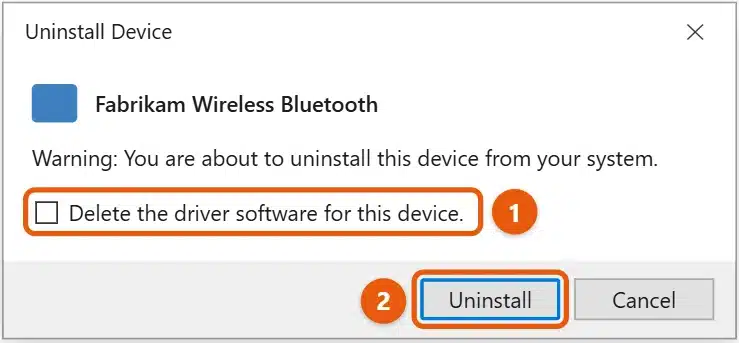
- Right-click your Bluetooth adapter and select Uninstall device.
- Leave Delete the driver software for this device unchecked, so Windows reinstalls the same driver when you restart. Check it only if you’ve already downloaded a newer driver from your PC maker or the current driver is known to be faulty.
- Select Uninstall.
- Restart your PC.
After the restart, open Device Manager again and expand Bluetooth. The adapter should be back without a warning sign. If it isn’t, select Action > Scan for hardware changes.
Will Windows reinstall the driver by itself?
Usually. If you uninstall the adapter without deleting the driver software, Windows reinstalls the same driver when you restart. If you deleted the driver software, Windows looks for one through Windows Update, or you can install it from the PC maker’s site. When Windows keeps reinstalling the same faulty Bluetooth driver, ticking the delete checkbox or using pnputil removes the stored copy, as explained in how to delete drivers in Windows 10.
Check Windows Update for a driver
Windows Update sometimes offers a newer Bluetooth driver as an optional update.
- Select Start > Settings > Update & Security > Windows Update.
- Select Check for updates and install anything offered.
- Select View optional updates, open Driver updates, and install any Bluetooth driver listed.
- Restart your PC.
Find out which Bluetooth adapter you have
You need the exact adapter to download the right driver. In Device Manager, expand Bluetooth. The adapter is usually named after its maker, such as Intel(R) Wireless Bluetooth(R), Realtek Bluetooth Adapter, or Qualcomm or MediaTek Bluetooth. Ignore entries for paired headphones or mice; those are devices, not the adapter. If a newer driver is available, the steps to update or install the Bluetooth driver in Windows 10 show where to find it.
Right-click the adapter, select Properties, and open the Driver tab to see the driver version and date. Compare these with the newest version on your PC maker’s support page.
Install the driver from your PC maker
Your PC or Bluetooth adapter maker often has a newer driver than Windows Update.
- Go to the support page for your exact PC or adapter model on the maker’s website.
- Download the Bluetooth driver for Windows 10 that matches your system (usually 64-bit).
- Run the installer, then restart your PC.
Only download drivers from the PC or adapter maker’s own site. Avoid driver-updater programs, which can install the wrong driver or unwanted software.
Is Windows 10 still getting driver updates?
Windows 10 no longer gets regular updates, so newer Bluetooth drivers may only be on your PC maker’s site, and some makers have stopped releasing them. If you plan to stay on Windows 10, read about enrolling in Windows 10 Extended Security Updates.
If the driver isn’t the problem, work through fixing Bluetooth problems in Windows 10. On a Windows 11 PC, use reinstalling the Bluetooth driver in Windows 11 instead. Microsoft’s own instructions are in Update Bluetooth drivers in Windows.
Check the Bluetooth service after reinstalling
A fresh driver won’t work if the service it relies on is turned off. Press Windows + R, type services.msc, and press Enter. Double-click Bluetooth Support Service. If Startup type is Disabled, change it to Manual or Automatic, select Apply, then Start. Restart the PC and test Bluetooth again.
Do a full restart, not a shutdown
Windows 10’s fast startup can bring back a stuck driver after you shut down. After reinstalling, use Start > Power > Restart rather than Shut down, so Windows loads the driver from scratch.
If Bluetooth isn’t in Device Manager at all
- Show hidden devices: in Device Manager, select View > Show hidden devices, then look under Bluetooth and Other devices. An unknown device with a yellow warning sign usually needs a driver from your PC maker.
- Check airplane mode: select the Action center icon on the taskbar and make sure Airplane mode is off.
- Check for a wireless switch or key: some laptops have a switch or a function key that turns Bluetooth and Wi-Fi off.
- Shut down fully: select Start > Power, hold Shift, and select Shut down. Wait 30 seconds, then turn the PC back on.
- Your PC may not have Bluetooth: many desktop PCs don’t. A small USB Bluetooth adapter adds it.
Related guides
- How to Send Files from iPhone to Windows 10 (Bluetooth and Better Ways)
- Microsoft Store Missing in Windows 10? Repair or Reinstall

Matt Jacobs writes and maintains the guides on Support Your Tech, which he started in 2017. He spent most of his career keeping small-business PCs running and still takes the occasional consulting job, so the steps here come from fixing the same problems on other people’s computers. Each guide follows Microsoft, Apple and Google’s own documentation and is updated when the steps change. Screenshots marked “Recreated” are illustrations of the real screens.