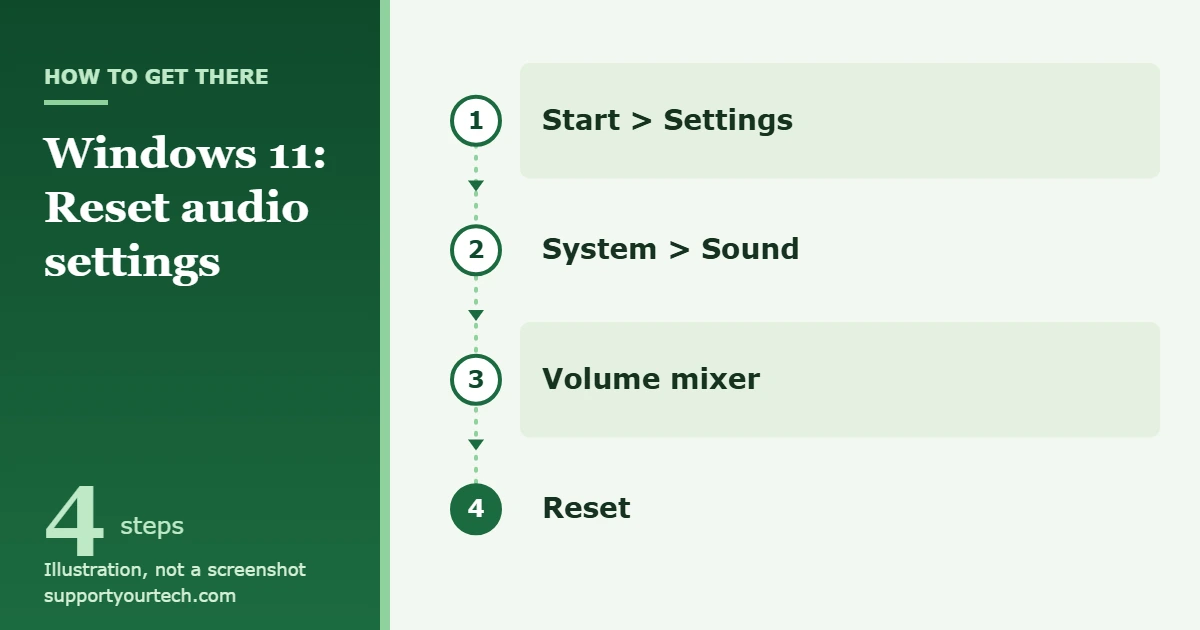
Windows 11 has no single button that resets every audio setting, but one control comes close: open Start > Settings > System > Sound > Volume mixer and select Reset. That puts sound devices and app volumes back to the recommended defaults. Anything it doesn’t cover, such as enhancements, spatial sound, the audio format, and the driver, is reset separately with the steps below.
Applies to: Windows 11. Checked against Microsoft Support and Lenovo Support on October 7, 2026.
What “reset all audio settings” means in Windows 11
Sound settings in Windows 11 live in several places, and each one is reset on its own. Knowing which part is causing the trouble saves time, because you can go straight to the reset that matters.
| Setting | Where it lives | How to reset it |
|---|---|---|
| App volumes and the device each app plays through | Settings > System > Sound > Volume mixer | Select Reset |
| Output and input device | Settings > System > Sound | Select the device again |
| Audio enhancements, spatial sound, audio format | The device’s own page in Sound settings | Change each setting back by hand |
| Audio services | Services | Restart the services |
| Audio driver | Device Manager | Update, roll back, or reinstall |
Start with the Volume mixer reset. It is quick, it doesn’t remove anything, and it fixes the most common complaint: one app that is silent, too quiet, or playing through the wrong speakers.
Before you start
- Make a note of any app volume levels or per-app output choices you want to keep. The reset clears them, and there is no undo button.
- Check the basics first. Microsoft’s own checklist starts with loose cables, a muted volume control, and headphones or speakers that are switched off.
- Save your work if you plan to go as far as the driver steps, because those need a restart.
Reset sound devices and app volumes in Volume mixer
- Select Start, then Settings. The Settings window opens.
- Select System, then Sound. You see your output devices at the top and input devices below them.
- Scroll down and select Volume mixer. This page lists the system volume and every app that is currently able to play sound.
- Find the line that reads Reset sound devices and volumes for all apps to the recommended defaults and select Reset next to it.
- Look at the Apps list on the same page. Each app’s volume slider and output device should now be back at the default.
Now play something in the app that was giving you trouble. If the sound is back, you’re done. Lenovo documents this same reset for Windows 11 on its support page, How to reset the sound to the Microsoft recommended defaults.
Choose the right output and input device again
After a reset, confirm that Windows is sending sound where you expect. A PC with a monitor, a headset, and a Bluetooth speaker has several possible outputs, and the wrong one may be selected.
- Select Start > Settings > System > Sound.
- In the Output section, select the device you want to use for playback. Sound switches to that device immediately.
- Further down the same page, in the input section, select the microphone you want to use.
You can also switch outputs without opening Settings: select the Speakers icon on the taskbar, then select the arrow that opens the list of audio devices. If your speakers aren’t in the list at all, see our guide to turning on computer speakers in Windows 11.
Reset the settings for one audio device
Each speaker, headset, and microphone has its own page of settings. The Volume mixer reset doesn’t promise to change these, so check them by hand on the device that sounds wrong. Repeat the steps for every device you use.
Turn off audio enhancements
Enhancements are extra processing that Windows or the audio driver applies to the sound. They can cause distortion, crackling, or low volume, which is why Microsoft suggests turning them off while troubleshooting.
- Select Start > Settings > System > Sound.
- Under Output, select your audio device. Its settings page opens.
- Find Audio enhancements and set it to Off.
- Play some audio to test. If nothing changes, you can turn the setting back on.
Turn off spatial sound
Spatial sound is a surround-style effect for headphones. Microsoft’s built-in version is called Windows Sonic for Headphones. On the same device page, look for the Spatial sound setting. If a spatial format is selected there and audio sounds echoey or thin, switch the setting off and test again. Microsoft explains the feature in How to turn on spatial sound in Windows.
Try a different audio format
The audio format is the quality level (sample rate and bit depth) that Windows uses for a device. A format the hardware doesn’t handle well can cause crackling or silence.
- On the device’s settings page, select Advanced.
- Under Default format, select a different format.
- Test the sound. Try another format if the first one doesn’t help.
Microsoft doesn’t name one correct format, because it depends on the hardware. Work through the list until the sound is clean.
Make sure the device is enabled
A device that has been disabled won’t play anything, no matter how the volume is set.
- Select Start > Settings > System > Sound.
- Under Advanced, select More sound settings. The classic Sound window opens (see other ways to open the Sound Control Panel).
- Select the Playback tab for speakers and headphones, or the Recording tab for microphones.
- Select your device, then select Properties.
- Next to Device usage, choose Use this device (enable), then confirm the change.
Run the Windows audio troubleshooter
The troubleshooter checks common problems and applies fixes for you. It is a good next step when the manual resets haven’t helped and you aren’t sure which setting is wrong.
- Select Start > Settings > System.
- Select Troubleshoot, then Other troubleshooters.
- Go to the Audio section and select Run.
- Follow the prompts on screen.
Microsoft now runs its automated audio troubleshooter through the Get Help app on Windows 11, so the troubleshooter may open there. That is expected.
Restart the Windows audio services
Services are background programs that Windows needs for sound to work. Restarting them reloads the audio system without restarting the whole PC.
- Select Start, type services.msc, and press Enter. The Services window opens with a long alphabetical list.
- Right-click Windows Audio, select Restart, and select Yes if you’re asked to confirm.
- Do the same for Windows Audio Endpoint Builder.
- Microsoft’s main audio article also lists Remote Procedure Call (RPC). If the Restart option isn’t available for a service, restart the PC instead.
- Test your audio.
Any sound that is playing stops for a moment while the services restart. You may need to close and reopen an app before it plays again.
Reset the audio driver
A driver is the software that lets Windows talk to your sound hardware. If sound problems began after a Windows update or a driver change, resetting the driver is the fix most likely to work. Try these in order and stop when the sound returns.
Update the driver
- Select Start, search for Device Manager, and open it.
- Expand Sound, video and game controllers.
- Right-click your audio device and select Update driver.
- Select Search automatically for drivers and follow the instructions.
- Restart your PC.
For more ways to get a newer driver, see how to update audio drivers in Windows 11.
Roll back the driver
Rolling back returns to the driver you had before the last update. Use it when sound worked until a recent driver change.
- In Device Manager, right-click your audio device and select Properties.
- Select the Driver tab, then select Roll Back Driver.
- Read the instructions, then select Yes.
If the button can’t be selected, Windows has no earlier driver stored for that device.
Uninstall and reinstall the driver
Save your documents and close your apps before this one. Your PC will have no sound until it restarts.
- In Device Manager, right-click your audio device and select Uninstall device.
- Select the Attempt to remove the driver for this device check box, then select Uninstall.
- Restart your PC. According to Microsoft, the restart prompts Windows to reinstall the audio driver automatically.
If sound still doesn’t work after the restart, Microsoft’s advice is to install the latest driver from the device manufacturer’s website. Use the support page for your exact PC or sound card model, not a driver-download utility from an unknown site.
How to confirm the reset worked
- Open Settings > System > Sound > Volume mixer and check that the app you’re testing shows a raised volume slider, isn’t muted, and has the correct output device.
- Play audio in two different apps, such as a browser video and a music app. Sound in one but not the other points to a setting inside the silent app.
- Test the microphone too if you reset it, using the recording app or the call app you normally use.
There is no way to undo the Volume mixer reset. To get a custom setup back, return to Volume mixer and set each app’s volume and output device again. If an app isn’t in the list, open it and play something first.
Troubleshooting
The Reset button or Volume mixer isn’t there
Install pending updates first: select Start > Settings > Windows Update > Check for updates. Also confirm you’re on Windows 11. On Windows 10 the same reset sits under a different heading in Sound settings, so these steps won’t match your screen.
An app is missing from Volume mixer
Open the app and start playing something, then return to the Apps list in Volume mixer and look again.
One app is still silent after the reset
Check the volume and mute controls inside the app itself, and any audio device setting the app has. Call and meeting apps often keep their own speaker and microphone choices, which Windows doesn’t reset. Microsoft covers this case in Fix app audio not working while system sounds work in Windows.
The microphone still doesn’t work
This is often a privacy permission, not an audio setting. Select Start > Settings > Privacy & security, then select Microphone under App permissions. Turn on Microphone access and Let apps access your microphone, then make sure the switch for the app you’re using is on.
Settings are greyed out on a work or school PC
Organizations can lock device settings, block driver changes, and limit who can restart services. If a control can’t be selected or Windows asks for an administrator password you don’t have, contact your IT help desk. Don’t try to work around the restriction.
A USB or Bluetooth headset still sounds wrong
Headsets, speakers, monitors, and external sound cards can store their own settings in the hardware or in the maker’s app. Resetting Windows doesn’t touch those. Look for a reset option in the manufacturer’s app or manual. For wireless headphones, removing and pairing them again often helps; see how to connect Bluetooth headphones to a Windows 11 laptop.
Nothing here brought the sound back
Test the speakers or headphones on another device, such as a phone. If they’re silent there too, the hardware is the problem, and no Windows setting will fix it. If they work elsewhere, go through Microsoft’s full checklist in Fix sound or audio problems in Windows.
Frequently asked questions
Is there one button that resets every audio setting in Windows 11?
No. The Reset button in Volume mixer is the closest thing, and it covers sound devices and app volumes. Enhancements, spatial sound, audio formats, services, and drivers are each reset separately.
Will resetting audio settings delete my files or apps?
No. None of the steps in this article remove personal files or installed apps. The Volume mixer reset only changes sound preferences. Uninstalling the audio driver removes that driver, and Windows reinstalls it when you restart.
Do I need to restart my PC after the reset?
The documented steps for the Volume mixer reset don’t include a restart. You do need to restart after updating or uninstalling the audio driver, and a restart is a reasonable extra step if sound is still wrong.
Do I need to edit the registry to reset sound settings?
No. Microsoft’s audio troubleshooting steps don’t include any registry edits. Deleting audio entries from the registry isn’t a documented reset, so stick with Settings, Services, and Device Manager.
Why does an app keep playing through the wrong speakers?
Windows 11 lets you pick an output device for each app in Volume mixer. If an app was pointed at a headset or monitor in the past, it keeps using that device. Select Reset, or change the app’s Output device in the Apps list.
Does the reset fix crackling or distorted sound?
Usually not by itself. Distortion is more often caused by enhancements, the audio format, or the driver. Turn off Audio enhancements, try a different Default format, then update the driver.
Do these steps work on Windows 10?
The ideas are the same, but the screens differ. Windows 10 doesn’t use the Windows 11 Volume mixer page in Settings, so follow a Windows 10 guide for that version.
If the Volume mixer reset didn’t settle things, work down the page in order: device settings, troubleshooter, services, then the driver. Most sound problems are solved before you reach the last step.

Matt Jacobs has been working as an IT consultant for small businesses since receiving his Master’s degree in 2003. While he still does some consulting work, his primary focus now is on creating technology support content for SupportYourTech.com.
His work can be found on many websites and focuses on topics such as Microsoft Office, Apple devices, Android devices, Photoshop, and more.