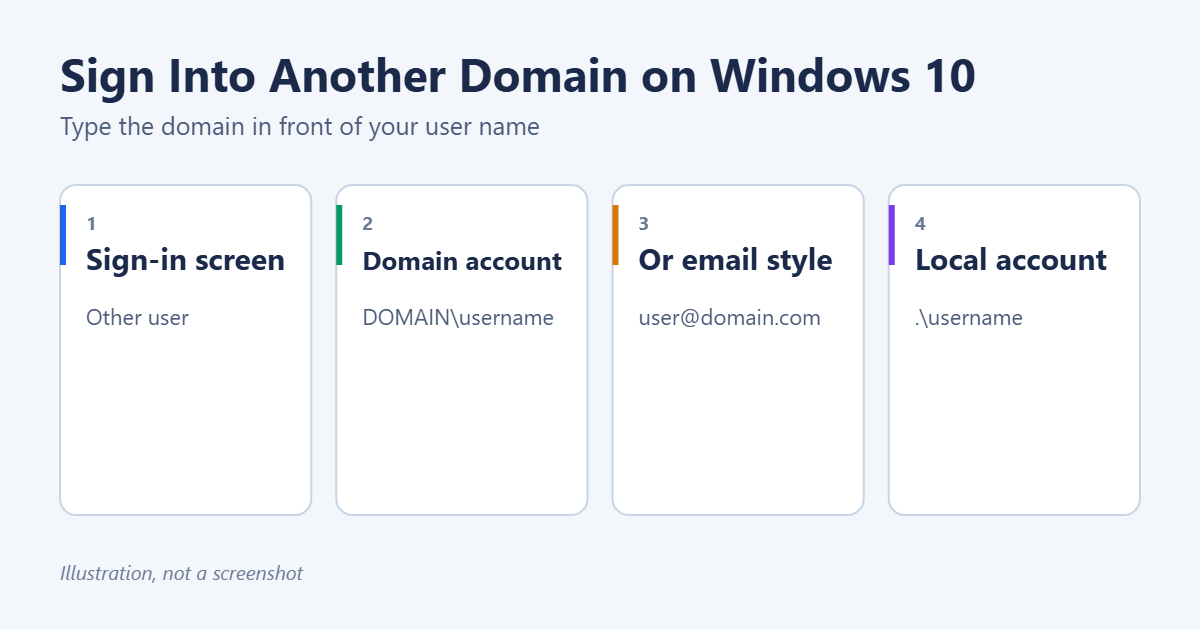
To sign in to another domain on a Windows 10 PC, click Other user on the sign-in screen and type your user name with the domain in front of it, as DOMAIN\username (for example, CONTOSO\jsmith). Then enter your password. You can also use the email-style format [email protected]. To sign in to a local account on the same PC instead, type .\username. This only works if the PC is joined to a domain and that domain trusts the one you’re signing in to. Here are the steps, plus how to check which domain you’re in and fix common errors.
Note: On a work or school PC, your IT department controls which domains and accounts can sign in. If the steps below don’t work, ask them, because you may not have permission.
Sign in to another domain
- If someone is already signed in, press Ctrl + Alt + Delete and choose Switch user, or sign out.
- On the sign-in screen, click Other user in the bottom-left corner. If you don’t see it, click the current user name and choose Sign-in options or Other user.
- In the user name box, type DOMAIN\username. Below the box, Windows shows Sign in to: DOMAIN so you can check it.
- Enter the password and press Enter.
The first sign-in on a PC takes longer while Windows creates your profile.
User name formats
| Format | Example | Signs in to |
|---|---|---|
| DOMAIN\username | CONTOSO\jsmith | A domain account (the short domain name) |
| username@domain | [email protected] | A domain account (UPN format) |
| .\username | .\Admin | A local account on this PC |
| PCNAME\username | DESK-42\Admin | A local account on this PC |
The sign-in screen also has a How do I sign in to another domain? link that shows these formats.
Check which domain you’re signed in to
- Open Command Prompt and type
whoami. It shows domain\username. - Type
echo %USERDOMAIN%to see just the domain name. - Go to Settings > System > About > Rename this PC (advanced) to see which domain the PC itself belongs to.
For more detail, see how to find your domain name in Windows 11. The steps are similar in Windows 10.
Use another domain account without switching users
- Run one program as another user: Hold Shift, right-click a program’s shortcut and choose Run as different user, then enter DOMAIN\username and the password.
- Command line:
runas /user:DOMAIN\username "mmc.exe"starts a program with that account’s permissions. - Network shares: When Windows asks for credentials to open a shared folder, type DOMAIN\username.
- Remote Desktop: Enter DOMAIN\username when connecting. See how to set up Remote Desktop on Windows 10.
When you’d sign in to another domain
Large organizations often have more than one domain, for example one per country or one for a company they’ve acquired. If your account lives in a different domain from the PC, you need to tell Windows which domain to check. Common situations include:
- Using a shared or loaner PC that belongs to another department.
- Signing in with a separate administrator account that lives in an admin domain.
- Working on a PC after a company merger, before accounts have been moved.
Troubleshooting
“The user name or password is incorrect”
Check the domain spelling and that Caps Lock is off. Try the other format (user@domain instead of DOMAIN\user).
“There are currently no logon servers available”
The PC can’t reach a domain controller. Connect to the office network or VPN. If you’ve signed in on this PC before, Windows may let you in with cached credentials.
“The trust relationship between this workstation and the primary domain failed”
The PC’s domain membership needs repairing. Sign in with a local administrator account (.\username) and contact IT. They usually fix it by rejoining the PC to the domain.
The other domain isn’t accepted
The PC’s domain must trust the other domain. That’s set up on the servers, not on the PC.
Frequently asked questions
Can I add a domain to a home PC?
No. Only Windows 10 Pro, Enterprise and Education can join a domain, and joining needs an administrator account in that domain. Windows 10 Home can’t join a domain.
Is it the same in Windows 11?
Yes. The sign-in formats and steps are the same.
Will I see my files from my other account?
No. Each account has its own profile, so files and settings from your other account won’t appear. Use OneDrive or a network share to access them.
Related guides
- How to join a Windows 10 PC to a domain
- How to add a computer to a domain in Windows 11
- How to switch users in Windows 10
Summary
- On the sign-in screen, choose Other user.
- Type DOMAIN\username or [email protected], then your password.
- Use .\username for a local account on the same PC.
- Check with
whoamiafter signing in.
Related: how to install Active Directory Users and Computers on Windows 10.

Matt Jacobs has been working as an IT consultant for small businesses since receiving his Master’s degree in 2003. While he still does some consulting work, his primary focus now is on creating technology support content for SupportYourTech.com.
His work can be found on many websites and focuses on topics such as Microsoft Office, Apple devices, Android devices, Photoshop, and more.