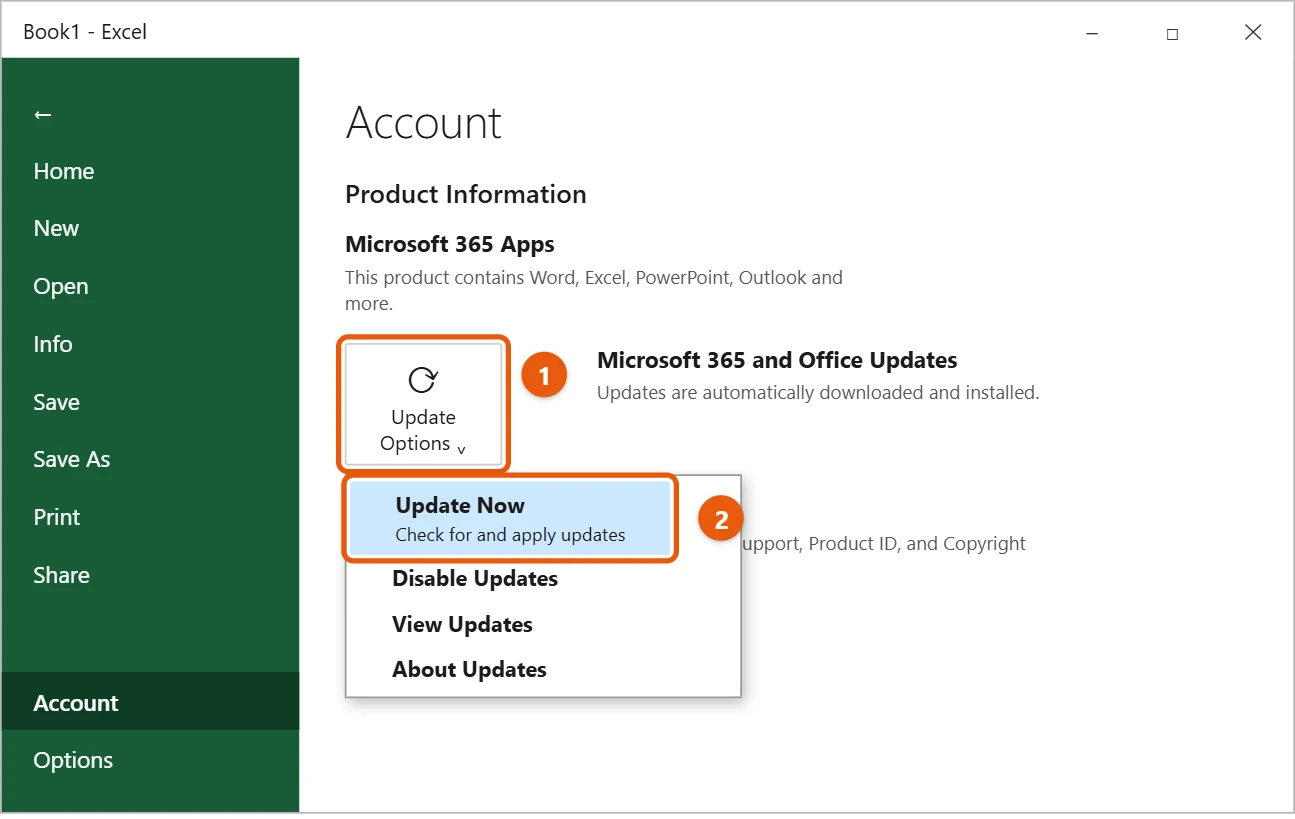
To update Excel in Windows 10, open Excel and select File > Account > Update Options > Update Now. This updates Excel and the other Office apps together. If you see Enable Updates, select it first.
Applies to: Microsoft 365 and Office on Windows 10.
Update Excel
- Open Excel and start a blank workbook, or open any file.
- Select File, then Account at the bottom left.
- Under Product Information, select Update Options > Update Now.
- Save your work if asked, because Office closes the apps to finish.
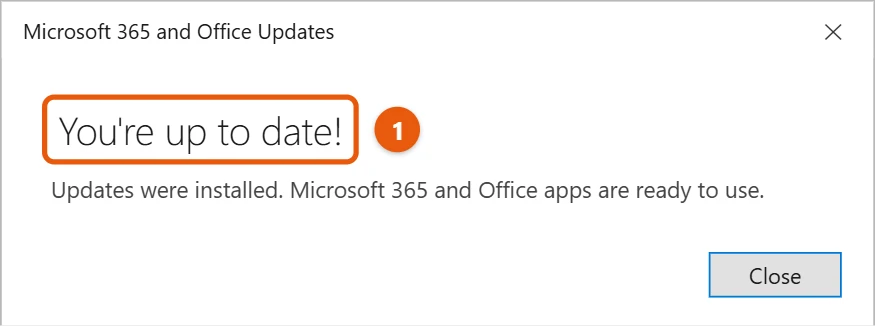
- When you see You’re up to date!, select Close.
Turn automatic updates on or off
Office updates itself in the background by default. Under File > Account > Update Options you’ll also find:
- Enable Updates, if automatic updates were turned off.
- Disable Updates, which stops all updates. We don’t recommend it, because you’ll miss security fixes.
- View Updates, which opens Microsoft’s list of what changed in each version.
With Microsoft 365, home users get updates about once a month. Workplaces may pick a slower schedule, so their Excel can be a few versions behind.
If you don’t see Update Options
- If there’s only an About button, your copy is probably managed by your work or school, or it uses a different license. Ask your IT team. Windows Update below only helps with older Office versions installed from an MSI package, which many workplaces use.
- If you got Office from the Microsoft Store, open Microsoft Store, select Library, and select Get updates.
Get Office updates through Windows Update
- Select Start > Settings > Update & Security > Windows Update > Advanced options.
- Turn on Receive updates for other Microsoft products when you update Windows.
- Go back and select Check for updates.
The rest of the Windows Update settings are covered in updating Windows 10 and checking for updates.
If Excel still won’t update
- Update Now is grayed out. Your organization may manage updates. Check for a note under Product Information, or ask your IT team.
- The update gets stuck. Close all Office apps, including Outlook and Teams, restart the PC, and try again. Make sure your PC has at least a few gigabytes of free space.
- Excel shows it’s up to date, but a new feature is missing. Microsoft releases features to Microsoft 365 a little at a time, so you may get them later than other people. Office 2021 and 2024 bought outright don’t get new features at all.
- You see an error code. Run an Online Repair from Settings > Apps. It takes longer than Quick Repair because it reinstalls Office, but it fixes most update errors.
Frequently asked questions
Why does the update fail?
Check your internet connection and free space, then try again. If it keeps failing, repair Office in Settings > Apps, select Microsoft 365 or Office, select Modify, and choose Quick Repair.
Does updating Excel cost anything?
No. Updates for the version you have are free. Moving to a newer version, such as a new Office release, may need a new purchase or a Microsoft 365 subscription.
How do I remove Office completely?
The full removal process is in uninstalling Microsoft Office in Windows 10.
Does Office still get updates on Windows 10?
Microsoft 365 apps keep getting security updates on Windows 10 until October 10, 2028. Office 2016 and 2019 stopped getting updates on October 14, 2025, and Office 2021 support ends on October 13, 2026. Microsoft’s Office and Windows support chart lists the exact dates for each version.
How do I see which version of Excel I have?
Go to File > Account. Under Product Information you’ll see the product name, and About Excel shows the full version and build number.
Do I need to update Word and Outlook separately?
No. Updating from any Office app updates all of them at once, including Word, PowerPoint, and Outlook.
After updating, you may need to allow macros again in some files. Here’s how to enable macros in Excel on Windows 10. Don’t have the apps yet? Start by installing Word in Windows 10.
Update options for every Office version are listed in How to update Microsoft 365 or Office for Windows on Microsoft Support.

Matt Jacobs has been working as an IT consultant for small businesses since receiving his Master’s degree in 2003. While he still does some consulting work, his primary focus now is on creating technology support content for SupportYourTech.com.
His work can be found on many websites and focuses on topics such as Microsoft Office, Apple devices, Android devices, Photoshop, and more.