Last updated on November 9th, 2026 at 01:39 pm
To add 15 minutes to a time in Excel, click an empty cell and enter =A2+TIME(0,15,0), where A2 holds the starting time. Press Enter, and 9:00 AM becomes 9:15 AM. If you see a decimal such as 0.385 instead of a time, format the cell as Time. To build a whole schedule in 15-minute steps, copy the formula down the column.
Applies to: Excel for Microsoft 365 (Windows and Mac), Excel 2024, Excel 2021, Excel 2019 and Excel 2016. The formulas also work in Excel for the web. The SEQUENCE method near the end needs Excel for Microsoft 365, Excel 2024 or Excel 2021.
Why you can’t just add 15
Excel stores a time as a fraction of one day. Noon is 0.5, 6:00 AM is 0.25, and one minute is 1/1440 of a day, because a day has 1,440 minutes. So if you type =A2+15, Excel adds 15 whole days, not 15 minutes. The cell can still show the same clock time, so the mistake is easy to miss.
The TIME function handles the conversion for you. Its three arguments are hours, minutes and seconds, so TIME(0,15,0) means “0 hours, 15 minutes, 0 seconds.” According to Microsoft’s TIME function reference, it returns a decimal between 0 and 0.99988426, which is exactly the kind of value Excel uses for times.
Add 15 minutes to one time
- Type the starting time. Click cell A2 and type a time such as 9:00 AM or 14:30, then press Enter. Include a space before AM or PM. A real time lines up on the right side of the cell; if it hugs the left side, Excel saved it as text (see troubleshooting).
- Select the result cell. Click B2, or any empty cell where you want the new time.
- Enter the formula. Type
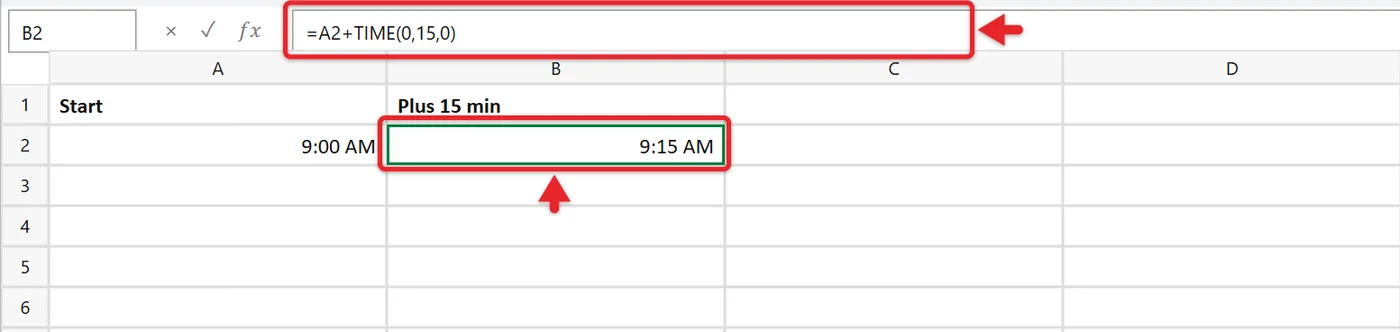
=A2+TIME(0,15,0)and press Enter. With 9:00 AM in A2, B2 shows 9:15 AM.
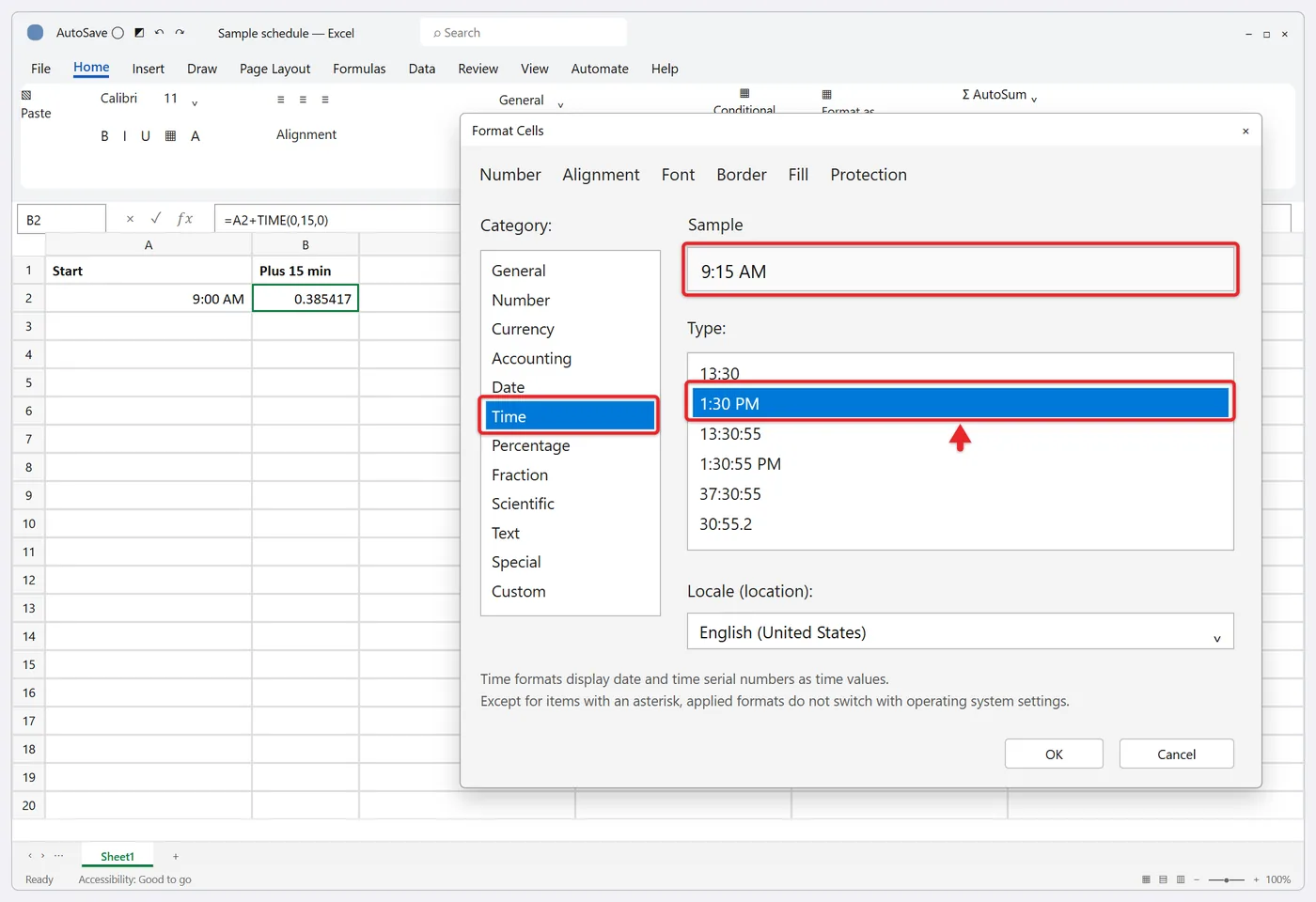
- Fix the display if needed. Excel usually copies the time format from A2. If B2 shows a number like 0.385417, right-click B2, choose Format Cells, select Time in the Category list and pick a style such as 1:30 PM or 13:30. On Windows you can also press Ctrl + 1 to open the same dialog. In Excel for the web, use the Number Format list on the Home tab.
- Copy it to other rows. Select B2, then drag the small square at the bottom-right corner of the cell (the fill handle) down the column. Each row adds 15 minutes to the time in its own row. If the fill handle is new to you, this walkthrough of Excel’s fill handle covers dragging, double-clicking and the Auto Fill Options button.
You’ll know it worked when B2 reads exactly 15 minutes later than A2 and changes on its own when you edit A2.
Four formulas that add 15 minutes
All four give the same answer for a normal time in A2.
| Formula | How it works | Best for |
|---|---|---|
=A2+TIME(0,15,0) | TIME turns 15 minutes into a fraction of a day | Most people; easy to read later |
=A2+15/1440 | Adds 15 of the 1,440 minutes in a day | Quick math when the minutes come from a calculation |
=A2+"0:15" | Excel converts the text 0:15 into a time | Short formulas; relies on Excel reading the text as a time |
=A2+TIME(0,C2,0) | Adds whatever number of minutes is typed in C2 | Lists where each row needs a different amount |
If you aren’t sure which to pick, use TIME. It never adds days by accident, and it is easy to read later. The text version is the most fragile, because it depends on Excel recognizing “0:15” as a time.
You might also see =TEXT(A2+TIME(0,15,0),"h:mm AM/PM"). It displays the right time, but the result is text, so you can’t add to it, sort it as a time or use it in later formulas. Use number formatting instead unless you need the time inside a sentence, such as a label that reads “Starts at 9:15 AM.”
TIME also accepts values above 59. TIME(0,90,0) adds 1 hour 30 minutes, because Microsoft documents that minutes over 59 are converted to hours and minutes. Keep in mind that TIME by itself never returns more than one day, so for a duration of 24 hours or more, use division instead, such as =A2+1500/1440.
Add 15 minutes to the current time
For “15 minutes from now,” enter =NOW()+TIME(0,15,0) and format the cell as Time. NOW reads your computer’s clock, but it isn’t a live clock: Microsoft notes it changes only when the worksheet recalculates, such as when you edit a cell or reopen the file. That means the result will drift.
If you need a fixed time that won’t change, click a cell and press Ctrl + Shift + ; (semicolon) on Windows to type the current time as a plain value. Then add 15 minutes to that cell with the usual formula.
Fill a schedule in 15-minute steps
Agendas and shift rosters often need start times every quarter hour. Pick the method that fits your sheet.
- Fill handle with two times: type 9:00 AM in A2 and 9:15 AM in A3. Select both cells and drag the fill handle down. Excel spots the 15-minute pattern and continues it. If it repeats 9:00 AM instead, you started with only one cell selected.
- Chained formula: type the start time in A2, enter
=A2+TIME(0,15,0)in A3, and fill down. Change A2 later and every slot below it moves too. - SEQUENCE: in Excel for Microsoft 365, Excel 2024 or Excel 2021, enter
=SEQUENCE(32,1,TIME(9,0,0),TIME(0,15,0))in one cell. It spills 32 rows, from 9:00 AM to 4:45 PM. The arguments are rows, columns, start and step, as listed on Microsoft’s SEQUENCE page. Format the spilled cells as Time.
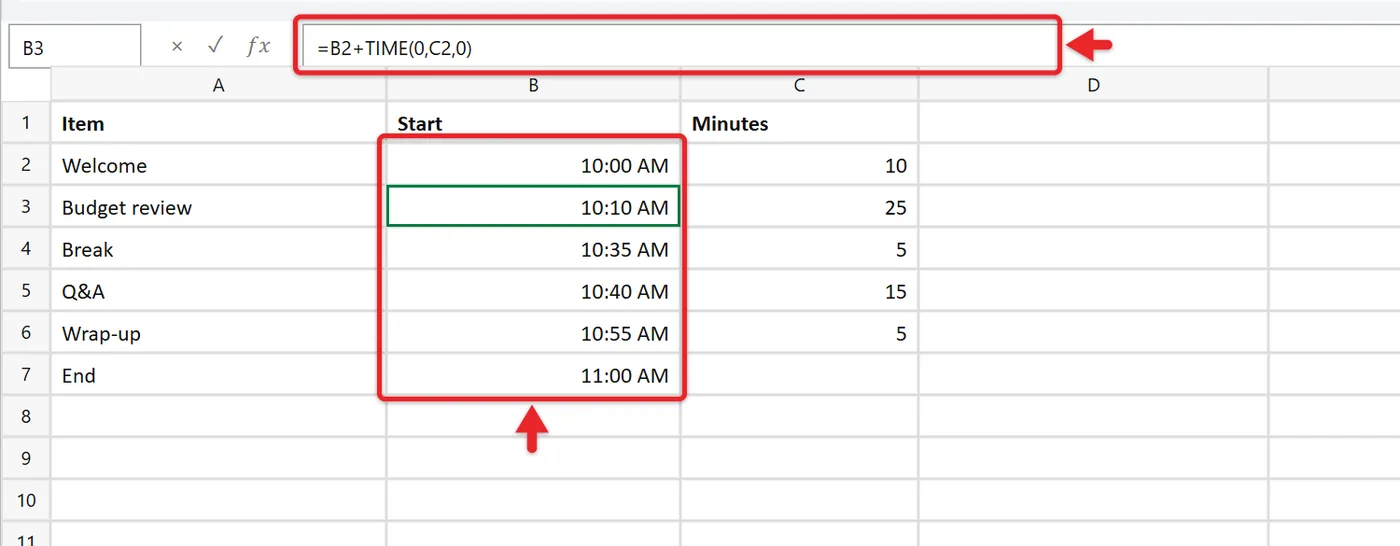
For a meeting where items run different lengths, put the start time in B2 and each item’s minutes in column C (C2, C3 and so on). In B3, enter =B2+TIME(0,C2,0) and fill down. If Priya adds a 5-minute break, insert a row with 5 in column C, and every later start time updates.
Times that include a date or cross midnight
If A2 holds a date and a time, such as 10/9/2026 11:50 PM, the same formula rolls over to 10/10/2026 12:05 AM. Apply a format like m/d/yyyy h:mm AM/PM (Format Cells > Custom) to see both parts.
With a time only, 11:50 PM plus 15 minutes gives a value just over 1. It still displays as 12:05 AM, but it’s technically “12:05 AM tomorrow,” which can throw off later math such as comparing it with another time. To keep a pure clock time, use =MOD(A2+TIME(0,15,0),1). MOD drops the whole day and keeps the remainder. Night shifts are the classic case; this guide to calculating hours worked in Excel uses the same MOD trick for a shift from 10:00 PM to 6:30 AM.
Subtract 15 minutes instead
Swap the plus sign for a minus: =A2-TIME(0,15,0). Type a regular hyphen; a dash copied from a web page or document can break the formula. If the start time is shortly after midnight, such as 12:10 AM, the answer would be negative, and Excel shows ##### instead. Use =MOD(A2-TIME(0,15,0),1) to get 11:55 PM.
Some guides suggest turning on the 1904 date system (File > Options > Advanced > Use 1904 date system) so negative times can display. That setting changes how every date in the workbook is counted (the two systems are 1,462 days apart, per Microsoft’s date systems page), so MOD is the safer fix for a clock time.
Round times to the nearest quarter hour
Adding 15 minutes is different from rounding to 15 minutes, which timesheets and billing often need. To snap a clock-in time to a quarter hour, use one of these:
=MROUND(A2,"0:15")rounds to the nearest 15 minutes.=CEILING.MATH(A2,"0:15")always rounds up.=FLOOR.MATH(A2,"0:15")always rounds down.
Format the results as Time. For more rounding options and their quirks, see how to round in Excel.
If the result looks wrong
- You see a decimal like 0.385417. The cell is formatted as General or Number. Format it as Time.
- The date jumped weeks ahead. You added a plain 15, which means 15 days. Use
TIME(0,15,0)or15/1440. - #VALUE! appears. The starting time is stored as text, often after pasting from another app. Retype it, or convert it with
=TIMEVALUE(A2)+TIME(0,15,0). - The cell shows #####. Either the column is too narrow (double-click the column’s right border to widen it) or the result is a negative time. Microsoft’s ##### error page covers both causes.
- A total of times resets after 24 hours. Apply the custom format [h]:mm. The square brackets let hours go past 24, as shown on Microsoft’s add or subtract time page.
- Times show in 24-hour style when you want AM/PM. Choose a Time format that includes AM/PM; without it, Excel uses a 24-hour clock.
I have a column of minutes, like 135. How do I show it as hours?
Divide by 1,440 and use the [h]:mm format, which displays 135 as 2:15. You can read more about converting minutes to hours in Excel, including decimal hours.
Check the result or undo it
To confirm the math, click an empty cell and enter =(B2-A2)*1440, then format it as General. It should show 15. If it shows 21600, you added 15 days.
To undo, press Ctrl + Z right away, or select the formula cells and press Delete. If you need the new times as fixed values (so they stop depending on column A), copy them, then right-click and choose Paste Values.
Start with =A2+TIME(0,15,0), format the cell as Time, and fill it down. Once that works, switch the 15 to a cell reference so you can change the interval for the whole sheet in one place, and add MOD wherever a time might pass midnight.

Matt Jacobs writes and maintains the guides on Support Your Tech, which he started in 2017. He spent most of his career keeping small-business PCs running and still takes the occasional consulting job, so the steps here come from fixing the same problems on other people’s computers. Every guide is checked on his own Windows 11, Windows 10, Mac, iPhone and iPad before it goes up.