To remove all page breaks in Excel, go to the Page Layout tab, click Breaks, and choose Reset All Page Breaks. That deletes every manual break you or someone else inserted on the sheet. Excel’s automatic breaks, which depend on paper size and margins, can’t be deleted, but you can move them by fitting the sheet onto fewer pages, and you can hide the dotted lines they leave in Normal view.
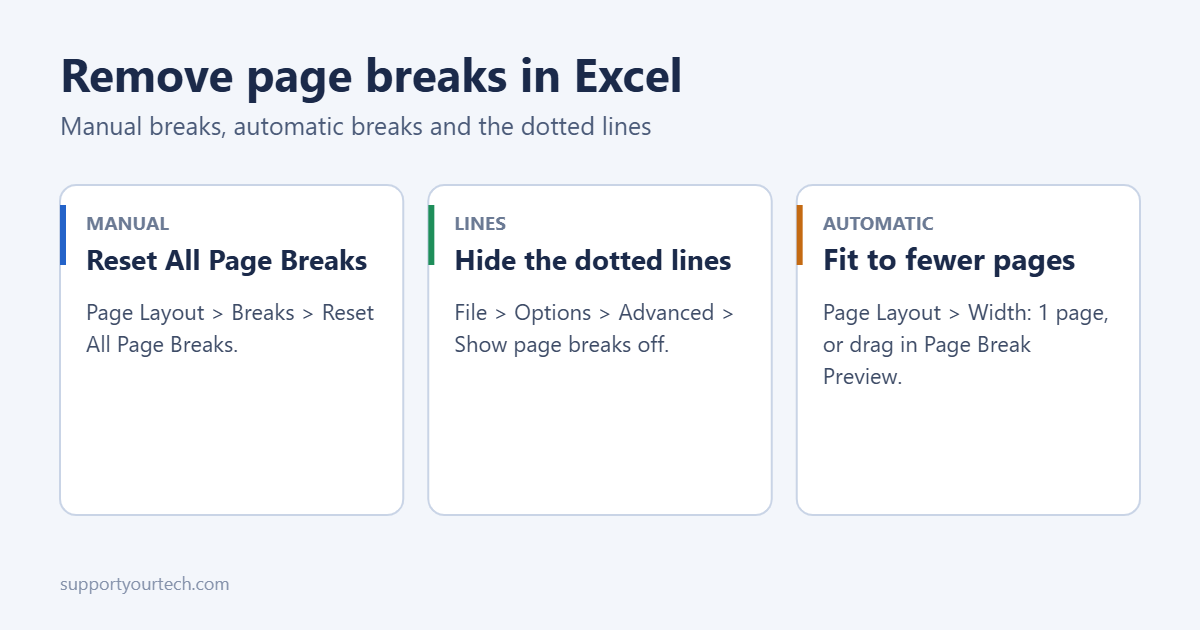
Manual vs automatic page breaks
| Type | How it looks | Where it comes from | Can you delete it? |
|---|---|---|---|
| Manual | Solid blue line in Page Break Preview | Inserted with Breaks > Insert Page Break | Yes |
| Automatic | Dashed blue line in Page Break Preview | Excel, based on paper size, margins and scaling | No, but you can move it |
Remove all manual page breaks
- Click the sheet tab with the breaks. To clear several sheets, hold Ctrl and click each tab.
- Go to Page Layout > Breaks.
- Choose Reset All Page Breaks.
If Reset All Page Breaks is greyed out, the sheet has no manual breaks. The lines you see are automatic. Right-click a tab and choose Ungroup Sheets when you’re done if you selected more than one.
Remove one page break
- Select the cell just below a horizontal break, or just to the right of a vertical one.
- Go to Page Layout > Breaks > Remove Page Break.
Or open View > Page Break Preview and drag a solid blue line off the edge of the print area.
Hide the dotted page break lines
After you print or use Page Layout view, Excel shows dotted lines in Normal view. They don’t print, but they can be distracting. To hide them:
- Go to File > Options > Advanced.
- Scroll to Display options for this worksheet and choose the sheet.
- Untick Show page breaks and click OK.
Closing and reopening the workbook also hides them until the next time you print or preview.
Move automatic page breaks
If Excel splits your table across pages in awkward places, change what fits on a page:
- Fit to width: on Page Layout > Scale to Fit, set Width to 1 page and Height to Automatic. Columns stay on one page and rows flow onto as many pages as needed.
- Drag in Page Break Preview: go to View > Page Break Preview and drag the dashed blue lines. Excel turns them into manual breaks and scales the page to match.
- Change orientation: Page Layout > Orientation > Landscape fits more columns.
- Narrow the margins: Page Layout > Margins > Narrow.
For more ways to fill or fit a printed page, see how to stretch an Excel spreadsheet to fill a printed page.
Check the print area
A print area that’s set too small or too large creates unexpected breaks. Go to Page Layout > Print Area > Clear Print Area to reset it, or select the cells you want and choose Set Print Area.
Get out of Page Break Preview
If the sheet is gray with large “Page 1” labels, you’re in Page Break Preview. Click View > Normal to go back. If you only see “Page 1” text behind your data, that’s this view, not a watermark. More in how to remove the Page 1 watermark in Excel.
Remove page breaks with VBA (many sheets)
To clear manual breaks on every sheet at once, press Alt + F11, choose Insert > Module, paste the code below and press F5.
Sub ResetAllBreaks()
    Dim ws As Worksheet
    For Each ws In ActiveWorkbook.Worksheets
        ws.ResetAllPageBreaks
    Next ws
End Sub
Excel for Mac and the web
On a Mac, use Page Layout > Breaks > Reset All Page Breaks, the same as Windows. To hide the dotted lines, close and reopen the workbook. Excel for the web doesn’t show page breaks or let you edit them. Open the file in the desktop app instead.
Frequently asked questions
Why do page breaks come back after I remove them?
The lines that return are automatic breaks, which Excel recalculates. Only manual breaks stay deleted. Use Scale to Fit to change where automatic breaks fall.
How do I remove a page break in Word instead?
Word works differently. See how to get rid of a page break in Word.
Summary
- Manual breaks: Page Layout > Breaks > Reset All Page Breaks.
- One break: select the cell below it, Breaks > Remove Page Break.
- Dotted lines: File > Options > Advanced > untick Show page breaks.
- Automatic breaks: Scale to Fit, orientation or Page Break Preview.
Related: how to print a selection in Excel.
Related: how to remove lines in Excel.

Matt Jacobs has been working as an IT consultant for small businesses since receiving his Master’s degree in 2003. While he still does some consulting work, his primary focus now is on creating technology support content for SupportYourTech.com.
His work can be found on many websites and focuses on topics such as Microsoft Office, Apple devices, Android devices, Photoshop, and more.