Windows 11 can’t change your mouse’s DPI directly, because DPI is a setting inside the mouse itself. To change true DPI, press the DPI button on your mouse (usually behind the scroll wheel) or use the maker’s app, such as Logitech G HUB, Razer Synapse, Corsair iCUE or SteelSeries GG. To make the pointer faster or slower without changing DPI, go to Settings > Bluetooth & devices > Mouse and move the Mouse pointer speed slider.
Applies to: Windows 11 with any USB or Bluetooth mouse. Most steps also work in Windows 10. Last reviewed October 7, 2026.
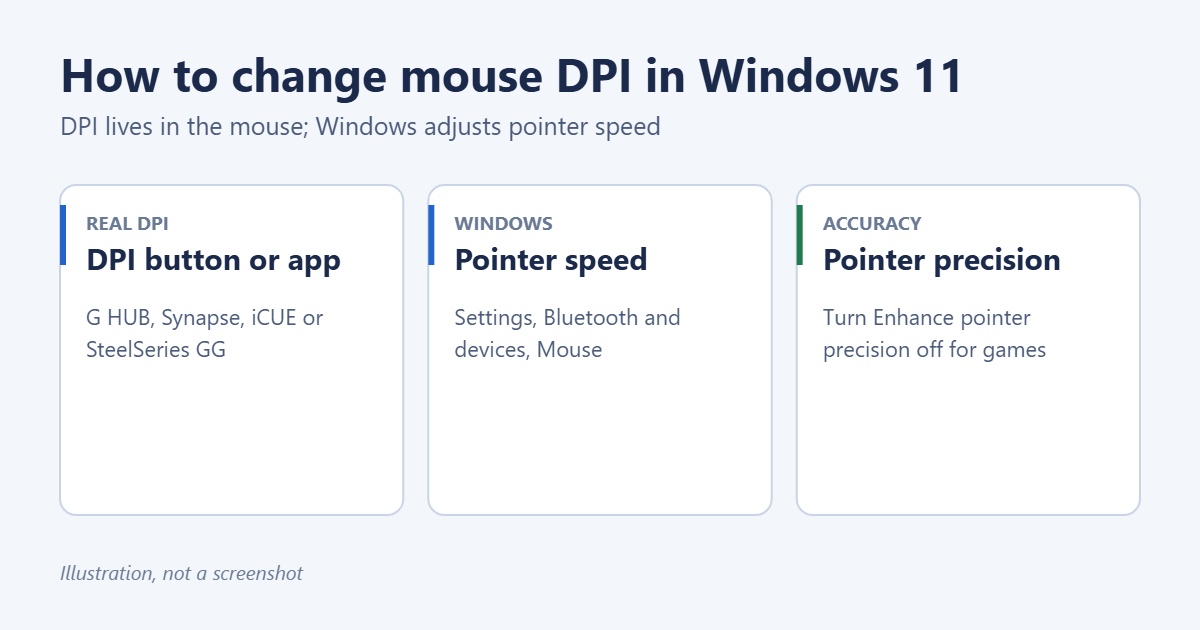
DPI vs. pointer speed
- DPI (dots per inch), sometimes called CPI, is how many steps the mouse’s sensor reports for each inch you move it. At 800 DPI, moving the mouse one inch sends 800 counts to the PC. Higher DPI means the pointer travels farther for the same hand movement.
- Pointer speed is a Windows multiplier applied to those counts. It changes how far the pointer moves, but it doesn’t change what the sensor reports.
For everyday use, changing either one makes the pointer feel faster or slower. For gaming, it’s better to set DPI in the mouse and leave Windows pointer speed at its default, because Windows scaling can make small movements less precise.
Many gaming mice and some office mice have a DPI button, usually just behind the scroll wheel or on the top. Each press cycles through preset levels, such as 800, 1600 and 3200. Some mice show the level with a colored light or briefly on screen. Check your mouse’s manual to see which color means which DPI.
Change DPI with your mouse maker’s software
The maker’s app lets you set exact DPI values, save profiles and see your current DPI. Download it only from the maker’s website or the Microsoft Store.
- Logitech: G HUB for gaming mice, or Logi Options+ for office mice such as the MX series. In G HUB, select the mouse, then the Sensitivity (DPI) tab.
- Razer: Razer Synapse. Select the mouse, then Performance > Sensitivity.
- Corsair: iCUE. Select the mouse, then DPI.
- SteelSeries: SteelSeries GG (Engine). Select the mouse and adjust CPI.
- HyperX: NGENUITY. Select the mouse, then DPI settings.
In most apps, you set several DPI stages and choose which one is active. The DPI button then cycles through the stages you set. Settings are usually saved to the mouse, so they work on other PCs too.
Change pointer speed in Windows 11 Settings
- Press Windows logo key + I to open Settings.
- Select Bluetooth & devices > Mouse.
- Drag the Mouse pointer speed slider left to slow the pointer or right to speed it up.
The default is the middle position (10 on a scale of 1 to 20). At that setting, Windows moves the pointer exactly as far as your mouse reports, with no scaling. Microsoft’s guide to changing mouse settings covers the other options on this page.
Turn Enhance pointer precision on or off
Enhance pointer precision is Windows’ mouse acceleration. When it’s on, fast movements move the pointer farther than slow ones, which helps with small office tasks but makes aiming inconsistent in games.
- Go to Settings > Bluetooth & devices > Mouse.
- Turn Enhance pointer precision on or off. On older versions, select Additional mouse settings, then the Pointer Options tab, and use the checkbox there.
Most gamers turn it off. See how to disable mouse acceleration in Windows 11.
What DPI should you use?
- Office work on a 1080p screen: 800 to 1,600 DPI is comfortable for most people.
- High-resolution or multiple monitors: 1,600 to 3,200 DPI so you don’t have to lift the mouse to cross the screen.
- First-person shooters: many players use 400 to 1,600 DPI with a lower in-game sensitivity for precise aim.
- Design and photo editing: a moderate DPI with acceleration off gives the most predictable control.
Very high DPI settings, such as 16,000 or more, are mostly a marketing number. Few people can control a pointer that fast.
Match sensitivity across games
Gamers often compare eDPI: your DPI multiplied by the in-game sensitivity. A player at 800 DPI with sensitivity 0.5 has an eDPI of 400. If you change your DPI, adjust the in-game sensitivity so the eDPI stays the same, and your aim will feel unchanged. Many games also have a Raw input setting that ignores Windows pointer speed and acceleration. Turn it on for consistent results.
Adjust touchpad speed on a laptop
Touchpads don’t have DPI settings. Go to Settings > Bluetooth & devices > Touchpad and drag the Cursor speed slider.
Troubleshooting
My mouse has no DPI button or software
Many basic office mice have a fixed DPI. Use the Windows Mouse pointer speed slider to change how fast the pointer moves.
The DPI button doesn’t do anything
Some mice disable the button until you assign stages in the maker’s app. Open the app, check the DPI stages, and make sure the button is set to cycle DPI, not another action.
DPI resets when I restart the PC
The setting is stored in the app instead of on the mouse. Look for an onboard memory or save to device option, or let the app start with Windows.
The pointer jumps or skips
Clean the sensor on the bottom of the mouse, use a mouse pad with a consistent surface, and replace the batteries or charge a wireless mouse. Very high DPI settings can also make the pointer jittery.
The pointer is too fast even at the lowest Windows speed
Lower the DPI on the mouse first, then fine-tune with the Windows slider.
Frequently asked questions
How do I check my mouse’s current DPI?
Open the mouse maker’s app, which shows the active DPI stage. See how to check mouse DPI in Windows 11 for other ways.
Does changing pointer speed change DPI?
No. It changes how Windows scales the mouse’s movement. The DPI reported by the sensor stays the same.
Is higher DPI better?
Not necessarily. Higher DPI moves the pointer farther with less hand movement, which suits large screens. Lower DPI gives finer control. Choose what feels comfortable.
How do I change mouse sensitivity in Windows 11?
Sensitivity is another name for pointer speed.

Matt Jacobs has been working as an IT consultant for small businesses since receiving his Master’s degree in 2003. While he still does some consulting work, his primary focus now is on creating technology support content for SupportYourTech.com.
His work can be found on many websites and focuses on topics such as Microsoft Office, Apple devices, Android devices, Photoshop, and more.