Your bulleted list looks fine except that each line of text starts well to the right of its bullet, and you want it closer without touching line spacing. The fastest fix in Word for Windows: click any bullet in the list, right-click it, choose Adjust List Indents and lower the Text indent value. If the gap you mean is the vertical space between bullet lines, that is a different setting, linked near the end.
Fix the gap in 30 seconds with Adjust List Indents
These steps follow Microsoft’s change bullet indents page for Word in Microsoft 365, Word 2024, 2021 and 2016 on Windows.
- Click directly on one of the bullets, not on the text. Word highlights every bullet at that level of the list, which means your change applies to the whole list instead of one line.
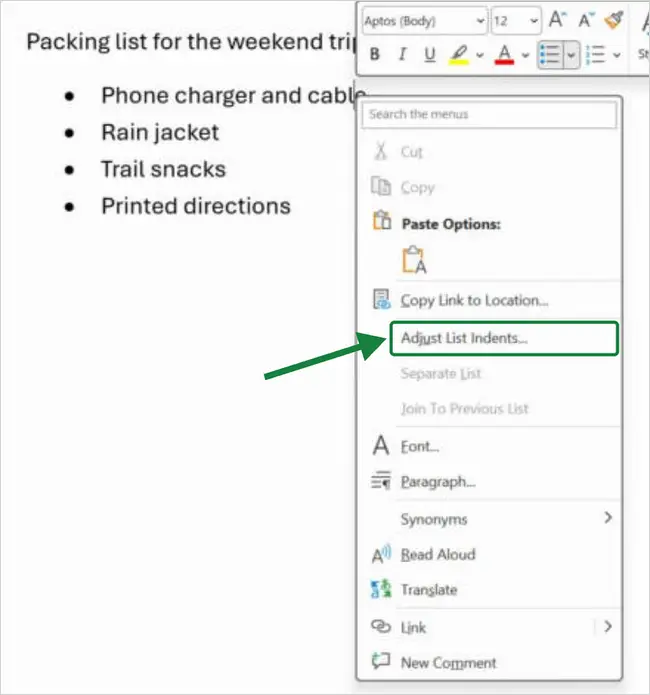
- Right-click the highlighted bullet and select Adjust List Indents.
- Look at the two boxes. Bullet position is how far the bullet sits from the left margin. Text indent sets where the text begins. Lowering it moves the text toward the bullet.
- Lower Text indent in small steps. For example, if it reads 0.5″, try 0.4″ or 0.35″ and check the result.
- Check Follow number with. It is usually set to Tab character. Leave it for now; the next section explains when to change it.
- Select OK. The text moves closer to every bullet in the list.
Don’t see Adjust List Indents when you right-click? You probably clicked the text instead of the bullet, or the “bullets” are typed characters (such as a hyphen or asterisk followed by spaces) rather than a real Word list. Click the bullet itself and try again. If nothing highlights, the list is plain text: select it and apply bullets from Home > Bullets, or press Ctrl+Shift+L.
Example: Tightening a Four-Item Packing List
In Word for Microsoft 365 on a Windows 11 laptop, I typed a four-item packing list and applied the default round bullets from Home > Bullets. Right-clicking the end of the first item opened a menu with Adjust List Indents in the middle, under Copy Link to Location. In this one-level list the command also appeared when I right-clicked the text instead of the bullet, and the change still applied to all four items.
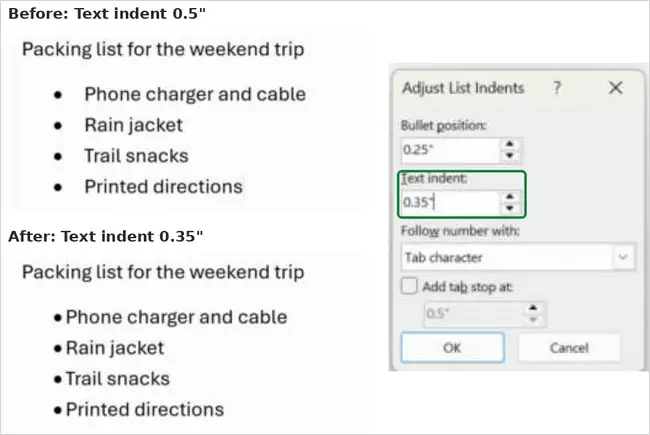
The box opened with Bullet position at 0.25″, Text indent at 0.5″ and Follow number with set to Tab character. Changing only Text indent to 0.35″ and selecting OK pulled the text of every item in close to its bullet, leaving a gap of about a tenth of an inch. At the default 12-point size that looked quite tight, so if it seems cramped in your document, 0.4″ is a good middle setting.
When the text jumps instead of moving closer
Sometimes you lower Text indent and the text snaps back out, or sits at a spot that does not match your number. This usually happens because Word follows each bullet with a tab character, and a tab always jumps to the next tab stop. If there is a tab stop further out, the text lands there.
Open Adjust List Indents again and change Follow number with:
- Space puts a single space after the bullet. The gap becomes very small, but wrapped second lines may no longer line up under the first word.
- Nothing removes the separator, so text sits right against the bullet. This rarely looks good with round bullets but can suit dash-style or arrow bullets.
- Tab character with a closer tab stop keeps wrapped lines aligned. If the dialog shows an Add tab stop at option, select it and enter the same value as Text indent so the tab lands exactly where you want.
Use the ruler or the Paragraph dialog instead
Both methods change the same two values as Adjust List Indents, but some people find them quicker once they know what to look at. Select the list first (here, selecting the text of all list items works).
Drag the ruler markers
- If the ruler is hidden, go to View and select the Ruler check box.
- On the ruler above the list you will see a downward triangle at the top (where the bullet sits) and an upward triangle with a small box below it (where the text starts).
- Drag only the upward triangle, the hanging indent marker, to the left toward the bullet. Dragging the small box underneath moves bullet and text together, which keeps the gap the same.
Type exact values in the Paragraph dialog
- On the Home tab, select the small arrow at the bottom right of the Paragraph group.
- On the Indents and Spacing tab, look under Indentation. Left is where the text starts. Special should read Hanging, and the By value is the distance from the bullet to the text.
- Reduce By to shrink the gap, then select OK.
A worked example: Priya’s list shows Left 0.5″ and Hanging By 0.25″, so the bullet sits at 0.25″ and the text at 0.5″. She wants the text to stay where it is but sit closer to the bullet, so she sets By to 0.15″, which moves the bullet out to 0.35″. If she would rather keep the bullet still, she lowers Left to 0.4″ and By to 0.15″ instead. For more on how these two numbers interact, see making a hanging indent in Word and the different ways to indent in Word.
Make the tighter spacing your default for new lists
Adjusting one list does not change the next list you start. If you create bulleted lists often, set the spacing once:
- Define a multilevel list. On the Home tab, select the arrow next to Multilevel List > Define New Multilevel List, then More. For each level, choose a bullet, then set where it is aligned and the text indent. Set for All Levels fills in every level in one go. The list appears in the Multilevel List gallery for reuse.
- Bullet alignment. Bullets arrow > Define New Bullet offers Alignment (Left, Centered, Right). Changing it nudges the bullet within its space, which can close the gap slightly. Try each option and check the preview before you select OK.
Word for Mac and Word for the web
Word for Mac: Microsoft’s Mac steps are to select the list, open the Numbering arrow on the Home tab, choose Define New Number Format, and enter a smaller value in the Indent at box under Text position. Right-clicking a bullet may also offer Adjust List Indents on recent versions.
Word for the web: Microsoft notes that you need the desktop app to create custom bullets. For precise bullet spacing, open the document in the desktop Word app and use the steps above.
If the gap will not shrink
Only one bullet changed. Why?
You selected that item’s text rather than the bullet. Click a bullet so all bullets at that level highlight, then repeat the change.
Sub-bullets still have a wide gap.
Each level has its own settings. Click a bullet at the lower level and adjust it separately, or use Define New Multilevel List to set all levels at once.
The list was pasted from a web page or email.
Pasted lists can bring their own spacing, sometimes as real spaces or tabs typed after each bullet. Paste with Keep Text Only, then apply Word’s bullets fresh.
The problem is space above and below each bullet.
That is paragraph spacing, not the bullet indent. See reducing the gap between lines in Word, or removing extra space in a Word document if blank lines or stray spacing are the cause.
The same controls work for numbered lists: right-click a number instead of a bullet and you should get the same Adjust List Indents dialog.

Matt Jacobs writes and maintains the guides on Support Your Tech, which he started in 2017. He spent most of his career keeping small-business PCs running and still takes the occasional consulting job, so the steps here come from fixing the same problems on other people’s computers. Every guide is checked on his own Windows 11, Windows 10, Mac, iPhone and iPad before it goes up.