Windows 11 doesn’t have a setting to add the power button to the taskbar. Instead, make a desktop shortcut that runs shutdown /s /t 0, then pin it to the taskbar. Selecting it shuts the PC down right away, so save your work first.
Applies to: Windows 11.
Make the shut down shortcut
- Right-click an empty area of the desktop and select New > Shortcut.
- In Type the location of the item, enter shutdown /s /t 0 (that’s a zero).
- Select Next.
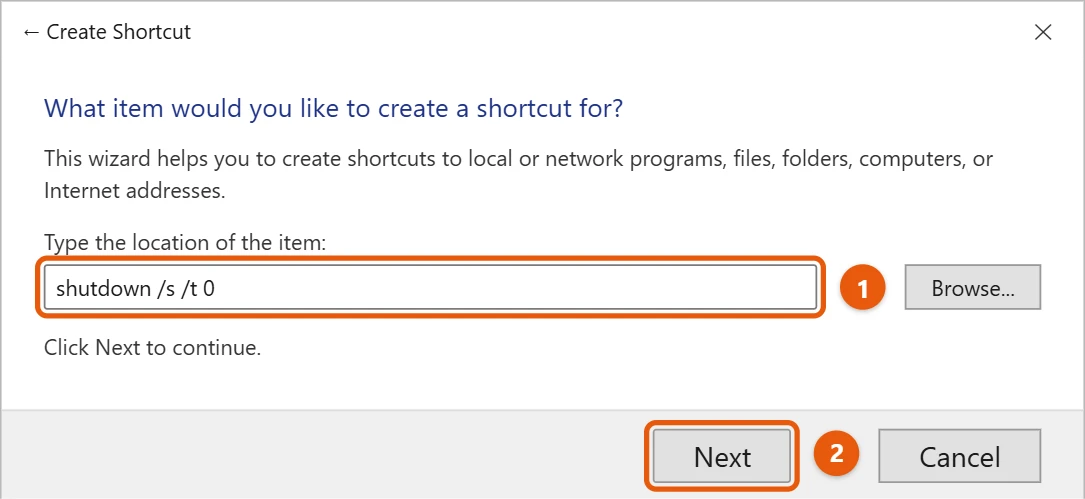
- Name it Shut down and select Finish.
Give it a power icon
- Right-click the new shortcut and select Properties.
- Select Change Icon. If Windows reports that the file has no icons, select OK to see the standard icons.
- Pick the power icon, then select OK twice.
Pin it to the taskbar
- Right-click the Shut down shortcut.
- Select Show more options, then Pin to taskbar. On some PCs, Pin to taskbar is in the first menu.
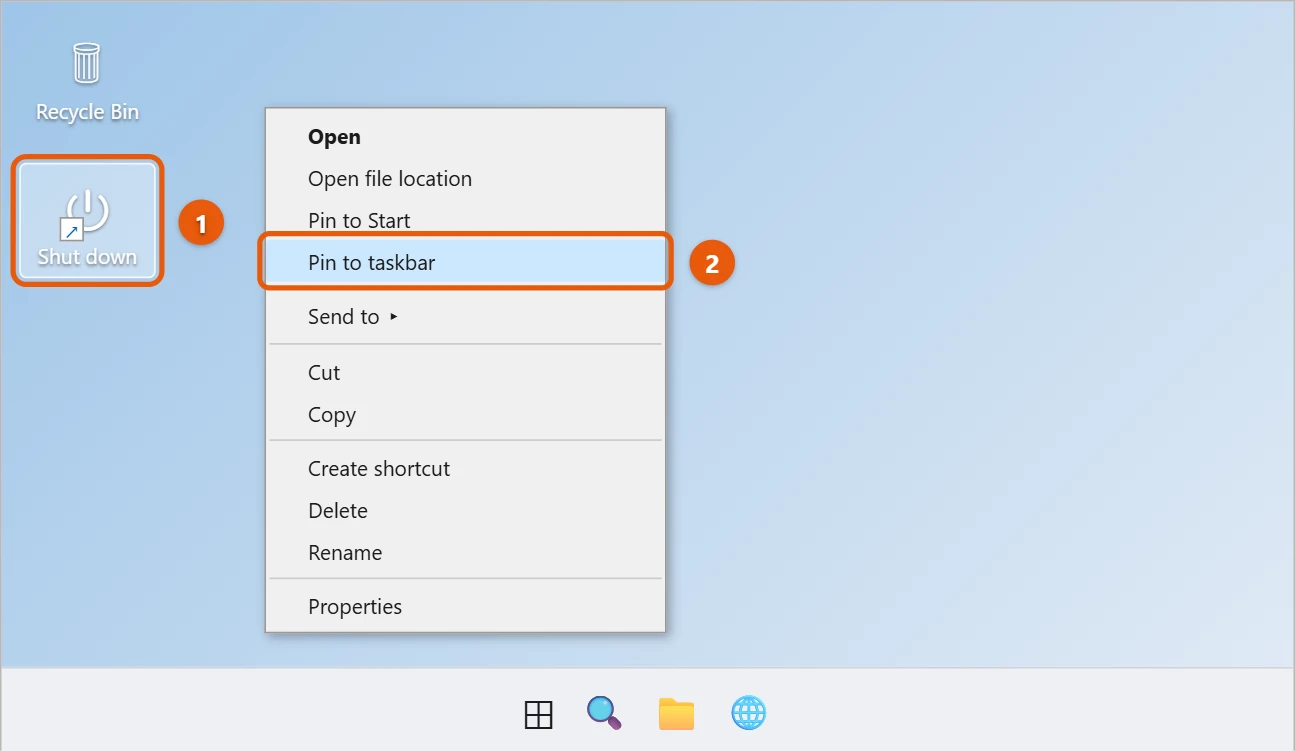
Now one click on the taskbar icon shuts the PC down. There’s no warning, and open apps close without asking to save.
Other commands you can use
Make more shortcuts the same way with these commands:
- Restart: shutdown /r /t 0
- Shut down after 60 seconds (time to cancel): shutdown /s /t 60
- Cancel a timed shut down: shutdown /a
- Hibernate: shutdown /h (only if hibernation is turned on)
- Sign out: shutdown /l
- Lock the screen: rundll32.exe user32.dll,LockWorkStation
- Restart into the recovery options menu: shutdown /r /o /t 0
A sleep button is trickier. The command many guides suggest, rundll32.exe powrprof.dll,SetSuspendState 0,1,0, hibernates the PC instead of sleeping it if hibernation is turned on, and that’s the default on many laptops. It’s more reliable to use the keyboard: press Windows + X, then U, then S.
Use a different icon for each button. In the Change Icon window, Windows’ own icon file has a power symbol, a restart arrow, and a padlock. If the list is empty, type %SystemRoot%\System32\shell32.dll in Look for icons in this file and press Enter.
Faster built-in ways to shut down
- Select Start > Power > Shut down.
- Right-click Start and select Shut down or sign out > Shut down.
- On the desktop, press Alt + F4 and choose Shut down.
From the keyboard, Windows + X, then U, opens the shut-down menu. Press U again to shut down, R to restart, or S to sleep.
If you want the Start menu’s power button closer, move the Start button to the left corner: go to Settings > Personalization > Taskbar > Taskbar behaviors and set Taskbar alignment to Left.
Want a confirmation first? Use the slide-to-shut-down screen
If you worry about clicking the button by accident, point the shortcut at Windows’ built-in slide screen instead. When you make the shortcut, enter this as the location:
C:\Windows\System32\SlideToShutDown.exeClicking it drops a panel over the top half of the screen. Drag it down to the bottom to shut down, or click anywhere else (or wait about 10 seconds) to cancel. It works with a mouse as well as a touch screen.
Give it a keyboard shortcut
Right-click the desktop shortcut, select Properties, click in the Shortcut key box, and press a letter. Windows adds Ctrl + Alt for you, so pressing S makes it Ctrl + Alt + S. Select OK. The key combination only works while the shortcut stays on the desktop, so don’t delete it after pinning.
How it differs from Start > Shut down
The shutdown /s command does a full shutdown. The Start menu’s Shut down normally uses Fast Startup, which saves part of Windows to disk so the next boot is quicker. A full shutdown clears everything, which is useful after installing drivers, but the next start-up can take a few seconds longer.
- A black window flashes and nothing happens. Check the command in the shortcut’s Target box. There must be a space before each slash:
shutdown /s /t 0. - An app stops the shutdown. Use
shutdown /s /f /t 0to close apps without asking. Save your work first, because unsaved changes are lost. - The pinned icon is blank. Unpin it, change the icon on the desktop shortcut, and pin it again.
- Pin to taskbar is missing. On work or school PCs, your organization may block pinning. Ask your IT team.
Pin to taskbar doesn’t appear for the shortcut. Put the shortcut in the Start menu first. Press Windows + R, type shell:programs, and press Enter. Move the Shut down shortcut into the folder that opens. Then open Start > All, right-click Shut down, and select Pin to taskbar (it may be under More).
Older guides mention a taskbar toolbar. Windows 11 removed taskbar toolbars, so the New toolbar option from Windows 10 isn’t there. Pinned shortcuts are the way to go.
Frequently asked questions
Can I move the Start menu’s power button to the taskbar?
No. The shortcut above is the closest you can get. More shut down options are in fully shutting down a PC in Windows 11.
How do I remove it later?
Right-click the icon on the taskbar and select Unpin from taskbar, then delete the desktop shortcut.
Can I add a sign-out button too?
Yes. Make another shortcut with shutdown /l as the location and pin it the same way. It signs you out without closing other people’s sessions on the PC.
Does the shortcut work on Windows 10?
Yes. The same commands and the slide-to-shut-down screen work in Windows 10. The only difference is that Pin to taskbar appears in the first right-click menu.
The differences between shut down, sleep, and hibernate are explained on the Shut down, sleep, or hibernate your PC page.

Matt Jacobs has been working as an IT consultant for small businesses since receiving his Master’s degree in 2003. While he still does some consulting work, his primary focus now is on creating technology support content for SupportYourTech.com.
His work can be found on many websites and focuses on topics such as Microsoft Office, Apple devices, Android devices, Photoshop, and more.