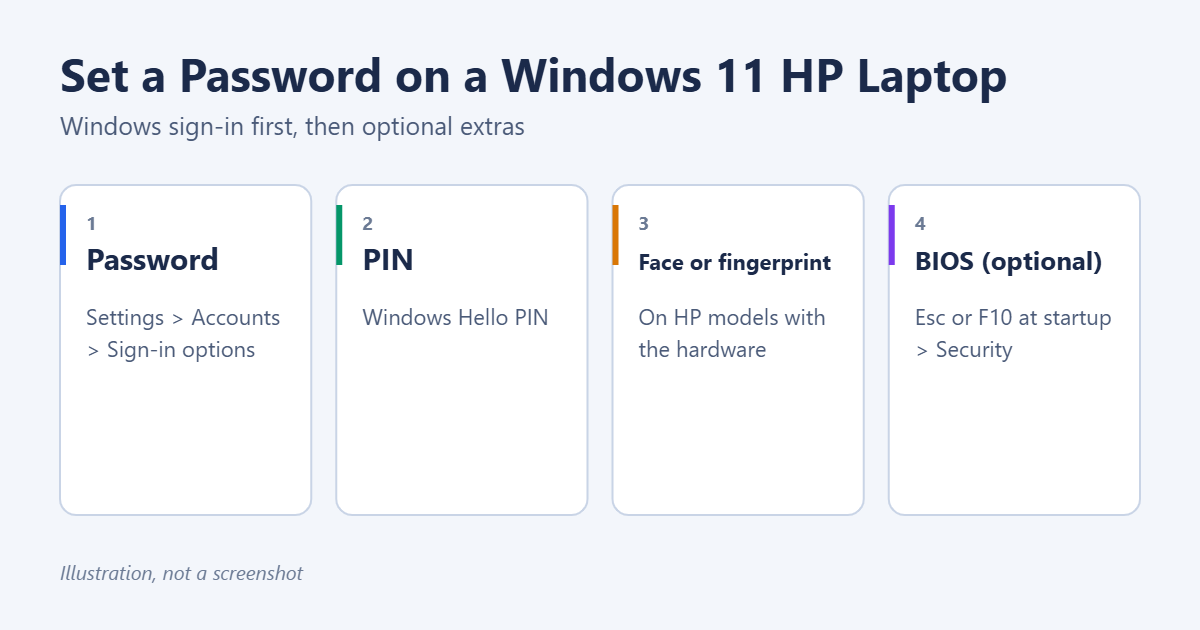
To set a password on an HP laptop running Windows 11, open Settings > Accounts > Sign-in options, click Password, then Add, and follow the prompts. The steps are the same as on any Windows 11 PC, because the password belongs to Windows, not to HP. If you sign in with a Microsoft account, you already have a password, and you change it online instead. Many HP laptops can also use a PIN, face or fingerprint sign-in, and an optional BIOS password that stops anyone starting the laptop at all. Here’s how to set up each one.
First: check which kind of account you have
- Open Settings with Windows + I and click Accounts.
- Look under your name at the top. If an email address is shown, you’re using a Microsoft account. If it says Local account, the password is stored only on this laptop.
Most new HP laptops are set up with a Microsoft account during first startup.
Set a password on a local account
- Go to Settings > Accounts > Sign-in options.
- Click Password, then Add.
- Type a new password, type it again to confirm, and add a password hint. The hint is shown on the sign-in screen, so don’t make it obvious.
- Click Next, then Finish.
From now on, the laptop asks for the password when you start it, wake it or unlock it.
If you can’t see the Password option
Windows 11 can hide passwords in favor of Windows Hello. On the same Sign-in options page, scroll to Additional settings and turn off For improved security, only allow Windows Hello sign-in for Microsoft accounts on this device. Then go back to the top of the page.
Change the password on a Microsoft account
A Microsoft account always has a password, which is the same one you use for Outlook.com or OneDrive. To change it:
- Press Ctrl + Alt + Delete and choose Change a password, or sign in to your Microsoft account online and go to the security settings.
- Enter the current password and the new one, then confirm.
The new password works on the laptop the next time it’s online. For more detail, see how to change your password in Windows 11.
Add a PIN
A Windows Hello PIN is quicker to type than a password and only works on this laptop. That makes it safer if someone sees you type it.
- Go to Settings > Accounts > Sign-in options > PIN (Windows Hello).
- Click Set up, confirm your password, and enter a PIN of at least four digits. Tick Include letters and symbols for a stronger PIN.
To change it later, see how to change your PIN on Windows 11.
Use face or fingerprint sign-in on HP laptops
Many HP Envy, Spectre, Elite and some Pavilion models have a fingerprint reader (often in the power button or beside the touchpad) or an infrared camera for face recognition. If yours does:
- Go to Settings > Accounts > Sign-in options.
- Click Fingerprint recognition (Windows Hello) or Facial recognition (Windows Hello), then Set up.
- Follow the prompts to scan your finger or face.
If the option says it’s unavailable, the laptop doesn’t have the hardware, or the driver is missing. Run HP Support Assistant to install the latest drivers.
Optional: set a BIOS password on an HP laptop
A BIOS password protects the laptop before Windows even starts. A power-on password is needed to boot the laptop at all. An administrator password protects the BIOS settings.
- Shut down the laptop.
- Turn it on and press Esc repeatedly until the Startup Menu appears, then press F10 for BIOS Setup. On some models, pressing F10 straight away works.
- Open the Security tab.
- Choose the option to create a BIOS Administrator Password or a Power-On Password, and enter it twice.
- Save and exit, usually with F10, and confirm.
Menus vary by model, so check HP’s guide to BIOS passwords for yours. Write the BIOS password down and keep it somewhere safe. If you forget it, you usually can’t reset it yourself, and you’ll need to contact HP support.
Make the password actually protect you
- Press Windows + L to lock the laptop when you step away.
- Under Sign-in options > If you’ve been away, when should Windows require you to sign in again?, choose Every time.
- Set the screen to turn off after a few minutes under Settings > System > Power & battery.
For more lock screen settings, see how to put a password on the lock screen in Windows 11.
Troubleshooting
Windows doesn’t ask for my password after sleep
Check the “If you’ve been away” setting above, and make sure Dynamic lock isn’t set up with a phone you’ve left nearby.
I forgot my Windows password
On the sign-in screen, click I forgot my password or I forgot my PIN. Microsoft accounts can be reset online. Local accounts use the security questions you set up. See how to reset a Windows 11 password without logging in.
Frequently asked questions
Is the process different on HP laptops?
No. The Windows password steps are the same on every brand. Only the fingerprint, face and BIOS options depend on the HP model.
Can I skip passwords and use passkeys?
Windows 11 supports passkeys for websites and apps, but you still need a password or PIN to sign in to the laptop itself. See how to use passkeys in Windows 11.
Does Windows 10 work the same way?
Mostly. See how to set a password in Windows 10.
Summary
- Go to Settings > Accounts > Sign-in options > Password > Add.
- With a Microsoft account, change the password with Ctrl + Alt + Delete or online.
- Add a PIN, fingerprint or face sign-in for quicker unlocking.
- Add a BIOS password only if you’ll keep it safe.

Matt Jacobs has been working as an IT consultant for small businesses since receiving his Master’s degree in 2003. While he still does some consulting work, his primary focus now is on creating technology support content for SupportYourTech.com.
His work can be found on many websites and focuses on topics such as Microsoft Office, Apple devices, Android devices, Photoshop, and more.