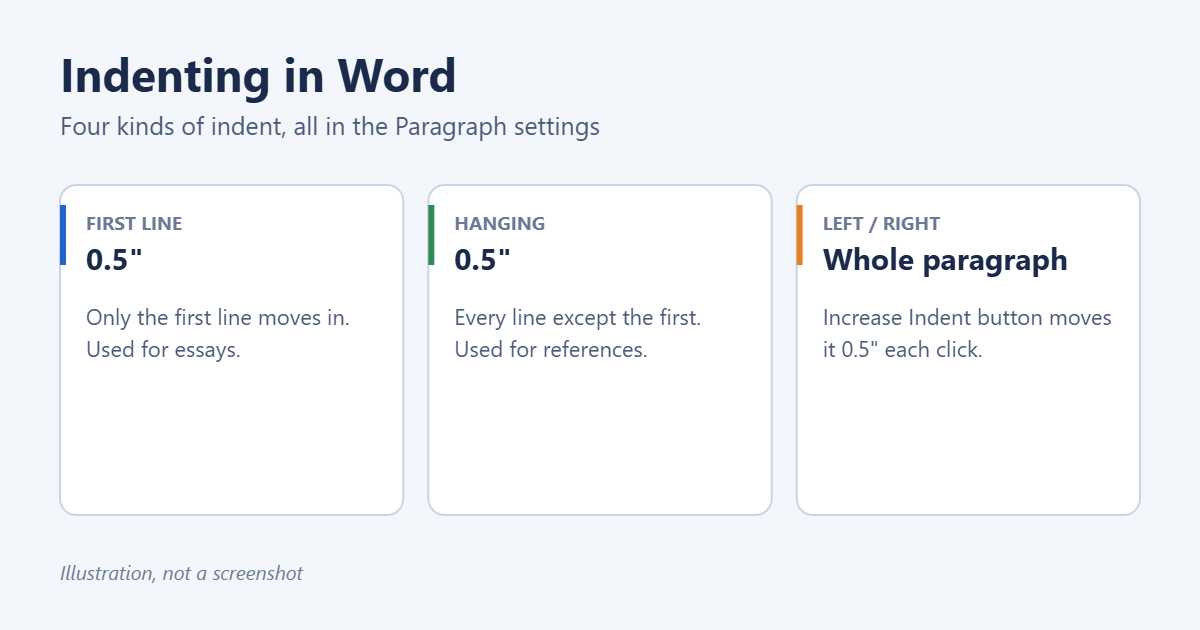
To indent in Word, click in the paragraph and press Tab at the start of the line for a quick first-line indent, or click Increase Indent on the Home tab to move the whole paragraph in. For precise or consistent indents, open the Paragraph settings and set a First line or Hanging indent, usually 0.5 inch. Using the Paragraph settings rather than pressing Tab means every paragraph lines up and the indent carries on as you type. Here’s each type and how to set it.
Indent the first line of every paragraph
- Select the paragraphs, or press Ctrl + A for the whole document.
- On the Home tab, click the small arrow at the bottom-right of the Paragraph group.
- Under Indentation, set Special to First line and By to 0.5″.
- Click OK.
New paragraphs you type will be indented automatically. This is the standard for essays, including APA and MLA papers. See how to set up APA format in Word.
Create a hanging indent
A hanging indent keeps the first line at the margin and indents the following lines. It’s used for reference lists and bibliographies.
- Select the references.
- Open the Paragraph settings as above.
- Set Special to Hanging and By to 0.5″, then click OK.
Shortcut: select the paragraphs and press Ctrl + T. Press Ctrl + Shift + T to undo it.
Indent a whole paragraph
- Click Home > Increase Indent to move the paragraph 0.5 inch to the right, or Decrease Indent to move it back.
- Shortcuts: Ctrl + M to indent, Ctrl + Shift + M to remove it.
- For exact values, set Left and Right under Indentation in Paragraph settings. Indenting both sides is common for block quotes.
Use the ruler
Turn the ruler on with View > Ruler. On the left of the ruler there are three markers:
- The top triangle sets the first-line indent.
- The bottom triangle sets the hanging indent.
- The small box below them moves both together (left indent).
Drag them with the paragraph selected. Hold Alt while dragging for exact measurements.
Tab key vs. first-line indent
Pressing Tab at the start of a paragraph inserts a tab character, and Word may convert it to a first-line indent automatically. It’s fine for a quick fix, but paragraph settings are more reliable, especially for documents with many paragraphs or strict formatting rules. To change how far Tab moves, see how to set multiple tabs in Word.
Indent bulleted and numbered lists
Click in a list item and press Tab to make it a sub-item, or Shift + Tab to move it back out. To change the spacing between the bullet and text for the whole list, right-click a bullet and choose Adjust List Indents.
Troubleshooting
Indents look different on some paragraphs
Those paragraphs have their own settings. Select the whole document and set the indent once in Paragraph settings.
The first line is indented twice
You have both a tab and a first-line indent. Turn on Home > Show/Hide ¶, delete the arrow (tab) symbols, and keep the paragraph indent.
Frequently asked questions
How big should an indent be?
Half an inch (1.27 cm) is the standard in most style guides.
How do I change line spacing too?
See how to double space in Word and how to adjust spacing in Word.
Summary
For consistent indents, open Paragraph settings and set Special to First line or Hanging at 0.5 inch. Use Increase Indent or Ctrl + M to move whole paragraphs, Ctrl + T for a hanging indent, and the ruler for quick visual adjustments.
Related: How to Show Margins in Word.
Related: How to Put Text in the Middle of a Page in Word.

Matt Jacobs has been working as an IT consultant for small businesses since receiving his Master’s degree in 2003. While he still does some consulting work, his primary focus now is on creating technology support content for SupportYourTech.com.
His work can be found on many websites and focuses on topics such as Microsoft Office, Apple devices, Android devices, Photoshop, and more.