Last updated on November 17th, 2026 at 03:08 pm
On Android 13 and later, touch and hold the app icon on the home screen, then drag it to Remove at the top (Google Pixel and most phones) or tap Remove in the menu that appears (Samsung Galaxy and its One UI). Menu names vary slightly by phone maker. The app stays installed and still opens from the app drawer, so choose Uninstall only if you want to delete it completely.
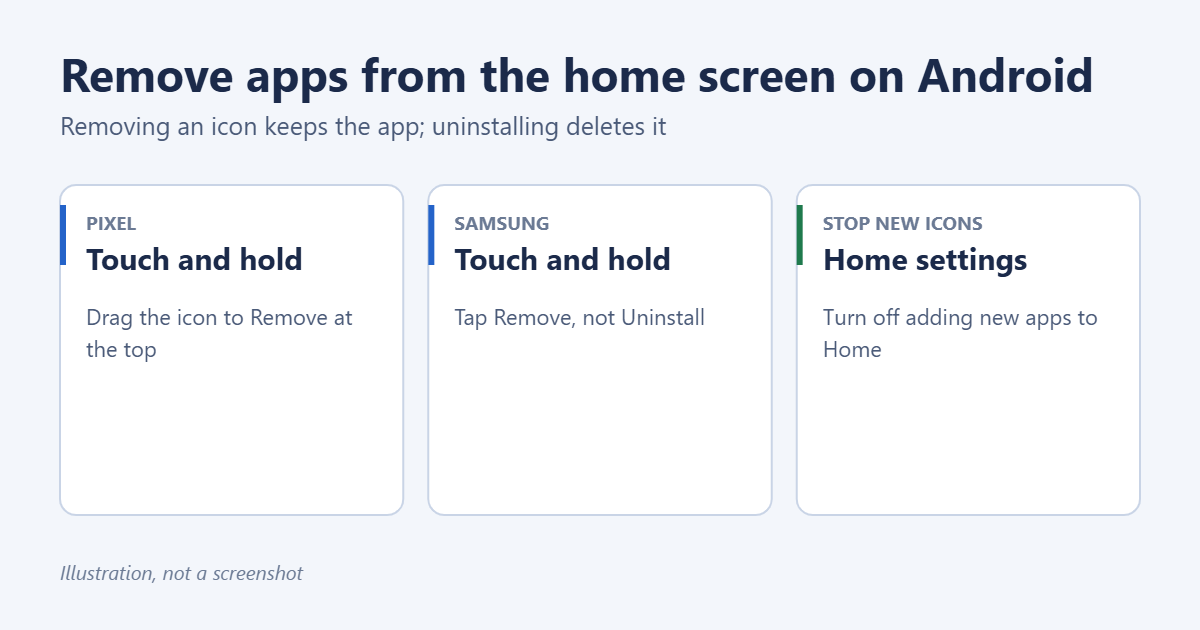
Remove vs. uninstall
- Remove (or Remove from Home) deletes only the shortcut on the home screen. The app, its data and its icon in the app drawer stay.
- Uninstall deletes the app and its data from the phone. You can reinstall it from Google Play later. Full steps are in deleting an app in Android.
Remove an app icon on a Google Pixel
- Touch and hold the app icon on the home screen.
- Drag it to Remove at the top of the screen and let go.
Dragging it to Uninstall instead deletes the app, so check which word you’re over before you lift your finger. Most phones that use Google’s standard launcher, such as Motorola and Nokia, work the same way.
Remove an app icon on a Samsung Galaxy
- Touch and hold the app icon on the home screen.
- Tap Remove in the menu that appears.
On some One UI versions the option is labeled Remove from Home. If you only see Uninstall, the home screen layout needs changing first, as explained under Troubleshooting. Removing the app entirely is covered in uninstalling an app on a Samsung Galaxy.
Remove several icons at once
- Samsung: touch and hold an icon and tap Select items (Select on some versions). Tick several icons, then tap Remove at the top.
- Pixel: remove icons one at a time, or drag them into a folder first and then remove the folder by dragging it to Remove. The apps stay installed.
Remove widgets and folders
- Widgets: touch and hold the widget and drag it to Remove, or tap Remove on Samsung. Removing the weather widget is a typical example.
- Folders: drag the folder to Remove. On Samsung, touch and hold the folder and tap Delete folder; the apps inside stay installed and remain in the app drawer.
Stop new apps from adding icons to the home screen
By default, many phones put a new icon on the home screen every time you install an app.
- Pixel: touch and hold an empty part of the home screen, tap Home settings, and turn off Add app icons to Home screen.
- Samsung: open Settings > Home screen and turn off Add new apps to Home screen.
Hide an app without removing it
- Samsung: open Settings > Home screen > Hide apps on Home and Apps screens, select the apps and tap Done. They disappear from the home screen and the app drawer but stay installed.
- Pixel and other phones with Android 15 or later: use Private space in Settings > Security & privacy to keep apps in a separate, locked area.
Archive apps you rarely use
If you want to free space but keep an app’s icon and your data, archive it. Open Settings > Apps, select the app and tap Archive (available on recent Android versions). The icon stays with a small cloud symbol, and tapping it reinstalls the app. Archiving is described alongside deleting on Google’s page about deleting apps on Android.
Only Uninstall shows or icons won’t move
I only see Uninstall on a Samsung phone
Your home screen is set to Home screen only, which has no separate app drawer, so removing an icon would remove the app. Open Settings > Home screen > Home screen layout and choose Home and Apps screens. Then you can remove icons without uninstalling.
Icons won’t move or the menu doesn’t appear
The home screen layout is locked. On Samsung, open Settings > Home screen and turn off Lock Home screen layout.
I removed an icon by mistake
Swipe up from the bottom of the home screen to open the app drawer, touch and hold the app, and drag it back onto the home screen.
A preinstalled app can’t be uninstalled
Some carrier and manufacturer apps can only be disabled. Open Settings > Apps, select the app and tap Disable. It disappears from the home screen and app drawer.

Matt Jacobs writes and maintains the guides on Support Your Tech, which he started in 2017. He spent most of his career keeping small-business PCs running and still takes the occasional consulting job, so the steps here come from fixing the same problems on other people’s computers. Every guide is checked on his own Windows 11, Windows 10, Mac, iPhone and iPad before it goes up.