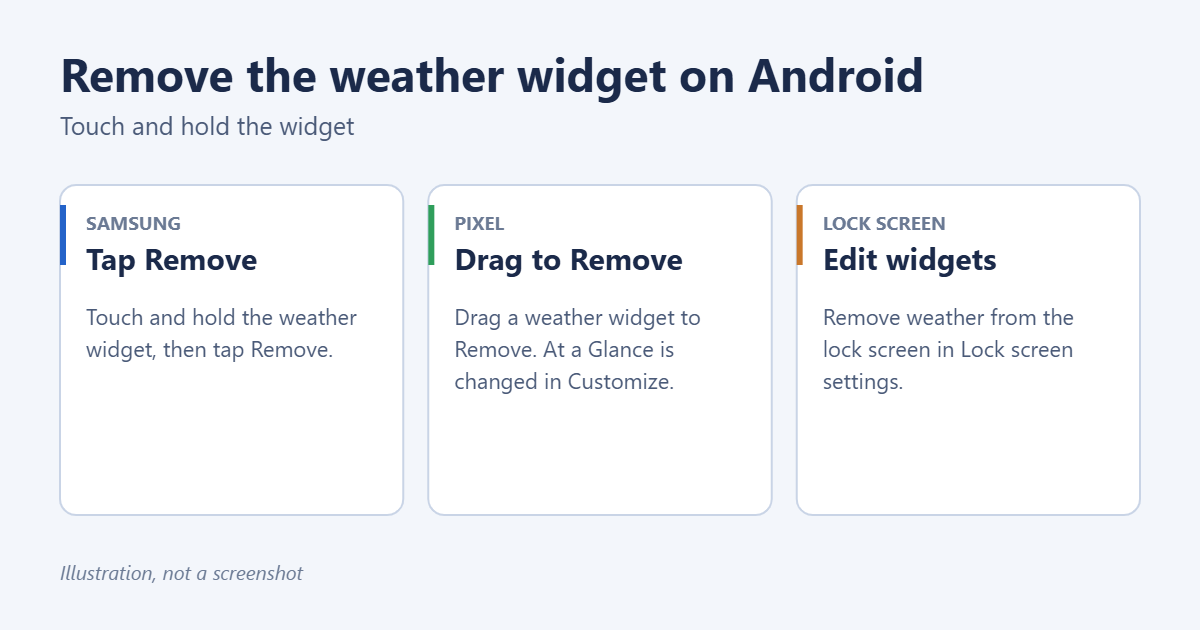
To remove the weather widget from your Android home screen, touch and hold the widget, then tap Remove (Samsung) or drag it to Remove at the top of the screen (Pixel and most other phones). This only takes it off the home screen. The Weather app and your other screens stay as they are, and you can add the widget back at any time.
Applies to: Samsung Galaxy phones with One UI 5 or later, Google Pixel phones, and most Android 12 or later phones. Menu names vary a little by phone maker. Last reviewed October 8, 2026.
Samsung Galaxy
- Go to the home screen page that has the weather widget.
- Touch and hold the widget until a menu appears.
- Tap Remove. On older One UI versions, tap Remove from Home.
If several widgets are stacked together, swipe the stack to the weather widget first, touch and hold it, and choose Remove for just that widget, or remove the whole stack.
Google Pixel and stock Android
- Touch and hold the weather widget.
- Drag it to Remove at the top of the screen and let go.
The date and weather line at the top of a Pixel home screen is At a Glance, not a regular widget, and the Pixel Launcher doesn’t let you delete it. You can change what it shows: touch and hold it, tap Customize, and turn off the items you don’t want. On some Pixel versions the weather part can’t be turned off, so a third-party launcher is the only way to hide it completely.
Other phones (Motorola, OnePlus, Xiaomi)
Touch and hold the widget and look for Remove, a trash can icon, or an X. On some launchers you drag the widget to the trash can at the top or bottom of the screen.
Remove weather from the lock screen
- Samsung: touch and hold the lock screen, unlock when asked, tap the clock or widget area, and remove the weather widget. On older versions, go to Settings > Lock screen > Widgets and turn off Weather.
- Pixel: go to Settings > Display > Lock screen and turn off the weather or At a Glance option if your version has it.
Stop weather notifications
If weather alerts are what bother you, removing the widget won’t stop them. Instead:
- Pull down the notification shade and touch and hold a weather notification.
- Tap the settings icon, or Turn off notifications.
- Turn off the categories you don’t want, such as daily forecasts, and keep severe weather alerts on if you find them useful.
Turn off the Samsung Weather app completely
Samsung Weather is a system app, so it can’t be uninstalled, but you can disable it. Go to Settings > Apps > Weather and tap Disable. This removes its widget and notifications. Tap Enable to get it back. For apps you can remove fully, see how to uninstall an app on a Samsung Galaxy.
Add the weather widget back
- Touch and hold an empty area of the home screen.
- Tap Widgets.
- Find Weather (Samsung) or Google > weather (Pixel), then touch and hold a widget and drag it to the home screen.
Troubleshooting
There’s no Remove option
Samsung’s home screen may be locked. Go to Settings > Home screen and turn off Lock Home screen layout, then try again.
The widget keeps coming back
A launcher or theme update can restore the default layout. Remove it again and turn on Lock Home screen layout afterwards so it isn’t added back. If it’s At a Glance on a Pixel, it’s part of the launcher and returns by design.
I removed the wrong widget
Add it back from Widgets as shown above. Removing a widget never deletes the app or its data.
Frequently asked questions
Does removing the weather widget save battery?
A little. The widget refreshes in the background and may use location. Disabling the Weather app or its location permission saves more.
Is removing a widget the same as uninstalling an app?
No. A widget is a shortcut view of an app. To remove app icons, see how to remove apps from the home screen in Android. To delete an app entirely, see how to delete an app in Android.
Can I use a different weather widget?
Yes. Install another weather app from the Play Store, then add its widget from the Widgets menu.
Related: How to Set the Default Browser on Android.
Related: How to Set an Alarm on a Samsung Galaxy.

Matt Jacobs has been working as an IT consultant for small businesses since receiving his Master’s degree in 2003. While he still does some consulting work, his primary focus now is on creating technology support content for SupportYourTech.com.
His work can be found on many websites and focuses on topics such as Microsoft Office, Apple devices, Android devices, Photoshop, and more.