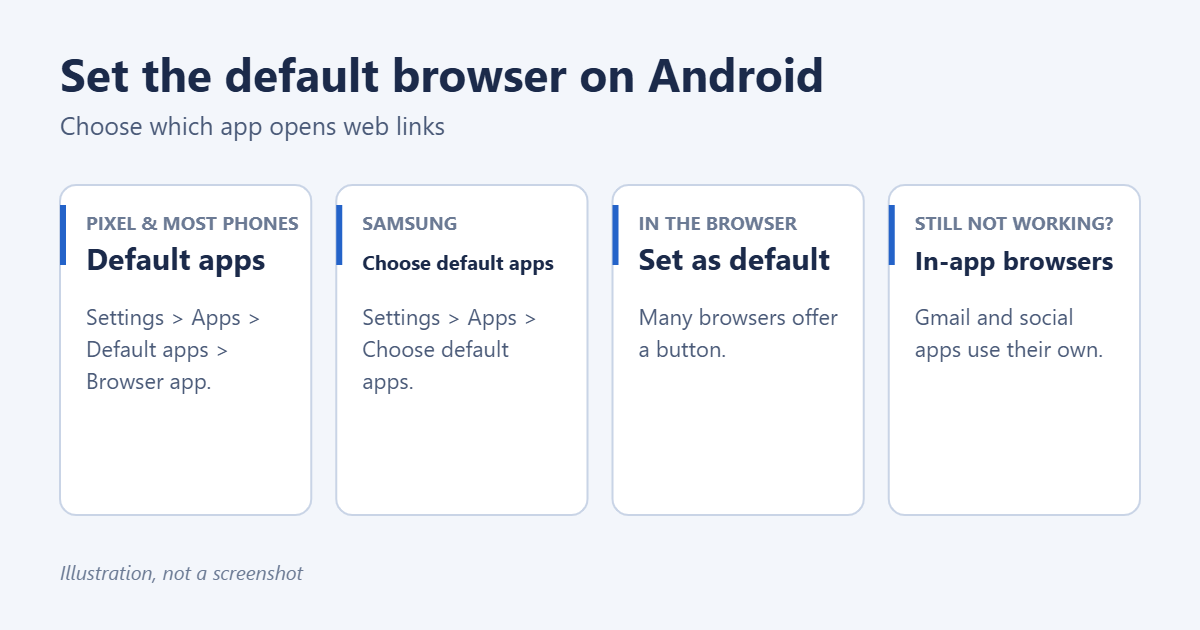
To set the default browser on Android, open Settings > Apps > Default apps > Browser app and choose the browser you want, such as Chrome, Firefox, Edge, Brave or Samsung Internet. On Samsung Galaxy phones, the path is Settings > Apps > Choose default apps > Browser app. From then on, links you tap in other apps open in that browser.
Applies to: Android 12 and later, including Google Pixel, Samsung Galaxy and other phones. Menu names can vary slightly by phone maker.
Install the browser you want
The browser must be installed before you can choose it. Open the Play Store, search for the browser and tap Install. Only install browsers from well-known developers.
Set it as the default
Google Pixel and most Android phones
- Open Settings.
- Tap Apps > Default apps.
- Tap Browser app.
- Choose the browser you want.
Samsung Galaxy phones
- Open Settings > Apps.
- Tap Choose default apps.
- Tap Browser app and choose the browser.
If you can’t find the menu, open Settings, tap the search icon and type default.
From inside the browser
Many browsers offer to make themselves the default when you first open them, or have a Set as default browser option in their settings. Tapping it takes you to the same Android setting.
Check links open in the new browser
Open a message or email with a link and tap it. It should open in the browser you chose. If it opens inside the app instead, that app uses its own built-in browser, which the next section covers.
Links still open in the wrong place
Apps with their own browser
Some apps open links inside themselves rather than in your default browser:
- Gmail: tap the menu > Settings > General settings and turn off Open web links in Gmail.
- Google app: in the Google app’s settings, look for an option to open web pages in the app and turn it off.
- Facebook, Instagram and other social apps: tap the three dots in the in-app page and choose Open in browser or Open in external browser.
Links that open in another app
Links to services such as YouTube, Maps or Amazon may open in their own app rather than a browser. To change that, open Settings > Apps, select the app (for example YouTube), tap Open by default (or Set as default on Samsung) and turn off Open supported links.
Change the default search engine
The default browser and the default search engine are separate. To change the search engine, open the browser’s settings and look for Search engine. In Chrome, tap the three dots > Settings > Search engine.
Which browser should you choose?
All the main Android browsers are free and handle everyday browsing well. The differences are mostly about syncing and extras:
- Chrome: preinstalled on most phones and syncs bookmarks, passwords and tabs with Chrome on your computer through your Google account.
- Samsung Internet: preinstalled on Galaxy phones, with optional content blockers and a secret mode for private browsing.
- Firefox: supports a range of add-ons on Android and syncs with Firefox on your computer.
- Microsoft Edge: syncs with Edge on Windows, which is handy if you use a Windows PC.
- Brave: blocks most ads and trackers by default.
Pick the one that matches the browser you use on your computer, so your bookmarks and passwords follow you.
Troubleshooting
The browser doesn’t appear in the list
Make sure it’s fully installed and has been opened at least once. Some lightweight or kids’ browsers can’t be set as the default.
The default keeps changing back
A phone update or a browser asking to be the default can change it. Set it again, and decline prompts from other browsers. On work phones, your organization may set the default.
I want to remove a browser completely
Remove it like any other app: deleting an app on Android covers most phones, and uninstalling an app on a Samsung Galaxy covers Galaxy models. Preinstalled browsers can usually only be disabled.
Frequently asked questions
Does changing the default browser move my bookmarks?
No. Sign in to the new browser with your account or import bookmarks from its settings.
How do I do this on a computer?
On a Windows PC, follow changing the default browser in Windows 11.

Matt Jacobs writes and maintains the guides on Support Your Tech, which he started in 2017. He spent most of his career keeping small-business PCs running and still takes the occasional consulting job, so the steps here come from fixing the same problems on other people’s computers. Every guide is checked on his own Windows 11, Windows 10, Mac, iPhone and iPad before it goes up.