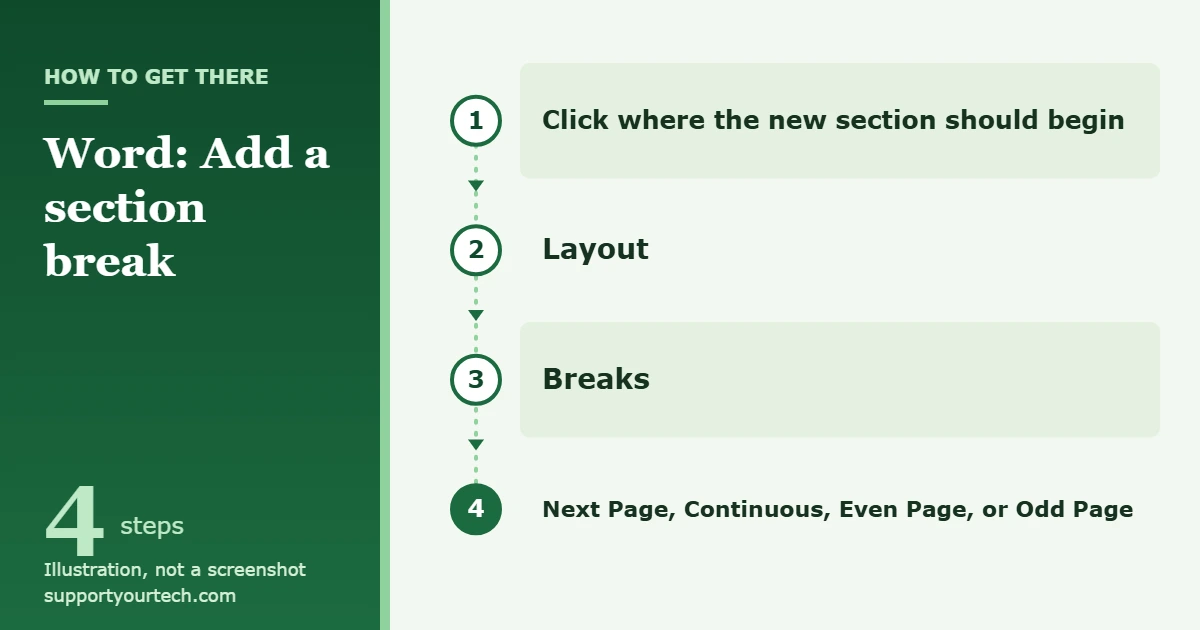
To add a section break in Word, click where the new section should begin, open the Layout tab, select Breaks, and choose Next Page, Continuous, Even Page, or Odd Page. Everything after the break becomes a new section that can have its own orientation, columns, headers, footers, page numbers, and page borders.
Applies to: Word for Microsoft 365, Word 2024, and Word 2021 on Windows. Checked against Microsoft Support on October 7, 2026.
What a section break does
A new Word document is one section, so layout settings such as orientation or the header apply to every page. A section break divides the document into separate sections that you can format independently. Microsoft lists these as the kinds of formatting you can apply to one part of a document with section breaks: page orientation, headers and footers, page numbering, columns, page borders, and page numbering that starts later in the document.
A page break is different. It only pushes the text that follows onto the next page and does not create a new section. If all you want is for a heading to start on a fresh page, press Ctrl+Enter to insert a page break and leave the sections alone.
Choose the right type of section break
The Breaks menu offers four section break types. Pick the one that matches where the new section should start.
| Type | Where the new section starts | Typical use |
|---|---|---|
| Next Page | On the following page | New chapters, or a page with a different orientation, header, or page numbering |
| Continuous | On the same page | Changing the number of columns partway down a page |
| Even Page | On the next even-numbered page | Chapters that must always open on an even page |
| Odd Page | On the next odd-numbered page | Chapters that must always open on an odd page |
Because Even Page and Odd Page jump to the next page with the matching number, a page can be skipped to get there. If you see an unexpected gap in a printed document, check which break type was used.
Add a section break in Word
- Open the document and click exactly where the new section should begin. The cursor position matters: text before it stays in the current section, and text after it moves into the new one.
- Select the Layout tab on the ribbon.
- Select Breaks. A menu opens that lists the available breaks, including the section break types.
- Choose Next Page, Continuous, Even Page, or Odd Page. Word inserts the break at the cursor. With Next Page, the text after the cursor moves to a new page; with Continuous, the text stays where it is and nothing appears to change until you format the new section.
- Click anywhere in the new section and apply the layout you want, such as a different orientation or a different header.
Microsoft documents the same path, with separate tabs for Windows, Mac, and the web, in Insert a section break.
Format only the middle of a document
One section break splits a document into two sections, so a layout change made after it runs to the end of the document. To change only a part in the middle, such as one wide table, you need two breaks: one before that part and one after it. The content between the two breaks becomes its own section, and the pages on either side keep their original layout.
For orientation, Word can add both breaks for you. Select the content, go to Layout, open the Page Setup dialog box, choose Landscape, and set Apply to to Selected text. Word inserts section breaks around the selection automatically. Our guide to making only one page landscape in Word walks through that method in detail.
Confirm the section break was added
Section breaks are hidden formatting marks, so you normally cannot see them. To display them:
- Select the Home tab.
- Select Show/Hide (the button with the ¶ paragraph symbol), or press Ctrl+Shift+8 using the number row rather than the numeric keypad.
- Look for a dotted line labeled with the break type, for example Section Break (Continuous), at the point where you inserted it.
Select Show/Hide again to hide the marks when you are finished. Turning the marks on is also the quickest way to find out why a header, page number, or orientation changes partway through a document that someone else created.
Adding a section break does not, on its own, give the new section a separate header or footer. The new section stays linked to the one before it until you break that link.
- Double-click the header or footer on the first page of the new section.
- Turn off Link to Previous. The header or footer in this section is now independent of the earlier one.
- Repeat for the other area if you need it. Headers and footers are linked separately, so turning off the link in the header does not unlink the footer.
- Type the new header or footer text.
- Select Close Header and Footer or press Esc.
To restart or reformat page numbers in the new section, open its header or footer, turn off Link to Previous, and then select Page Number > Format Page Numbers. Use Number format to switch to a style such as lowercase letters or Roman numerals, and select Start at to enter the number the section should begin with. Microsoft covers both tasks in Configure headers and footers for different sections of a Word document.
Change a section break to a different type
If you picked the wrong type, for example Next Page when you wanted Continuous, you do not have to delete the break and start again. Change the type in place so the section keeps its formatting:
- Click in the section whose break you want to change.
- Select the Layout tab.
- Select the dialog launcher arrow in the corner of the Page Setup group. The Page Setup dialog box opens.
- Select the Layout tab inside the dialog box.
- Open the Section start list and choose the new type.
- Select OK.
Remove a section break safely
Read this before you delete anything: when a section break is removed, Word merges the text before and after it into one section, and the merged section takes the formatting of the section that came after the break. Removing the break in front of a landscape section, for example, can turn the earlier pages landscape too.
- Select Home > Show/Hide (¶) so the section breaks are visible.
- Click just before the section break you want to remove.
- Press Delete.
- Check the pages on both sides of the old break. If the layout changed in a way you did not want, press Ctrl+Z to undo the deletion.
If your real goal is to get rid of an unwanted page jump rather than a section, see our guide to getting rid of a page break in Word first, because ordinary page breaks can be removed without affecting section formatting.
Troubleshooting section breaks
Link to Previous is dimmed
Microsoft notes that Link to Previous can appear dimmed when a section break was not created. Turn on Show/Hide and confirm there is a section break, not a page break, ahead of the page you are editing. If there is none, add one with Layout > Breaks > Next Page and open the header again.
The whole document changed instead of one part
This usually means the document is still a single section, or the cursor was in a different section from the one you meant to format. Press Ctrl+Z, display the formatting marks, make sure there is a section break before and after the content, click between the two breaks, and apply the change again.
The header changed in earlier sections too
The sections are still linked. Open the header in the later section, turn off Link to Previous, and then edit it. Do the same in the footer if it should also differ.
A page number change only affects the first page of the section
Open the header or footer in that section and make sure Different First Page is not selected.
You cannot find the section break
The formatting marks are hidden. Select Home > Show/Hide (¶) or press Ctrl+Shift+8. A Continuous break in particular leaves no visible sign on the page until the marks are shown.
Frequently asked questions
What is the difference between a section break and a page break?
A page break only starts the following text on a new page. A section break starts a new section, which can carry its own orientation, columns, header, footer, page numbering, and page borders. Use a page break for simple spacing and a section break when the layout itself has to change.
Which section break should I use to change columns on the same page?
Use Continuous. It starts the new section on the same page, and Microsoft describes it as the type often used to change the number of columns without starting a new page.
Will deleting a section break delete my text?
No. The text on both sides stays in the document and is combined into one section. What can change is the formatting, because the combined section uses the settings of the section that followed the break.
Once the break is in place, click inside the new section and apply the layout change you added it for, then turn on Show/Hide one more time to confirm each break sits where you expect.

Matt Jacobs has been working as an IT consultant for small businesses since receiving his Master’s degree in 2003. While he still does some consulting work, his primary focus now is on creating technology support content for SupportYourTech.com.
His work can be found on many websites and focuses on topics such as Microsoft Office, Apple devices, Android devices, Photoshop, and more.