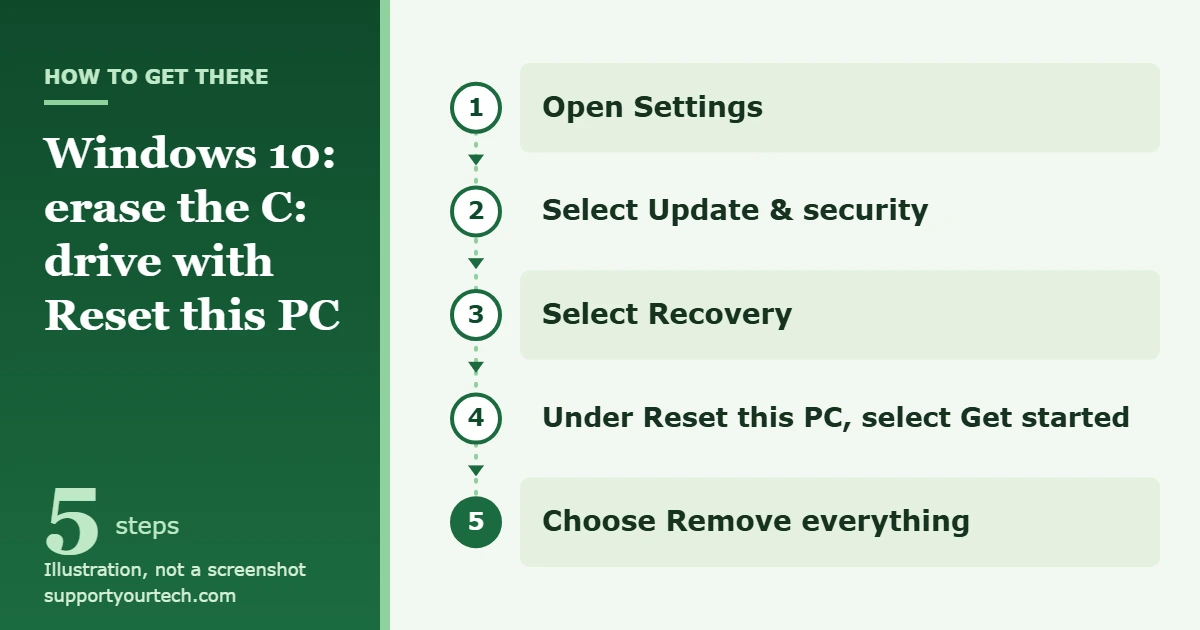
You cannot format the C: drive from inside Windows 10, because Windows will not format the partition it is running from. To erase it, either open Settings > Update & security > Recovery, select Get started under Reset this PC and choose Remove everything, or start the PC from Windows installation media and delete the partitions during a clean install.
Applies to: Windows 10. Checked against Microsoft Support on October 7, 2026.
Why Windows 10 will not format its own C: drive
Formatting creates a new, empty file system on a partition, which destroys everything stored there. Windows 10 is loaded from the C: partition, so it cannot wipe that partition while it is in use. Microsoft states this directly in its Disk Management instructions: you cannot format a disk or partition that is currently in use, including the partition that contains Windows. That is why the Format command works on a USB drive or a second hard drive but not on C:.
Microsoft documents two ways to get the result people usually want from formatting C:, which is a clean drive with a fresh copy of Windows or nothing personal left on it:
| Route | What happens to C: | Choose it when |
|---|---|---|
| Reset this PC with Remove everything | Windows is reinstalled and all personal files, apps and settings are removed. The Windows partition is not literally formatted; files are deleted individually. | Windows still starts or reaches the recovery screen, and you want the simplest route. |
| Clean install from installation media | The partitions on the Windows disk are deleted and Setup creates new ones, so nothing from the old installation remains. | You want the drive truly emptied, Windows will not start, or you suspect malware. |
If you only need to format a different drive, such as a USB stick or a second internal disk, that is a much smaller job. Follow our guide to formatting a drive in Windows 10 instead.
Before you start: back up and check these things
Warning: both routes permanently remove your personal files, apps and settings from the C: drive. There is no undo. Do not continue until your files are safely stored somewhere else.
- Back up your files. Microsoft recommends copying personal data to an external hard drive, a USB flash drive or a cloud location such as OneDrive. Open a few of the copied files on the backup to confirm they work.
- Have your BitLocker recovery key. If the device is encrypted, Microsoft says to make sure you have the BitLocker recovery key before you reset.
- Confirm activation. For a clean install, Microsoft says your Microsoft account should be linked to the Windows digital license on the device, and the edition you reinstall must match the edition you are licensed for. If you have no product key and no linked digital license, do not go ahead.
- Keep installers and license details for your apps. Apps are removed along with everything else and must be installed again afterward.
- Plug in a laptop. The process restarts the PC several times and should not be interrupted.
- Know the support status. Microsoft ended support for Windows 10 on October 14, 2025, so a fresh Windows 10 installation no longer receives regular security fixes. If the PC can run Windows 11, consider installing that instead.
Method 1: Erase the C: drive with Reset this PC
This is the shortest route and needs no USB drive.
- Open Settings from the Start menu.
- Select Update & security, then select Recovery.
- Under Reset this PC, select Get started.
- Select Remove everything. Microsoft describes this option as reinstalling Windows and removing all your personal files, apps and settings. (Keep my files keeps your documents and photos, so it is not the choice for wiping the drive.)
- Choose how Windows is reinstalled. Cloud download downloads a fresh copy of Windows, and Local reinstall uses the files already on the PC, which is faster on a slow connection.
- Review the extra settings if they are offered. Turning on Clean data removes files and cleans the drive, which Microsoft recommends when you plan to donate or sell the PC. It takes longer. If the PC has more than one drive, Windows can also remove data from all drives or only the drive where Windows is installed; leave the other drives alone unless you want them erased too.
- Follow the on-screen instructions to start the reset, then leave the PC alone. The screen can stay black for a long time, occasionally more than 15 minutes, and the PC restarts by itself. Microsoft warns that restarting it manually during this stage can make the reset fail.
When the reset finishes, the Windows setup screens appear as they would on a new PC. Microsoft’s reference page is Reset your PC.
If Windows 10 will not open Settings
- On the sign-in screen, select the power button, then hold down Shift while you choose Restart. This opens the recovery menu, and it works even when you are not signed in.
- Select Troubleshoot.
- Select Reset this PC, choose Remove everything, and follow the instructions on the screen.
Method 2: Wipe C: during a clean install from installation media
Starting the PC from a USB drive means Windows is no longer running from C:, so Setup can delete that partition. Microsoft recommends this route when Startup Repair has failed and you have no recovery drive, or when you suspect a malware infection.
Create the installation media
- On a working PC with an internet connection, plug in a blank USB flash drive with at least 8 GB of space. Everything on that USB drive is deleted.
- Go to Microsoft’s Download Windows 10 page and, under Create Windows 10 installation media, select Download Now.
- Run the downloaded MediaCreationTool file and follow its prompts to build the USB drive.
Our walkthrough on getting a copy of Windows 10 covers this part in more detail, and Microsoft’s instructions are in Create installation media for Windows.
Start from the USB drive and delete the old partitions
Microsoft’s current step-by-step shows the Windows 11 version of Setup. Screens on Windows 10 media can be worded differently, but the decisions below are the same ones Microsoft lists for both versions.
- Connect the installation media to the PC you want to wipe and start the PC from it. Depending on the manufacturer, you may need to change the boot order or use a boot menu; check the manufacturer’s instructions for the key to press.
- Choose your language and keyboard settings, then continue.
- Choose to install Windows rather than repair it, and accept that files, apps and settings will be deleted.
- If Setup asks for a product key and the PC was already activated with a digital license, select I don’t have a product key and pick the edition you are licensed for. The product key screen may not appear at all if a key is stored in the device firmware.
- Accept the license terms.
- On the screen that asks where to install Windows, find Disk 0. Select each partition on Disk 0 and delete it, until only unallocated space is left on that disk. This is the step that wipes the old C: drive.
- Select the unallocated space on Disk 0 and select Next. Setup creates and formats the new partitions by itself, so you do not need to format anything manually.
- Let the installation finish. The PC restarts several times. When setup asks, sign in with your Microsoft account so the digital license is applied.
Warning: if the PC has more than one disk, the others are listed as Disk 1, Disk 2 and so on. Microsoft’s guidance is not to modify or delete partitions on any disk other than Disk 0. If you are unsure which disk is which, shut down and disconnect the extra drives first. The full procedure is in Microsoft’s Reinstall Windows with the installation media.
How to confirm it worked
- The PC starts at the first-time Windows setup screens instead of your old sign-in screen.
- After setup, File Explorer shows the C: drive with only Windows on it: your old folders, desktop files and installed apps are gone.
- After a clean install, check activation once you are online and signed in with your Microsoft account.
Neither method can be reversed. The only way to get files back is to copy them from the backup you made beforehand.
Troubleshooting
The Format option fails or is unavailable for C:
This is expected. Windows cannot format a partition that is in use, including the one that contains Windows. Use one of the two methods above.
Disk Management shows other partitions on the same disk
The main drive normally holds three partitions: Local Disk (C:), an EFI System partition that supports startup, and a Recovery partition that stores recovery tools. Microsoft recommends not modifying the EFI System and Recovery partitions from inside Windows, even though Disk Management may show them as 100 percent free. They are removed and recreated only as part of a clean install.
The reset asks for a BitLocker recovery key
The drive is encrypted. Enter the recovery key you saved before starting. Without it, use the clean install method, which deletes the encrypted partition instead of unlocking it.
The reset seems stuck on a black screen
Wait. Microsoft notes that the screen can stay black for a long period, occasionally upwards of 15 minutes, and that forcing a restart can cause the reset to fail.
The PC ignores the USB drive and starts Windows as usual
The boot order still puts the internal drive first. Check the PC maker’s instructions for opening the boot menu or changing the boot order, then try again.
The reset or recovery options are missing on a work or school PC
Devices managed by an organization can have recovery options restricted. Contact your IT administrator before trying to erase the drive.
Frequently asked questions
Can I format the C: drive from Command Prompt?
Not while Windows 10 is running from it. The format command is a documented Windows tool, and it warns that all data on the drive will be lost before it proceeds, but the rule about partitions in use still applies. Deleting the partitions during a clean install does the same job with less risk of choosing the wrong drive.
Does Reset this PC actually format the drive?
Not the Windows partition. Microsoft’s technical documentation says the Windows volume is never formatted during a reset, because the files needed to rebuild Windows are on it; your files are deleted individually. If you choose to remove data from all drives, the other data volumes are formatted.
Is Remove everything enough before selling a PC?
Turn on Clean data as well, which makes recovering the old files much more difficult. Microsoft notes that this erasure is aimed at consumers and does not meet government and industry data erasure standards.
What is the difference between a quick format and a normal format?
According to Microsoft, a quick format creates a new file table but does not fully overwrite the volume, so it is much faster. A normal format fully erases existing data on the volume.
Will I need to buy Windows 10 again?
Not if the PC was activated. A digital license linked to your Microsoft account, or a key stored in the device firmware, is applied again when the same edition is reinstalled.
Once Windows is back, restore your files from the backup and reinstall your apps. If your goal is a fresh system rather than an empty drive, our guide to reimaging a Windows 10 computer compares the options.

Matt Jacobs has been working as an IT consultant for small businesses since receiving his Master’s degree in 2003. While he still does some consulting work, his primary focus now is on creating technology support content for SupportYourTech.com.
His work can be found on many websites and focuses on topics such as Microsoft Office, Apple devices, Android devices, Photoshop, and more.