To get a printer back online in Windows 10, restart the printer and your PC, and make sure both are on the same network. Then go to Settings > Devices > Printers & scanners, select the printer, select Open queue, open the Printer menu, and clear Use Printer Offline and Pause Printing.
“Offline” means Windows can’t talk to the printer right now. The printer may be off or asleep, showing an error, on a different network, or at an address Windows no longer knows. It rarely means the printer is broken.
Try the fixes in order and test a print after each one.
Applies to: Windows 10. Checked against Microsoft Support on September 25, 2026.
1. Restart the printer and check its connection
- Turn the printer off, wait 30 seconds, and turn it back on.
- For a USB printer, check both ends of the cable, or try another USB port.
- For a wireless printer, check that it’s on the same Wi-Fi network as your PC. Most printers show this on their screen or on a printed network report.
- Check the printer’s screen or lights for an error, such as a paper jam, an open cover, or empty ink or toner. Many printers stay offline until the error is cleared.
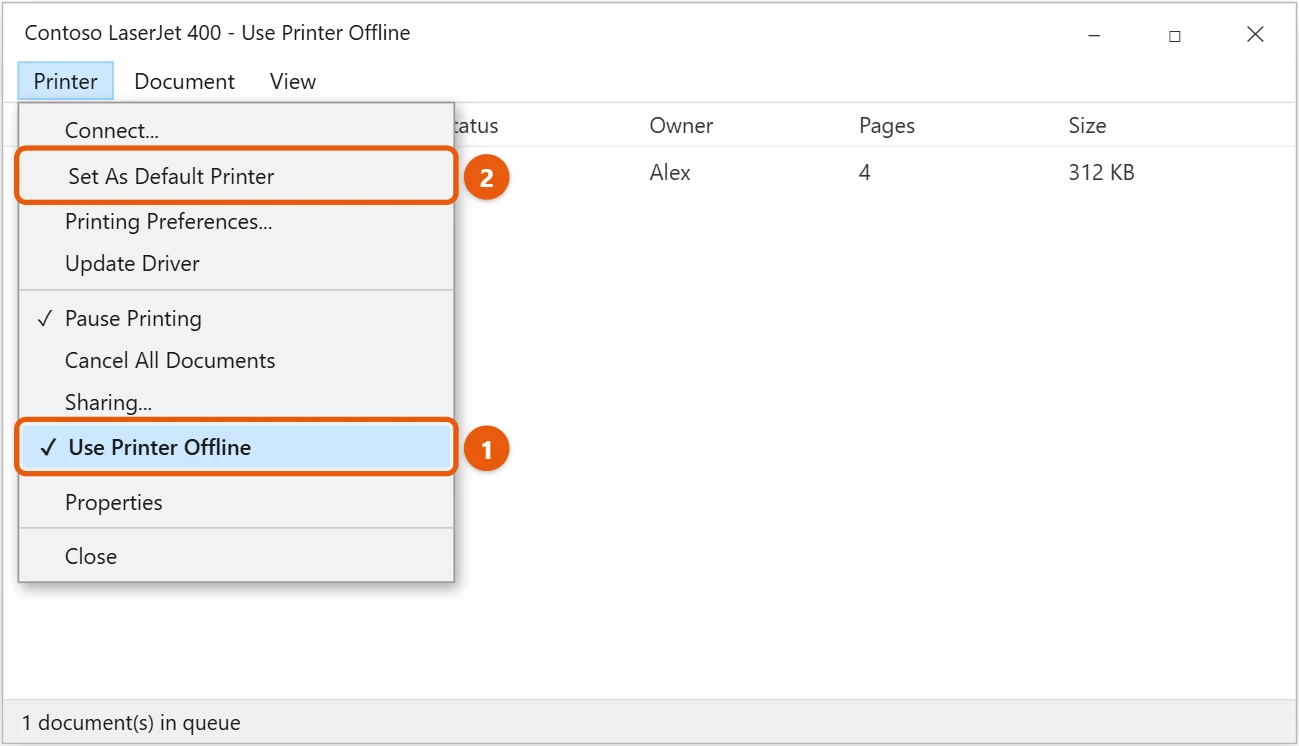
2. Turn off Use Printer Offline
- Select Start > Settings > Devices > Printers & scanners.
- Select your printer, then select Open queue.
- Select the Printer menu.
- If Use Printer Offline or Pause Printing has a check mark, select it to clear it.
- Select Set As Default Printer if this is the printer you use most.
3. Clear stuck print jobs
In the same queue window, select Printer > Cancel All Documents, then select Yes. A stuck job can keep the printer showing as offline.
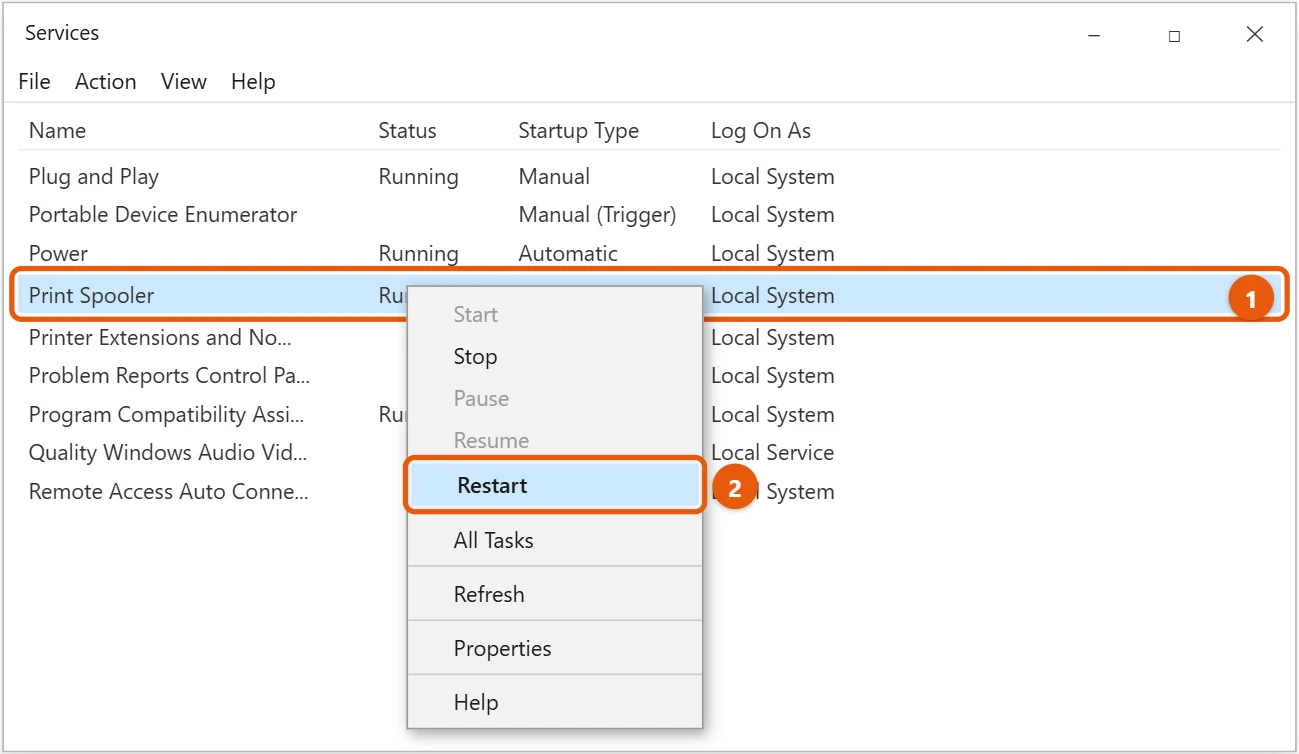
4. Restart the Print Spooler
- Press Windows logo key + R, type
services.msc, and press Enter. - Find Print Spooler in the list.
- Right-click it and select Restart.
5. Run the printer troubleshooter
Select Start > Settings > Update & Security > Troubleshoot > Additional troubleshooters > Printer > Run the troubleshooter.
6. Remove the printer and add it again
- In Settings > Devices > Printers & scanners, select the printer and select Remove device.
- Select Add a printer or scanner and pick the printer when it appears.
See how to add a printer in Windows 10 for printers that don’t appear.
7. Update the printer driver
Download the latest Windows 10 driver from the printer maker’s website and install it. See how to update all drivers on Windows 10.
While you’re on the maker’s site, check for a firmware update for the printer too. Many printers can also update themselves from their own control panel, usually under Setup, Tools or Maintenance. Firmware fixes often solve Wi-Fi drop-outs.
8. Check the printer’s port and IP address
For a network printer, Windows may still be looking for it at an old address.
- Print a network configuration page from the printer’s control panel, or check its screen, to find its current IP address.
- In Windows, open Control Panel > Devices and Printers, right-click the printer, and select Printer properties.
- Open the Ports tab and look at the checked port. If it shows an old IP address, select Add Port > Standard TCP/IP Port > New Port and enter the current address.
- If the port is already correct, select Configure Port and clear SNMP Status Enabled. Some printers report themselves as offline over SNMP even when they work fine.
- Select Apply and print a test page.
A port that starts with WSD can lose track of the printer when its address changes. A Standard TCP/IP port pointing to a fixed address is usually more reliable.
9. Give the printer a fixed address
Sign in to your router’s settings and look for DHCP reservation or Address reservation. Pick the printer from the list of connected devices and reserve its current IP address. The printer then keeps the same address after restarts, so Windows always finds it.
10. Stop power saving from taking the printer offline
A printer that goes offline after sitting idle is often asleep or being switched off to save power.
- On the printer, open its settings menu and look for Sleep, Auto Off or Energy Save. Set a longer time, or turn Auto Off off, so the printer doesn’t drop off the network.
- For a USB printer, Windows may be cutting power to the USB port.
- Right-click Start and select Device Manager.
- Expand Universal Serial Bus controllers.
- Double-click USB Root Hub and open the Power Management tab.
- Clear Allow the computer to turn off this device to save power and select OK. Repeat for each USB Root Hub in the list.
11. Disconnect from a VPN
A VPN can send all of your PC’s traffic through another network, so it can’t see the printer on your own network. Disconnect the VPN and print again. If that works, look in the VPN app for an option to allow local network or LAN access.
If nothing works
- Connect the printer with a USB cable for a moment. If it prints that way, the problem is the network, not Windows.
- Install the printer maker’s own app, such as HP Smart or Epson Connect, which can find and fix connection issues.
- Reset the printer’s network settings from its control panel and connect it to Wi-Fi again.
Frequently asked questions
Why does my printer keep going offline?
The most common causes are Wi-Fi drops, the printer going to sleep, or its network address changing. Giving the printer a fixed address in your router settings often stops it.
The printer is online but won’t print. What now?
Clear the queue and restart the Print Spooler (fixes 3 and 4), then check that the right printer is set as the default.
Why does Windows keep changing my default printer?
Windows 10 can set the default to the printer you used last. To stop it, go to Settings > Devices > Printers & scanners and clear Let Windows manage my default printer. Then select your printer, select Manage, and select Set as default.
Why does my printer say offline when it’s on Wi-Fi?
Windows is usually looking for it at an old IP address, or the printer is reporting its status wrongly over SNMP. Fixes 8 and 9 cover both. A VPN on the PC can cause it too (fix 11).
If the printer is shared from another PC, see how to share a printer in Windows 10.
To see which documents were printed, see how to check print history in Windows 10.
Microsoft’s guide is Troubleshooting offline printer problems in Windows. More help is on our Windows Help & Guides page.
Related: how to install an HP LaserJet 1018 on Windows 10.
Related: How to Check Ink Levels on a Canon Printer in Windows 10.

Matt Jacobs has been working as an IT consultant for small businesses since receiving his Master’s degree in 2003. While he still does some consulting work, his primary focus now is on creating technology support content for SupportYourTech.com.
His work can be found on many websites and focuses on topics such as Microsoft Office, Apple devices, Android devices, Photoshop, and more.