Last updated on November 17th, 2026 at 03:16 pm
The Sound page in Windows 11 Settings is fine for picking speakers but thin when you need a mic’s input level, the default communications device, the sample rate or the system sound scheme. Those live in the classic Sound window. Fastest route: press Windows logo key + R, type mmsys.cpl and press Enter. Without typing, go to Settings > System > Sound > Advanced > More sound settings.
Applies to: Windows 11 Home and Pro.
Type mmsys.cpl to open the Sound window directly
The Sound window is a Control Panel file named mmsys.cpl, so you can start it by name from anywhere.
- Press Windows logo key + R. The Run box opens.
- Type mmsys.cpl (no spaces).
- Press Enter. A small window titled Sound opens.
The same command works at a Command Prompt. To land straight on the Sounds tab, type control mmsys.cpl sounds instead.
Reach it from Settings when you’d rather click
- Press Windows logo key + I, or select Start > Settings.
- Select System > Sound.
- Scroll past the Output and Input sections to Advanced and select More sound settings. The Sound window opens in front of Settings.
Already working in Control Panel? Select Hardware and Sound > Sound to open the same window. If you need Control Panel itself first, there are several ways to open Control Panel in Windows 11.
Example: More Sound Settings Opens mmsys.cpl
On a Windows 11 Home laptop (version 25H2), the Advanced section at the bottom of Settings > System > Sound ends with More sound settings, which has an arrow icon showing it opens a separate window.
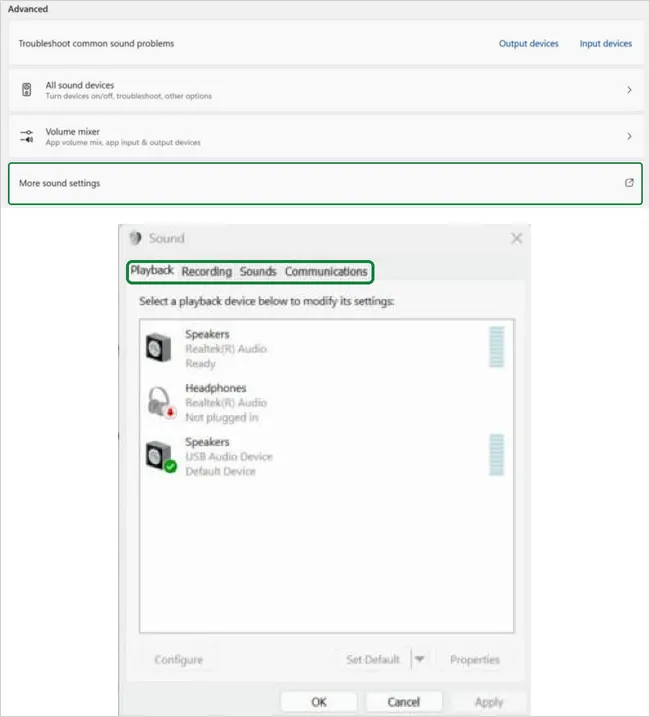
Selecting it opened the classic Sound window on the Playback tab, with Recording, Sounds and Communications beside it. It listed Speakers (Realtek), Headphones marked Not plugged in, and a USB Audio Device set as Default Device. I closed it with Cancel.
Make a one-click Sound shortcut
If you open this window often (for example, to switch a headset between music and calls), put it on the desktop.
- Right-click an empty part of the desktop and select New > Shortcut.
- In the location box, type control mmsys.cpl and select Next.
- Name it Sound and select Finish. Double-click it to open the window. You can also right-click it and select Pin to Start.
What each tab is for
| Tab | What you’ll find | Typical reason to open it |
|---|---|---|
| Playback | Speakers, headphones, monitor and TV audio | Set a default device, test a speaker, change the format |
| Recording | Microphones and other inputs | Raise mic level, turn on Listen, set the call mic |
| Sounds | Sound scheme and Program Events | Change or silence the sounds Windows plays |
| Communications | What happens to other audio during calls | Stop music getting quieter when a call starts |
Select a device and then Properties for its own tabs: General (including Device usage, to enable or disable it), Levels (volume and, on some mics, boost), Advanced (the Default Format sample rate and bit depth) and, depending on the device and driver, tabs such as Enhancements or Spatial sound. Recording devices usually also have a Listen tab; that is where you hear your own mic through your headphones. Some sound drivers add Loudness Equalization to the enhancement options, explained in turning on Loudness Equalization in Windows 11.
Two defaults can be set on Playback and Recording. Right-click a device to set it as the default device (used by most apps) or as the default communication device (used by call apps). Example: Alex wants music on his desk speakers but calls on his headset. He sets the speakers as the default device and the headset as the default communication device, so calls go to the headset while everything else stays on the speakers.
Settings or the classic window: which to use
| Task | Better place |
|---|---|
| Pick the speakers or mic you’re using right now | Settings > System > Sound, or the speaker icon on the taskbar |
| Turn one app up or down | Volume mixer |
| Separate default and call devices | Classic window |
| Mic level, boost or Listen | Classic window (Properties > Levels or Listen) |
| Change or silence system sounds | Classic window, Sounds tab |
| Show a disabled or unplugged device | Classic window |
Per-app volume never lived in the classic window; it is in the Volume mixer in Windows 11. For simply choosing which speakers play, the steps to turn on computer speakers in Windows 11 use Settings.
Check the change took, and undo it
- On Playback, right-click the device and select Test if it’s offered. You should hear a tone and see the green bar beside it move.
- On Recording, speak and watch the mic’s bar move.
- Before changing Default Format or Levels, note the old value. To undo, set it back and select OK, or select Restore Defaults on the Advanced tab if your device shows it.
If several settings have drifted at once, it is quicker to reset audio settings in Windows 11 layer by layer.
When mmsys.cpl does nothing or your device isn’t listed
Nothing opens. Check the spelling (two m’s, then sys, a period, cpl). The window may also have opened behind Settings; look for a Sound icon on the taskbar.
A device is missing from the list. Right-click an empty part of the list and turn on the options to show disabled and disconnected devices. If it then appears greyed out, open its Properties and set Device usage to Use this device (enable). If it never appears, check the cable or Bluetooth connection.
The mic is listed but silent in calls. Check the mute switch on the headset and the app’s own mute button; the steps to unmute your microphone in Windows 11 go through each place.
Bluetooth headphones show two entries and sound poor in calls. One entry is the hands-free (call) profile, which uses lower quality audio. If you don’t use the headset mic, you can disable hands-free audio in Windows 11.
Still no sound. Work through Microsoft’s fix sound or audio problems in Windows checklist, which covers the troubleshooter, drivers and audio services.
Related guides
Questions about the classic Sound window
Is the classic Sound window going away?
Microsoft hasn’t announced a removal, and it still opens in current Windows 11 versions. More options keep moving to Settings, so the More sound settings link could move in a later update; mmsys.cpl is the most reliable way in.
Why does my music get quieter when a call starts?
That setting is on the Communications tab, where Windows can lower other sounds when it detects a call. Choose Do nothing there and select OK to stop it.
How do I silence the Windows alert sounds?
On the Sounds tab, pick a different sound scheme (No Sounds turns them all off), or select one event under Program Events and set its sound to (None). Choose Windows Default in the scheme list to bring them back.

Matt Jacobs writes and maintains the guides on Support Your Tech, which he started in 2017. He spent most of his career keeping small-business PCs running and still takes the occasional consulting job, so the steps here come from fixing the same problems on other people’s computers. Every guide is checked on his own Windows 11, Windows 10, Mac, iPhone and iPad before it goes up.