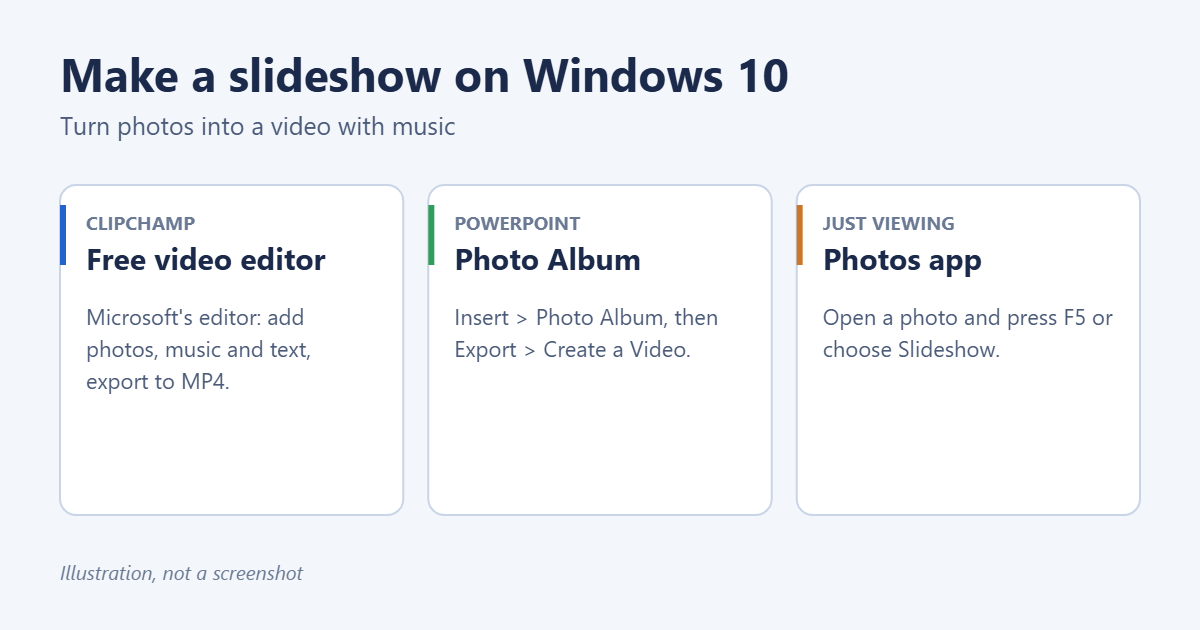
To make a slideshow on Windows 10, use Clipchamp, Microsoft’s free video editor. Install it from the Microsoft Store, select Create a new video, import your photos, drag them onto the timeline, add music, and select Export to save an MP4 video you can share or play on a TV. If you have Microsoft 365, PowerPoint’s Photo Album feature is another quick way. If you only want to show photos full screen, open one in the Photos app and start a slideshow.
Applies to: Windows 10 Home and Pro. The Video Editor that used to be built into the Photos app has been replaced by Clipchamp in current versions. Last reviewed October 8, 2026.
Method 1: Make a slideshow video with Clipchamp
- Open the Microsoft Store, search for Clipchamp and select Get. Open it and sign in with your Microsoft account.
- Select Create a new video.
- Select Import media and choose your photos. Hold Ctrl to pick several.
- Drag the photos from Your media onto the timeline in the order you want. Drag them around on the timeline to reorder.
- To change how long each photo shows, drag the edge of a photo on the timeline. Around 3 to 5 seconds per photo works well.
- Add transitions: select Transitions on the left and drag one between two photos.
- Add music: select Content library > Audio, or import your own song, and drag it onto the timeline below the photos. Trim the end so it finishes with the last photo.
- Add titles: select Text and drag a style onto the timeline above a photo, then type your text.
- Select Export and choose 1080p. Clipchamp saves an MP4 file to your Downloads folder.
The free plan exports up to 1080p without a watermark. Some stock music and effects are marked as premium and need a paid plan.
Method 2: Make a slideshow in PowerPoint
- Open PowerPoint and select Insert > Photo Album > New Photo Album.
- Select File/Disk, choose your photos and select Insert.
- Choose a Picture layout, such as Fit to slide, and select Create.
- Add transitions on the Transitions tab, and tick After under Advance Slide with a time such as 00:04.00. Select Apply To All.
- To add music, go to Insert > Audio > Audio on My PC, then on the Playback tab tick Play in Background.
- Press F5 to play it, or save it as a video with File > Export > Create a Video.
Method 3: Just view photos as a slideshow
Open any photo in the Photos app, select the … menu and choose Slideshow, or press F5. Photos plays every picture in that folder. In File Explorer, you can also select pictures and choose Manage > Slide show. See how to view photos as a slideshow in Windows 10. For a slideshow when the PC is idle, set the Photos screen saver; see how to set a screen saver in Windows 10.
Tips for a better slideshow
- Put the photos in one folder and rename them with numbers first (01, 02, 03) so they import in order.
- Use landscape photos where possible. Portrait photos get black bars on a 16:9 video.
- Keep it under 5 minutes for sharing, and match the length to your music.
- Get photos off your phone first; see how to transfer photos from a phone to a Windows 10 PC.
Troubleshooting
The Photos app has no Video Editor
Microsoft removed it from newer versions. Use Clipchamp, or install Microsoft Photos Legacy from the Microsoft Store if you prefer the old editor.
Clipchamp export is slow or stuck
Keep the Clipchamp window open and the PC awake during export. Close other heavy apps and try 720p for very long slideshows.
The music is cut off or too long
Drag the end of the audio clip on the timeline to match the last photo, or add a fade-out in the audio settings.
Frequently asked questions
Is there a free slideshow maker in Windows 10?
Yes. Clipchamp’s free plan is enough for most photo slideshows.
How do I play the slideshow on a TV?
Copy the MP4 to a USB stick and plug it into the TV, or cast it from the PC.
Can I add video clips too?
Yes. Import them alongside your photos in Clipchamp. To trim a clip first, see how to crop a video in Windows 10.

Matt Jacobs has been working as an IT consultant for small businesses since receiving his Master’s degree in 2003. While he still does some consulting work, his primary focus now is on creating technology support content for SupportYourTech.com.
His work can be found on many websites and focuses on topics such as Microsoft Office, Apple devices, Android devices, Photoshop, and more.