Last updated on November 17th, 2026 at 03:00 pm
There’s no Clipboard app, folder or window in Windows 10 to go looking for. The clipboard lives in memory, and the only way to see what’s on it is clipboard history: press Windows logo key + V on version 1809 or later. History is off by default, so the first time you’ll see a Turn on button instead of a list. With it off, Windows still holds the one thing you copied last, and Ctrl + V pastes it.
Why you can’t find a Clipboard window
Searching File Explorer or the Start menu for “clipboard” turns up nothing useful, and that confuses a lot of people. Windows 10 gives you two ways in, and neither is a file:
- The history panel, opened with Windows logo key + V. It’s a small pop-up that lists recent copies and pastes the one you click.
- The Clipboard page in Settings, at Start > Settings > System > Clipboard. It holds the on/off switches, sync options and the button that erases everything.
Microsoft’s management documentation for the clipboard history setting describes the history as stored in memory, which is why a restart wipes it. There’s nothing on disk for you to open, back up or browse.
Without history, the clipboard is the classic one-slot version. Copy a sentence, then copy a picture, and the sentence is gone. Ctrl + V always pastes whatever went in last. If that’s all you need, the basics of copying and pasting in Windows 10 cover it.
Switch on the history list the first time
Clipboard history starts switched off, as Microsoft’s list of Windows keyboard shortcuts points out next to the Windows logo key + V entry. You only have to turn it on once per account, and either route works.
From the shortcut:
- Press Windows logo key + V. A small panel appears saying it can’t show history yet.
- Select Turn on.
- Copy something, such as a word in a document, then press Windows logo key + V again. The item now shows at the top of the list.
From Settings:
- Select Start > Settings > System.
- Choose Clipboard in the left column.
- Set Clipboard history to On.
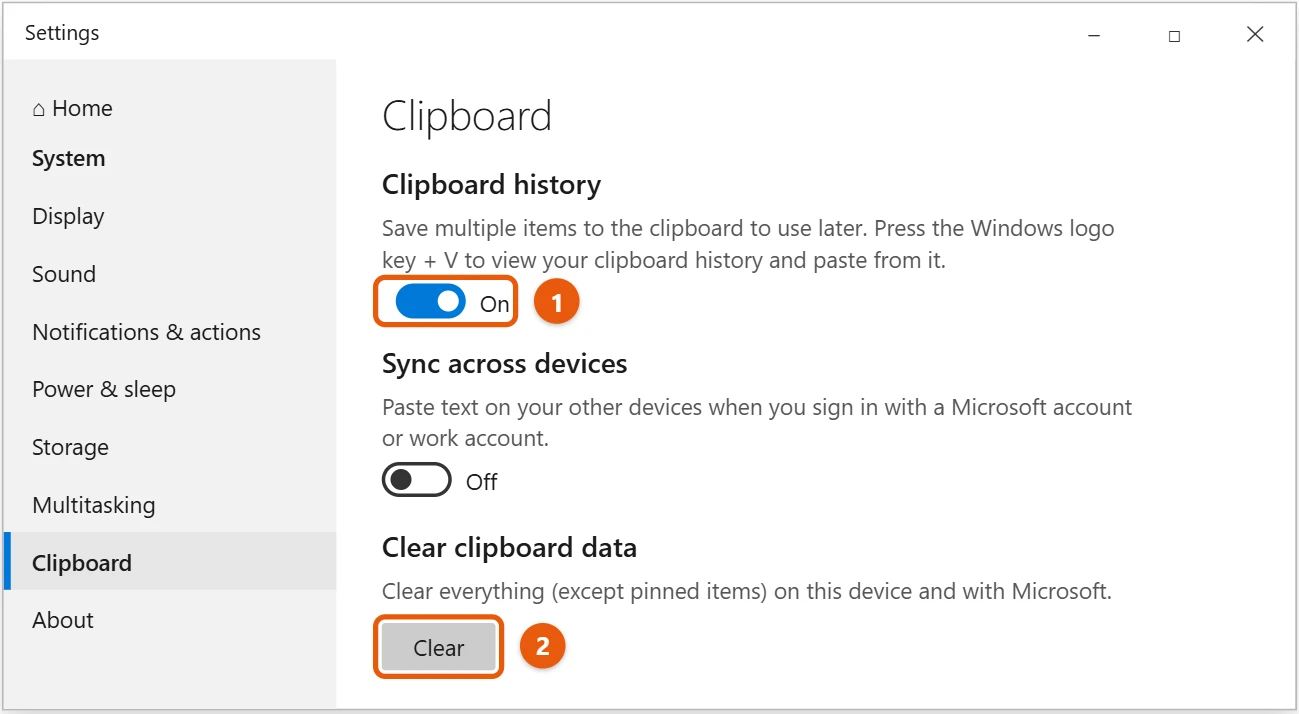
A quicker way to reach that Settings page is to press Windows logo key + R, type ms-settings:clipboard and press Enter. If it doesn’t open the right page on your build, use the menu path instead.
Only what you copy after the switch goes on appears in the list. Anything copied before that isn’t recovered.
Older Windows 10 builds without the shortcut
Clipboard history arrived with Windows 10 version 1809. On an earlier build, Windows logo key + V simply does nothing and the Clipboard page isn’t in Settings.
To check, press Windows logo key + R, type winver and press Enter. The window shows the version number near the top. If it’s lower than 1809, install the available feature updates through Settings > Update & Security > Windows Update, and the shortcut becomes available after that. Until then, you’re working with the one-item clipboard: paste each item where you need it before copying the next.
Paste an older item without leaving your app
The history panel opens on top of whatever you’re working in, so you don’t lose your place.
- Click in the document, email or box where the text should go.
- Press Windows logo key + V.
- Use the mouse, or the arrow keys and Enter, to pick an item. It’s pasted at your cursor right away and the panel closes.
Here’s a worked example. Priya is filling in a shipping form and has copied three things from an email: an order number, a street address and a phone number, in that order. Ctrl + V would paste only the phone number. With history on, she clicks the address field, presses Windows logo key + V and selects the address, then repeats for the order number, without going back to the email.
Microsoft lists what the list holds: up to 25 entries, each up to 4 MB, in text, HTML or bitmap (picture) format. Files you copy in File Explorer don’t show up there. A region you grab with Windows logo key + Shift + S goes to the clipboard as an image; for saving full screenshots as files, see how to take a screenshot in Windows 10.
Keep, remove or wipe what’s saved
Each entry in the panel has a See more (…) button.
- Press Windows logo key + V.
- Select See more next to the item.
- Choose Pin to keep it, Delete to remove only that item, or Clear all to empty the list except pinned items.
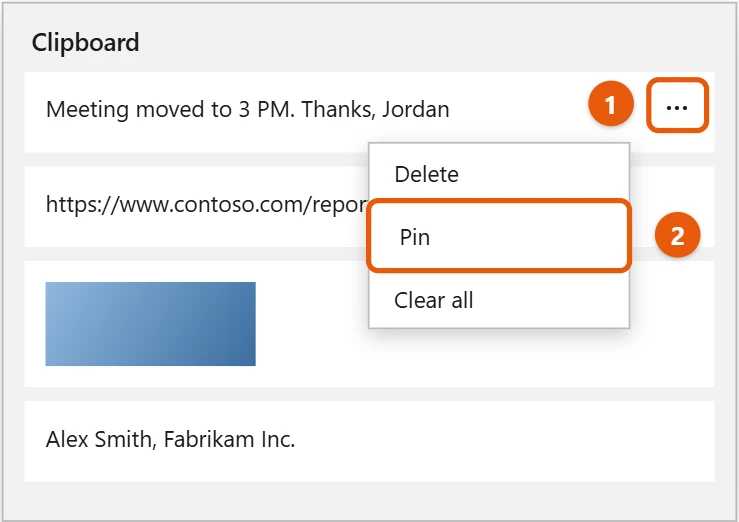
To erase from Settings, go to Settings > System > Clipboard and select Clear under Clear clipboard data. Microsoft says this clears the device and, if you sync, Microsoft’s copy too.
What happens to an entry depends on what you do next:
| Action | Unpinned items | Pinned items |
|---|---|---|
| Copy 25 more things | Oldest drop off the list | Stay |
| Clear all in the panel | Removed | Stay |
| Clear in Settings | Removed | Stay |
| Restart the PC | Removed | Stay |
Pinned entries are handy for text you paste over and over, like a mailing address or a standard reply. Because they outlast restarts, unpin and delete anything personal before someone else uses your account. If you copy a password or card number, open the panel afterward and delete that entry. Some password managers can clear the clipboard for you after a short delay.
Paste plain text instead of formatted text
Entries keep the font, color and links of the source. Windows 10’s panel doesn’t have its own plain-text option, so use the app’s paste tools:
- In many browsers and web apps, Ctrl + Shift + V pastes without formatting.
- In Word and Outlook, paste, select the Paste Options button that appears, and pick Keep Text Only.
- Elsewhere, paste into Notepad, copy it again from there, and paste that. Notepad can’t hold formatting.
Send copied text to your other PCs
Sync lets text you copy on one PC appear in Windows logo key + V on another. Every device must be signed in with the same Microsoft account or work account, and Microsoft describes both sync options in terms of text only, so don’t count on pictures syncing.
- Open Settings > System > Clipboard.
- Turn on the sync switch. On most Windows 10 builds it’s labeled Sync across devices; Microsoft’s current page calls it Clipboard history across your devices.
- Choose Automatically sync text that I copy or Manually sync text that I copy.
- Repeat on each PC.
Which to pick? Automatic sends everything you copy, including things you’d rather keep local, like an account number. Manual keeps items on the PC until you open the panel and choose to sync a specific entry. Jordan, who copies client details all day on a work laptop, would be better served by manual sync than by automatic.
Work or school PC with a grayed-out switch
If the Clipboard history switch is gray and a message says some settings are managed by your organization, it isn’t a fault on your PC. Microsoft’s Experience policy reference documents a setting called Allow Clipboard History, found in Group Policy under Computer Configuration > Administrative Templates > System > OS Policies. When it’s set to block history, Windows logo key + V shows no items and the Settings page is grayed out with a policy warning.
On a personal PC running Pro, you can open the Local Group Policy Editor (gpedit.msc) and set that policy to Not Configured if you blocked it yourself. On a managed device, ask your IT team; changing it locally is usually overwritten.
When Windows + V or Ctrl + V stops responding
Start with the setting, then work outward:
- The panel says history is off. Turn it on as shown above.
- Nothing happens at all. Check the version with
winver; it needs 1809 or later. - The Windows key itself is disabled. Test with Windows logo key + E. If File Explorer doesn’t open, a gaming keyboard’s Windows-key lock (often a key or a mode in the keyboard’s app) may be on.
- Another app grabs the shortcut. Some third-party clipboard tools take over Windows logo key + V. Close them and try again.
If copying and pasting stops everywhere, these general fixes are worth trying in order. They aren’t official Microsoft procedures, but they’re low risk:
- Close and reopen the app you’re copying from, since a frozen app can hold on to the clipboard.
- Copy something small in a different app, such as Notepad, to replace the stuck item.
- Restart File Explorer: press Ctrl + Shift + Esc, find Windows Explorer on the Processes tab and select Restart.
- In a Remote Desktop session, ending rdpclip.exe in the remote PC’s Task Manager and running
rdpclipfrom the Run box restarts the clipboard bridge between the two machines. - Restart the PC.
Microsoft’s Using the clipboard support page covers the official settings, and if you also use a newer machine, the clipboard in Windows 11 works much the same way with a few extra options.
Clipboard questions
Can I get back an item after I cleared it?
No. Clear all, Clear in Settings and Delete remove the entry, and there’s no recycle bin for the clipboard. Pin anything you can’t afford to lose.
Do I need a Microsoft account to use clipboard history?
Not for history on one PC; it works with a local account. You need the same Microsoft account or work account on each device only if you want sync.
Why is my pinned note still there after a restart?
That’s by design. Pinned entries survive restarts and Clear, so they’re the one part of the clipboard that sticks around until you unpin or delete them.
Does sync send pictures to my other PCs?
No. Sync handles text. Images you copy still appear in that PC’s own history, up to the 4 MB per item limit.
Will turning history off delete my pinned items?
Microsoft’s support page doesn’t say what happens to pins when you switch history off. If a pinned entry matters, paste it into a note or document first so you have a copy either way.

Matt Jacobs writes and maintains the guides on Support Your Tech, which he started in 2017. He spent most of his career keeping small-business PCs running and still takes the occasional consulting job, so the steps here come from fixing the same problems on other people’s computers. Each guide follows Microsoft, Apple and Google’s own documentation and is updated when the steps change. Screenshots marked “Recreated” are illustrations of the real screens.