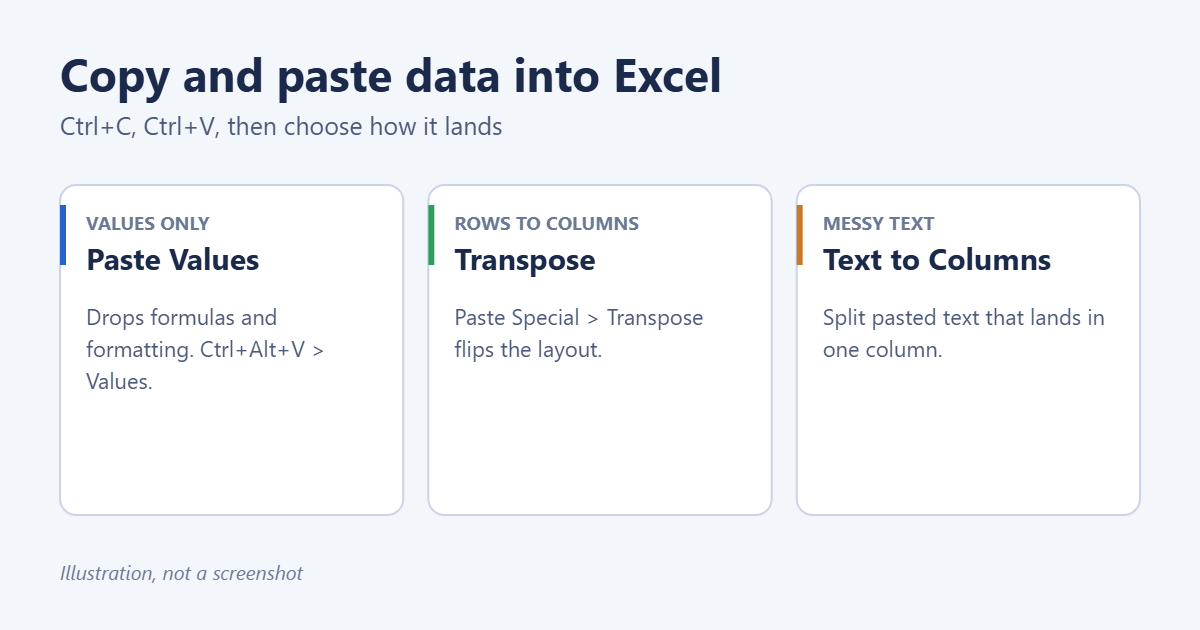
To copy and paste data into Excel, select it in the source (a web page, Word, a PDF or another sheet), press Ctrl+C, click the top-left cell where it should go in Excel, and press Ctrl+V. Then use the Paste Options button that appears to keep or drop the formatting. For numbers only, use Paste Special (Ctrl+Alt+V) > Values. If everything lands in one column, split it with Data > Text to Columns.
Applies to: Excel for Microsoft 365, Excel 2024, 2021, 2019 and 2016 on Windows and Mac (use Command instead of Ctrl on a Mac), and Excel for the web. Last reviewed October 8, 2026.
Basic copy and paste
- Select the data in the source and press Ctrl+C.
- In Excel, click the cell where the top-left value should go. Excel fills right and down from there, overwriting anything in the way.
- Press Ctrl+V.
- Select the Paste Options icon (Ctrl) at the bottom right of the pasted area and pick:
- Keep Source Formatting: keeps colors, fonts and borders from the source.
- Match Destination Formatting: uses the sheet’s existing style. Best for web pages.
- Values: plain numbers and text only.
Paste Special: control exactly what’s pasted
Press Ctrl+Alt+V, or right-click and choose Paste Special, to choose:
- Values: results without formulas. Recent Microsoft 365 versions also accept Ctrl+Shift+V for this.
- Formats: copies formatting only, like Format Painter.
- Column widths: makes columns match the source.
- Transpose: turns rows into columns and columns into rows.
- Operations (Add, Multiply…): applies the copied number to the selected cells, for example multiplying a column of prices by 1.1.
Paste from specific sources
From a web page
Copy the table and paste with Match Destination Formatting to avoid web fonts and links. For a table you’ll refresh regularly, use Data > From Web instead.
From Word
Word tables paste into cells neatly. Paragraphs land one per row. Use Keep Text Only to drop Word formatting.
From a PDF
Copying from PDFs often puts each row in a single cell. In Microsoft 365 on Windows, use Data > Get Data > From File > From PDF to import tables cleanly.
From a text or CSV file
Open the file with Data > From Text/CSV instead of copying, so Excel splits columns and keeps leading zeros. See how to import a CSV file into Excel.
From another workbook
Copying cells works as above. To bring over a whole sheet with its formatting, see how to copy a sheet to another workbook.
Fix data that pasted into one column
Select the column and go to Data > Text to Columns, choose Delimited, and tick the separator (tab, comma or space). Or type the first result next to it and press Ctrl+E for Flash Fill. More options are in how to split columns in Excel.
Troubleshooting
Numbers pasted as text
Green triangles appear and sums don’t work. Select the cells, click the warning icon and choose Convert to Number, or use Text to Columns and select Finish.
Dates came out wrong
The source uses a different date order, such as day/month instead of month/day. Use Text to Columns, and in step 3 set the column format to Date with the source order.
“The data you’re pasting isn’t the same size as your selection”
Click a single cell before pasting, rather than selecting a range of a different size.
Paste is greyed out
The clipboard is empty, the sheet is protected, or you’re editing a cell. Press Esc and copy again.
Frequently asked questions
How do I paste without overwriting existing data?
Right-click and choose Insert Copied Cells, then pick whether to shift cells down or right.
Can I copy formatting rules too?
Yes; see how to copy conditional formatting rules. To send a chart to Word, see how to copy a graph from Excel to Word.
Related: how to convert vertical data to horizontal in Excel.
Related: duplicate a column in Excel.
Related: how to flip data in Excel.

Matt Jacobs has been working as an IT consultant for small businesses since receiving his Master’s degree in 2003. While he still does some consulting work, his primary focus now is on creating technology support content for SupportYourTech.com.
His work can be found on many websites and focuses on topics such as Microsoft Office, Apple devices, Android devices, Photoshop, and more.