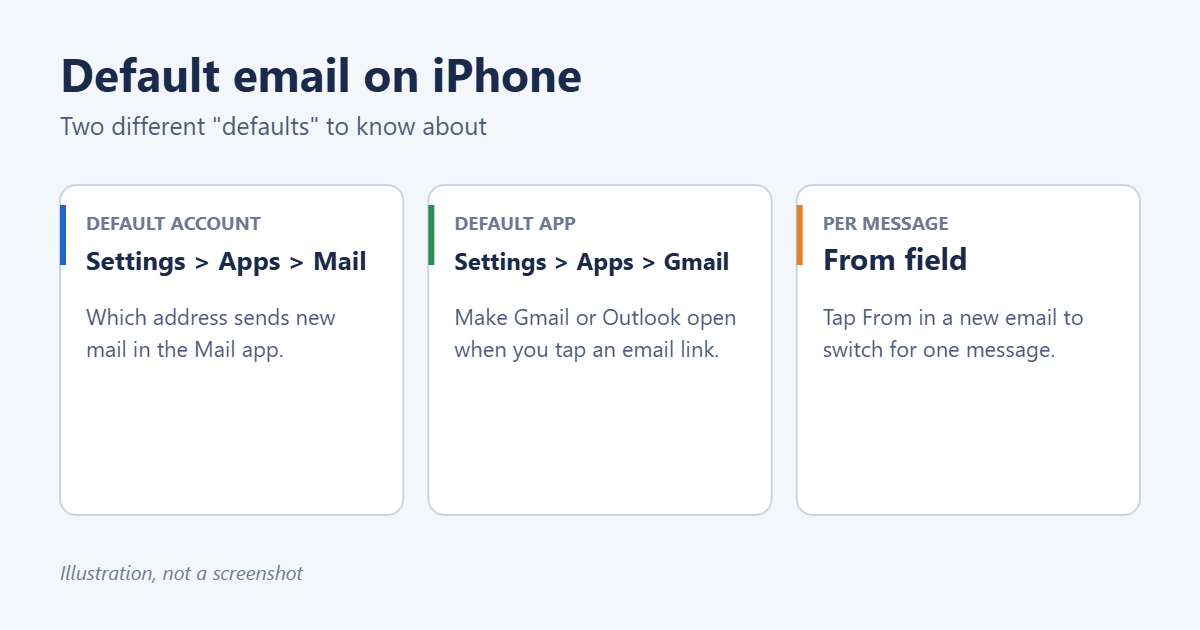
To change the default email account on your iPhone, open Settings > Apps > Mail, scroll down to Default Account, and choose the address you want new emails to come from. On iOS 17 and earlier, it’s Settings > Mail > Default Account. That controls Apple’s Mail app. If you’d rather tapped email links open Gmail or Outlook instead, change your default mail app, which is a separate setting. Both are covered below.
Change the default account in the Mail app
- Open Settings.
- Tap Apps, then Mail. On iOS 17 or earlier, tap Mail directly.
- Scroll to the Composing section and tap Default Account.
- Choose the account you want.
New messages in Mail, and emails you share from other apps such as Photos or Safari, now use that address. The Default Account option only appears when you have more than one email account in Mail.
Change the default email app
When you tap an email address on a website or in Contacts, iPhone opens Apple Mail unless you choose another app.
- Install the app you want, such as Gmail or Outlook, from the App Store and sign in.
- Open Settings > Apps and tap that app.
- Tap Default Mail App and select it.
On some iOS versions this option is under Settings > Apps > Default Apps > Email. Either way, the app must support being a default; Gmail and Outlook both do.
Send from a different address for one email
- Start a new message in Mail.
- Tap the Cc/Bcc, From line to expand it, then tap From.
- Pick the address to send from.
Your default stays the same for future messages.
Add another email account first
If the address you want isn’t listed, add it: go to Settings > Apps > Mail > Mail Accounts > Add Account (or Settings > Mail > Accounts on older iOS) and sign in. For a Microsoft address, see how to set up a Hotmail account on an iPhone.
Turn off an account you don’t use
If an old address keeps showing up, open its account in Mail Accounts and turn off Mail. The account stays on the phone for contacts or calendars, but its email disappears from Mail and from the default account list.
Change the signature for each account
In Settings > Apps > Mail > Signature, choose Per Account to set a different signature for each address, or delete the default “Sent from my iPhone.” For Gmail’s own signature settings, see how to remove your signature in Gmail.
Set default accounts for contacts and calendars too
If you use several accounts, such as iCloud, Gmail, and a work Exchange account, iPhone also lets you choose where new contacts and events are saved:
- Contacts: Settings > Apps > Contacts > Default Account. New contacts are saved to that account, which decides which devices they sync to.
- Calendar: Settings > Apps > Calendar > Default Calendar. New events go to that calendar unless you pick another when creating them.
Matching all three defaults to the same account, for example your personal Gmail, keeps your email, contacts, and calendar in one place and makes switching phones easier.
Troubleshooting
Default Account doesn’t appear
You have only one account in Mail, or only one with Mail turned on. Add or turn on another account.
Emails still send from the old address
If you’re replying, Mail uses the address the original message was sent to. Change it with the From field.
Links still open Apple Mail
Check the default mail app setting again, and update the app you chose from the App Store.
Frequently asked questions
Does this change my Apple ID email?
No. These settings only affect sending email. Your Apple ID is managed separately in Settings > [your name].
Does it work the same on iPad?
Yes, the steps are the same on iPad.
Summary
Go to Settings > Apps > Mail > Default Account to choose which address Mail uses. To have email links open Gmail or Outlook instead, set the Default Mail App in that app’s settings. Use the From field to switch addresses for a single message.
Related: How to Sign Out of the Outlook App on iPhone.

Matt Jacobs has been working as an IT consultant for small businesses since receiving his Master’s degree in 2003. While he still does some consulting work, his primary focus now is on creating technology support content for SupportYourTech.com.
His work can be found on many websites and focuses on topics such as Microsoft Office, Apple devices, Android devices, Photoshop, and more.