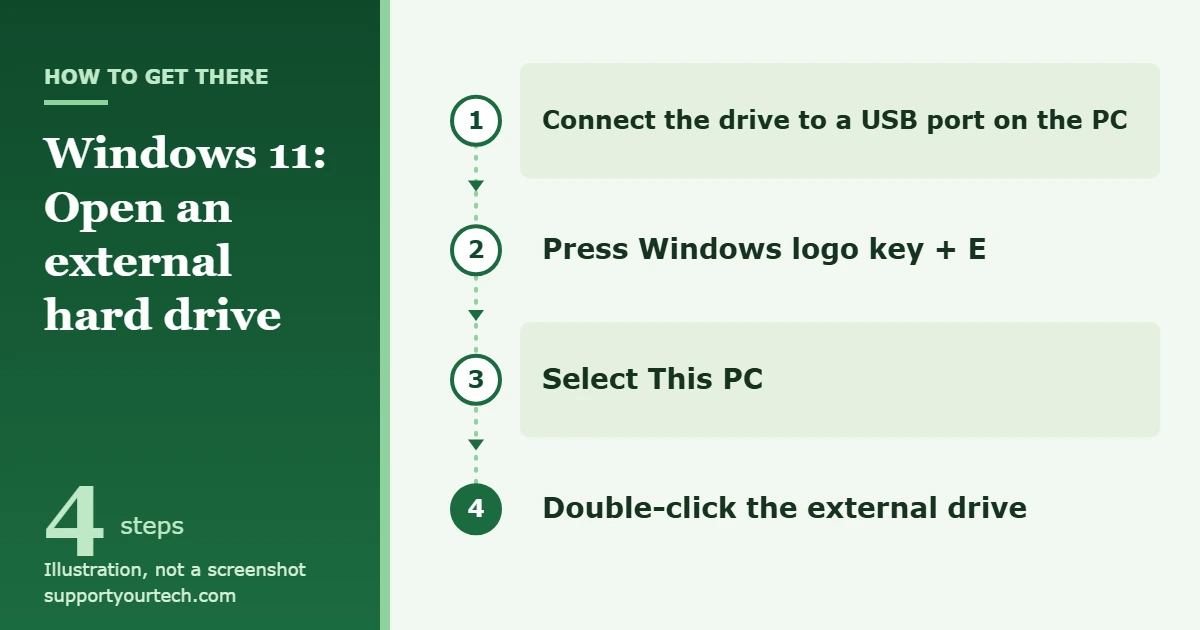
To access an external hard drive on Windows 11, plug it into a USB port on the PC, open File Explorer (press the Windows logo key + E), select This PC in the left pane, and double-click the drive. If the drive is not listed there, right-click Start, open Disk Management, and check whether the drive needs a drive letter, needs to be brought online, or is not being detected at all.
Applies to: Windows 11 (the Disk Management steps are the same in Windows 10). Works for external hard drives, portable SSDs and USB flash drives; for a flash drive on its own, see how to open a flash drive on Windows 11. Checked against Microsoft Support on October 6, 2026.
Before you start
- Connect the drive directly to the PC. Microsoft notes that USB disks sometimes don’t get enough power from certain ports, so skip hubs, docks and extension cables until the drive is working.
- Power on the drive if it has its own power cord. Larger desktop drives usually have a separate power adapter and sometimes a power switch. Portable drives take their power from the USB cable.
- Use an administrator account for the fixes. Opening files needs no special rights, but Disk Management changes require an account in the Administrators (or Backup Operators) group.
- Know whether the drive holds files you need. Several repair options in Windows erase the drive. If the drive has data on it, read the warning section below before you select anything named Format, Initialize or New Simple Volume.
Open the external hard drive in File Explorer
- Connect the drive. Plug the cable into the drive and into a USB port on the computer. Give Windows a few seconds to set it up; a drive with a spinning disk needs a moment to get up to speed.
- Open File Explorer. Select the File Explorer folder icon on the taskbar or in the Start menu, or press the Windows logo key + E. File Explorer opens on its Home page.
- Select This PC. In the left navigation pane, select This PC. The right side of the window now lists every drive Windows can open, each with a name and a letter such as D: or E:.
- Double-click the external drive. It is usually the one carrying the manufacturer’s name or the capacity you expect. The window changes to show the folders and files stored on it.
- Work with your files. Double-click a file to open it. To copy something, right-click it and use the Copy button at the top of the menu, then right-click an empty spot in the destination folder and select Paste. The same menu has Cut, Rename, Share and Delete, and Show more options opens the longer classic menu.
To find a particular file, open the drive first and then use the File Explorer search box. Searching from a drive or folder looks inside that location, while searching from Home looks across the PC.
If the drive is encrypted with BitLocker
A drive protected with BitLocker stays locked when you plug it in. Open it from This PC and Windows asks for the drive’s password or its recovery key before it shows any files. The recovery key is a 48-digit number that was created when BitLocker was turned on for that drive.
If you don’t have the key written down, Microsoft lists these places to look:
- Your Microsoft account, at aka.ms/myrecoverykey, if the key was backed up there.
- Your work or school account, at aka.ms/aadrecoverykey, or your organization’s IT help desk, if the drive was encrypted on a work or school device.
- A printout or a text file on a USB flash drive saved when BitLocker was set up.
There is no way around the key. Microsoft states that its support staff cannot retrieve, provide or recreate a lost BitLocker recovery key, so the only legitimate route into a locked drive is the password or key that belongs to it. Microsoft’s guide to finding your BitLocker recovery key walks through each location.
Do not format or initialize a drive that holds files you need
When Windows cannot read a drive, it may offer to format it, and Disk Management may show it as not initialized. Both actions are meant for empty drives. Microsoft’s documentation is direct about this: formatting a volume destroys the data on it, and initializing a disk erases all data on the disk.
If the drive contains photos, documents or backups you want, stop and work through the non-destructive checks below first: a different port, a different cable, a second computer, and a missing drive letter. If the drive still asks to be formatted after that, the file system is damaged or is one Windows doesn’t read, and the safe choices are to connect it to the kind of computer that last used it or to take it to a data recovery service.
Fix a drive that does not appear in File Explorer
Work through these in order. The first group needs no tools, and it resolves most cases where nothing happens at all when you plug the drive in.
Check the connection first
- Unplug the drive and plug it back in, pushing both ends of the cable in firmly.
- Move it to a different USB port on the PC itself, not on a hub.
- Try a different cable. Microsoft’s troubleshooting guide puts it plainly: cables fail often.
- Shut down the PC, turn off the external drive if it has a power cord, then turn both back on.
- Plug the drive into a different computer. If it doesn’t work there either, the problem is with the drive or its enclosure, not with your PC.
Pay attention to any notification Windows shows as you connect the drive. USB device might need more power means the PC can’t supply enough power to the drive through that port; connect the drive’s own power adapter if it has one, or use another PC. USB device functionality might be limited usually means the drive is on a hub or dock, or on a USB-C port that doesn’t support what the drive needs, so connect it straight to a different port. USB device not recognized means the device reported a problem or there is a driver issue, which the Device Manager steps further down address.
Look for the drive in Disk Management
Disk Management is the Windows utility that shows every disk attached to the computer, including ones File Explorer can’t open yet.
- Right-click Start and select Disk Management. You can also press Windows + R, type diskmgmt.msc and select OK, or search for Create and format hard disk partitions.
- Find the disk whose size matches your external drive. Each disk is listed with its status and the partitions it contains.
- If you just connected the drive and it isn’t listed, select Action > Rescan Disks.
- Read the status shown for the disk and its partition, then use the table below.
| What Disk Management shows | What it means | What to do |
|---|---|---|
| Healthy partition with a file system but no letter | The drive works; Windows just hasn’t given it a drive letter. | Add a drive letter (steps below). Your files are not affected. |
| Disk marked Offline | Windows sees the disk but is not using it. | Right-click the disk label and select Online. |
| Partition listed as RAW | Windows doesn’t find a file system it recognizes (NTFS, ReFS, FAT32 or exFAT). | Only if the drive is empty: right-click the partition and select Format. If it has files you need, don’t format it. |
| Unallocated space, or disk marked Not Initialized | A brand-new drive that was never set up, or a drive whose formatting is corrupted or that has a hardware problem. | New and empty drive: set it up (section below). Drive with data: don’t initialize it; test it on another PC. |
| Disk marked Unreadable | The disk isn’t accessible. It may still be spinning up, or it may have failed. | Rescan the disks or restart the PC, then repeat the connection checks. |
| The drive isn’t listed at all | Windows isn’t detecting the hardware. | Repeat the connection checks, then check Device Manager. |
Leave any small partitions labeled EFI System Partition or Recovery Partition alone. They are supposed to have no drive letter.
Add a missing drive letter
File Explorer only lists a drive that has a letter. This fix changes nothing on the drive itself.
- In Disk Management, right-click the external drive’s partition (the block marked Healthy) and select Change Drive Letter and Paths.
- Select Add. If the drive already has a letter and you want a different one, select Change instead.
- Leave Assign the following drive letter selected, pick a letter from the list, and select OK.
- If a confirmation message appears, select Yes.
Go back to This PC in File Explorer and the drive should now be listed under that letter. If Change Drive Letter and Paths is missing or grayed out, Microsoft gives three possible reasons: the space is unallocated and the disk needs to be initialized, the partition is a protected type such as an EFI System or Recovery partition, or your account doesn’t have administrator permissions. Microsoft’s instructions to change a drive letter cover the same steps.
Check Device Manager
- Right-click Start and select Device Manager.
- Look through the list for any device marked with an exclamation point.
- Right-click that device and select Uninstall device.
- Select Action > Scan for hardware changes. Windows detects the drive again and reinstalls its driver.
You can also right-click the device, select Update driver and let Windows search for a newer driver automatically. Installing pending updates from Start > Settings > Windows Update is worth doing at the same time.
Set up a brand-new, empty drive
Most external drives, such as a WD My Passport portable drive, are ready to use out of the box. A bare drive that you placed in an enclosure yourself, or one that shows as Not Initialized with unallocated space, has to be prepared once before Windows can store files on it. These steps erase the disk, so use them only on a drive with nothing on it that you need.
- In Disk Management, right-click the disk label and select Initialize Disk. If the disk is Offline, right-click it and select Online first.
- In the Initialize Disk dialog, confirm the correct disk is checked and select OK. The default partition style, GUID Partition Table (GPT), is the right choice for most drives and allows volumes larger than 2 TB. Master Boot Record (MBR) is the older style used by 32-bit and older computers.
- Right-click the Unallocated space and select New Simple Volume, then select Next.
- Accept the volume size, choose a drive letter, and choose a file system, selecting Next after each screen.
- Select Finish. The drive appears in This PC under the letter you chose.
For the file system, NTFS is the usual choice for a drive used only with Windows PCs. FAT32 cannot store a single file larger than 4 GB, which rules it out for large videos and backup images. If the drive will also be used with a Mac, Apple lists exFAT as the Windows-compatible format for volumes over 32 GB. Microsoft’s page on how to initialize new disks has the full procedure.
If the drive opens but files or folders won’t
- Errors when opening or copying files. Windows includes a checker for file system problems. Open Command Prompt as an administrator and run chkdsk e: (replace e with your drive’s letter). Run this way, with no extra options, it only reports the status of the volume and changes nothing. chkdsk e: /f fixes the errors it finds. Copy off anything important you can still open before running the fix, and let the check finish rather than interrupting it.
- A message that you don’t have permission to open a folder. Folders created under a different user account or on another PC can be restricted to that account. Sign in with an administrator account on your PC and try again.
- A work or school PC that ignores every external drive. Organizations can block removable storage on the computers they manage. If the drive works on a home PC but not on a managed one, contact your IT department; there is no setting for you to change.
- The drive keeps disconnecting, clicks, or drops out of Disk Management. These point to a failing drive, cable or enclosure. Use it as little as possible, copy your most important files first if it stays connected long enough, and don’t keep running repair or initialize commands on it. If a drive that is otherwise quiet and healthy only disconnects after sitting idle, check the USB power settings in Windows 11 instead.
How to confirm it worked, and how to disconnect safely
You are done when the drive appears in This PC with a drive letter, double-clicking it shows your folders, and a file opens normally.
When you finish, eject the drive before unplugging it. Select Show hidden icons on the taskbar, right-click the Safely Remove Hardware and Eject Media icon, and select Eject for your drive. Unplug it when the Safe To Remove Hardware notification appears. If you can’t find the icon, our guide on how to safely eject an external hard drive in Windows 11 shows how to turn it back on and what to do when a drive refuses to eject.
A drive letter you assigned can be changed again at any time from the same Change Drive Letter and Paths dialog by selecting Change. Formatting and initializing cannot be undone.
Frequently asked questions
Why does my external hard drive light up but not show in File Explorer?
A light only tells you the drive has power. If it is missing from This PC, open Disk Management. A drive that appears there as Healthy without a letter just needs a drive letter added. A drive that isn’t in Disk Management at all is a connection, power or hardware problem, so change the port and cable and test it on another computer.
Windows says I need to format the disk before I can use it. Should I?
Only if the drive is empty or you don’t need anything on it. Formatting destroys the data on the volume. If the drive holds files you want, cancel the message, try the drive on another computer, and check its status in Disk Management instead.
Can Windows 11 read an external drive that was used with a Mac?
It depends on how the drive was formatted. Apple identifies exFAT and MS-DOS (FAT) as its Windows-compatible formats, and Windows opens those normally. A drive formatted with APFS, the file system macOS uses for its own disks, is not one of the file systems Windows recognizes, so Windows may offer to format it. Don’t accept if you need the files; copy them off using a Mac first.
Do I need to install software or drivers to use an external hard drive?
Normally, no. Windows 11 recognizes a standard USB storage drive automatically when you connect it, and File Explorer is all you need to open it. If Device Manager shows a problem with the drive, reinstalling or updating its driver there is the fix.
Can I choose which letter the drive uses?
Yes. Right-click the drive’s partition in Disk Management, select Change Drive Letter and Paths, then Change, and pick the letter you want. Don’t change the letter of the drive that contains Windows or your apps.
Once the drive is opening reliably, a good next step is to put it to work: see how to back up Windows 11 to an external hard drive.

Matt Jacobs has been working as an IT consultant for small businesses since receiving his Master’s degree in 2003. While he still does some consulting work, his primary focus now is on creating technology support content for SupportYourTech.com.
His work can be found on many websites and focuses on topics such as Microsoft Office, Apple devices, Android devices, Photoshop, and more.