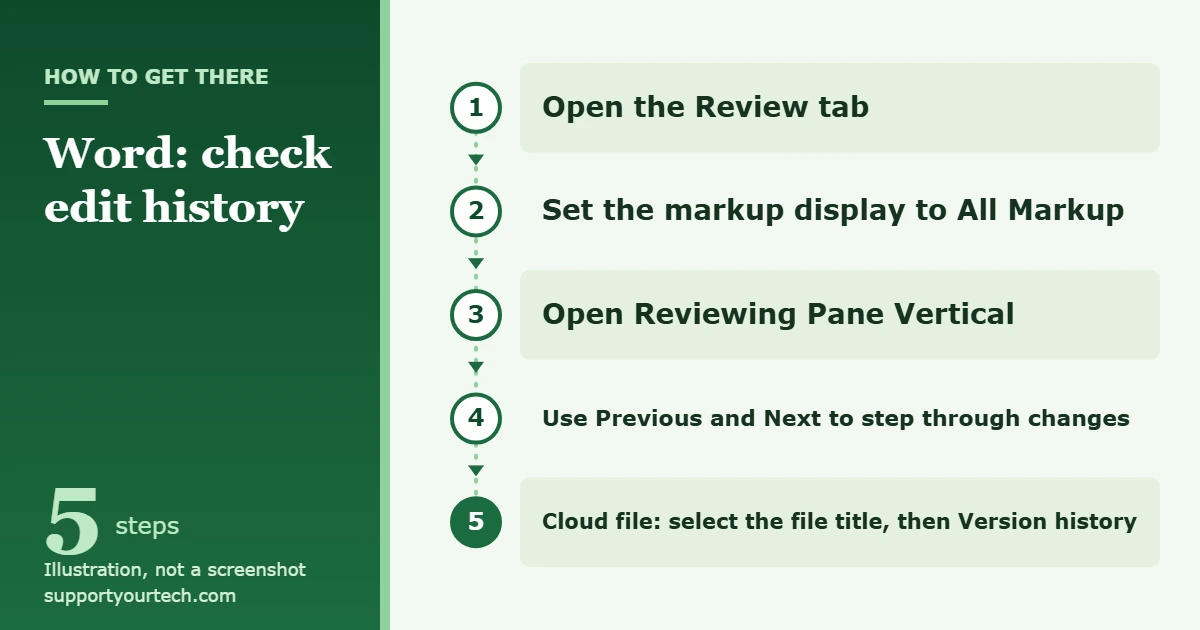
To check edit history in Word, open the Review tab, set the markup display to All Markup, and open the Reviewing Pane to read every tracked change with the name of the person who made it. If the document is saved in OneDrive or SharePoint, you can also select the file title at the top of the window and choose Version history to open earlier saved copies.
Applies to: Word for Microsoft 365 on Windows and Word for the web. Checked against Microsoft Support on October 7, 2026.
Which kind of edit history does your document have?
Word does not keep one single log of everything that ever happened to a file. It has three separate tools, and each one answers a different question. Picking the right one first saves a lot of clicking.
| What you want to know | Tool to use | What it needs |
|---|---|---|
| Which words were added, deleted or reformatted, and by whom | Tracked changes on the Review tab | Track Changes had to be turned on while the edits were made |
| What the whole document looked like at an earlier time | Version history | The file must be stored in OneDrive or SharePoint in Microsoft 365 |
| What is different between two separate files | Compare on the Review tab | Two copies of the document, such as an old draft and the current one |
A tracked change is a visible mark that Word leaves in the text: a deletion is shown with strikethrough and an addition is shown with an underline. A version is a full saved copy of the file from an earlier point. Tracked changes travel inside the document, while versions are kept by the cloud storage location and not inside the file.
Check tracked changes in Word on Windows
Use this method when other people have edited the document with Track Changes turned on, or when you are not sure and want to find out. These steps only display what is already recorded; they do not change the text.
- Open the document in Word. You should see the normal ribbon of tabs across the top of the window.
- Select the Review tab. Look for the Tracking group, which holds the Track Changes button and the markup options.
- Open the markup display list in the Tracking group and choose All Markup. Every recorded edit now appears in the text, with a different color for each reviewer. If the list was set to Simple Markup, you would only have seen a red line in the margin next to changed lines.
- Select Show Markup and make sure Insertions and Deletions and Formatting are both turned on. If either one is turned off, that type of edit stays hidden even in All Markup.
- Select Reviewing Pane on the Review tab, then choose Reviewing Pane Vertical to list the changes beside the document or Reviewing Pane Horizontal to list them below it. The top of the pane shows a summary with the number of tracked changes that remain.
- Select Next or Previous on the Review tab to jump from one tracked change to the next. Word selects each change in turn so you can read it in context.
If the Reviewing Pane is empty and no marks appear after step 4, the document has no tracked changes. Track Changes only records edits made while it is turned on, so it cannot show you edits from before that point. In that case, move on to version history or the Compare tool below.
See the changes from one person only
In a document that several people have edited, the marks can be hard to read. On the Review tab, select Show Markup, point to Specific People, and leave only the reviewers you want selected. Word then shows the edits from those reviewers and hides the rest. Nothing is removed; turn the other names back on to see everything again.
Change how the marks are displayed
The same Show Markup menu lets you choose where revisions appear. Show Revisions in Balloons moves them into the margin, Show All Revisions Inline keeps them inside the text, and Show Only Formatting in Balloons puts only formatting changes in the margin. These are display choices, so try each one and keep whichever is easiest to read on your screen.
Compare the edited text with the original
The markup display list has four settings, and switching between them is a quick way to understand what an edit did:
- Simple Markup shows a red line in the margin wherever a line has a tracked change.
- All Markup shows every edit in the text, in a different color for each reviewer.
- No Markup hides the marks and shows how the document would read with the changes included.
- Original shows the document as it was before the tracked changes.
Flipping between Original and No Markup gives you a before-and-after view of the same page. Remember that No Markup only hides the marks. The tracked changes are still in the file, and anyone who opens it can switch back to All Markup and read them.
For a walk-through of recording edits in the first place, see our guide on how to do track changes in Word.
Check tracked changes in Word for the web
Word for the web, the version you use in a browser, has the same review tools under slightly simpler menus. Use these steps when you open the document from OneDrive or SharePoint in a browser.
- Open the document in Word for the web and select the Review tab.
- Open the markup display options and choose All Markup. The tracked edits appear in the text.
- Select a marked change. A card appears that shows the name of the person who made it, along with buttons to accept or reject it.
- Select Next or Previous to move through the remaining changes one at a time.
You can read the card without choosing either button. Accepting or rejecting changes the document for everyone who has access to it, so leave those buttons alone if you only want to look.
Version history shows earlier saved copies of the whole file. It works even when Track Changes was never turned on, but only for files stored in OneDrive or SharePoint in Microsoft 365. A document that has only ever been saved on your computer’s own drive does not have this history.
- Open the file in Word for Microsoft 365 on Windows.
- Select the title of the file at the top of the Word window, then select Version history. A list of earlier versions opens.
- Select a version in the list. Word opens that version in a separate window, so your current document stays as it is.
- Read through the older version. If you only need a lost paragraph, copy it from the older version and paste it into your current document.
- If you want the whole document to go back to that version, select Restore in the window showing the older version.
Before you select Restore, be sure the older version is the one you want, because it becomes the current document for you and for everyone who shares the file. Copying the part you need is the lower-risk choice when only a section went missing.
Microsoft’s page on viewing previous versions of Office files has separate tabs for other Office versions, Mac and the web if your screen looks different.
Open version history from OneDrive instead of Word
You can reach the same versions without opening the document first, which helps when the file will not open or you are on a computer without Word.
- Sign in to the OneDrive website with the Microsoft account or the work or school account that has the file.
- Right-click the file and select Version history. The Version History pane lists the saved versions.
- Select the ellipsis (…) next to the version you want, then select Restore. That version becomes the current file, and the version it replaced moves into the history list.
If the OneDrive sync app is installed on your Windows PC, the same option is in File Explorer: right-click the synced file and select Version history. OneDrive restores one file at a time. The steps are on Microsoft’s page about restoring a previous version of a file stored in OneDrive.
Compare two copies when nothing was tracked
If Track Changes was off and the file was never in the cloud, you can still see what changed as long as you have two copies of the document, such as an emailed draft and the current file. Word’s Compare tool builds the edit marks for you. Microsoft calls this option legal blackline.
- Open both documents in Word on Windows.
- On the Review tab, select Compare in the Compare group.
- Select Compare two versions of a document (legal blackline). A dialog box opens.
- Under Original document, choose the older file.
- Under Revised document, choose the newer file.
- Under Show changes, choose whether Word should mark differences at the character level or the word level. Word level is usually easier to read.
- Select OK. Word creates a new, third document in which the differences between the two files appear as tracked changes.
Neither of your two source files is altered. You can review the new document with the Reviewing Pane and the Next and Previous buttons exactly as described above. Keep in mind what this result means: it shows what is different between the two files, not when each edit happened or who typed it. Microsoft documents the option in Compare document differences using the legal blackline option.
Finish the review: accept, reject, or keep the marks
Looking at edit history does not change anything. When you are ready to act on what you found, the Accept and Reject buttons on the Review tab settle each change.
- Accept and Move to Next keeps the selected edit and jumps to the following one, which suits a careful pass through the document.
- Accept This Change keeps the selected edit and stays where you are.
- Accept All Changes Shown keeps only the edits currently displayed. Combined with the Specific People filter, this accepts one reviewer’s edits and leaves the others.
- Accept All Changes keeps every tracked edit in the document.
- Accept All Changes and Stop Tracking keeps every edit and turns Track Changes off.
The Reject button has a matching set of options that discard edits instead. You can also right-click a tracked change in the text and accept or reject it from the menu that appears. Once a change is accepted or rejected, its mark is gone from the document, so finish reading the history before you use the “all” options.
To print a clean copy while the marks are still in the file, go to File > Print, open Print All Pages under Settings, and clear Print Markup.
Start recording edits from now on
If today’s search came up empty, set the document up so the next round of edits is recorded.
- Turn on Track Changes. On the Review tab, select Track Changes in the Tracking group, or press Ctrl+Shift+E. The button is highlighted while tracking is on.
- Choose whose edits are tracked. From the Track Changes menu, For Everyone records edits from every person who works on the document, and Just Mine records only your own.
- Stop others from turning it off. Lock Tracking on the same menu lets you set a password that is required before Track Changes can be turned off.
- Keep an indicator in view. Right-click the status bar at the bottom of the Word window and select Track Changes to show whether tracking is on at a glance.
- Save the file to OneDrive or SharePoint. Version history is only kept for files stored there.
Troubleshooting missing edit history
Version history does not appear when you select the file title
The file is most likely saved on the computer itself or on a network drive and not in OneDrive or SharePoint in Microsoft 365. Save it to one of those locations and versions are kept from that point on. Moving the file does not create versions for the past.
The version list is shorter than you expected
Microsoft states that with a personal Microsoft account you can retrieve the last 25 versions. With a work or school account, the number depends on how the library is configured, and an administrator can turn document versioning off. Ask your IT department if a version you need is not listed.
The Reviewing Pane is empty
Check the display first: set the markup list to All Markup, then open Show Markup and confirm that Insertions and Deletions and Formatting are turned on and that every name under Specific People is selected. If the pane is still empty, the document holds no tracked changes. They were either never recorded or have already been accepted or rejected.
You only see a red line in the margin
The display is set to Simple Markup. Switch it to All Markup to see the actual insertions and deletions.
You cannot turn Track Changes off
Someone has used Lock Tracking, which protects the setting with a password. You can still read all of the tracked changes; you need the password from the person who set it only if you want to turn tracking off.
The document was closed without saving
That is a recovery problem and not an edit-history one. Our guide on recovering unsaved or deleted Word documents in Windows 10 covers the steps for that situation.
Tracked changes and comments can reveal names, deleted wording and earlier drafts to anyone who receives the file. Hiding the marks with No Markup is not enough. To send a clean document:
- Save a copy of the document and work on the copy. Microsoft recommends this because data removed by the Document Inspector cannot always be restored.
- On the Review tab, accept or reject the remaining tracked changes so that none are left.
- Go to File > Info > Check for Issues > Inspect Document. The Document Inspector dialog box opens.
- Leave the check boxes selected for the kinds of content you want to look for, then select Inspect.
- Review the results and select Remove All next to each type of content you want deleted, such as comments, revision marks from tracked changes, document version information, and document properties like the author name.
Microsoft lists everything the tool can find on its page about removing hidden data and personal information by inspecting documents.
Frequently asked questions
Can I see edit history if Track Changes was never turned on?
Not as tracked changes. Your options are version history, if the file is stored in OneDrive or SharePoint, or the Compare tool, if you have an older copy of the document to compare against. A file that was only saved on your computer, with no tracking and no older copy, does not contain a record of its past edits.
Can I see who made each change?
Yes, for tracked changes. Word shows each reviewer’s edits in a different color, the Reviewing Pane lists the changes, and in Word for the web selecting a change opens a card with the person’s name. The Compare tool cannot tell you this, because it only measures the difference between two files.
Does checking the edit history change the document?
No. Switching the markup display, opening the Reviewing Pane and opening an older version in its separate window are all view-only actions. The document changes only when you accept or reject a tracked change or select Restore on an older version.
Does No Markup delete the tracked changes?
No. No Markup hides the marks on your screen so you can read the document as it would look with the changes included. The changes stay in the file until they are accepted or rejected.
Does restoring an older version erase my newer work?
When you restore from the OneDrive Version History pane, Microsoft notes that the version you replaced moves into the history list, so it can be restored again in the same way. Opening an older version just to read or copy from it never affects the current document.
Is there a keyboard shortcut for Track Changes?
On Windows, Ctrl+Shift+E turns change tracking on or off. The full list of review commands is in Microsoft’s guide to Track Changes in Word.
Start with the Review tab and All Markup, since that takes only a few seconds. If nothing is recorded there, check Version history, and turn on Track Changes before the next round of edits so the history is there when you need it.

Matt Jacobs has been working as an IT consultant for small businesses since receiving his Master’s degree in 2003. While he still does some consulting work, his primary focus now is on creating technology support content for SupportYourTech.com.
His work can be found on many websites and focuses on topics such as Microsoft Office, Apple devices, Android devices, Photoshop, and more.