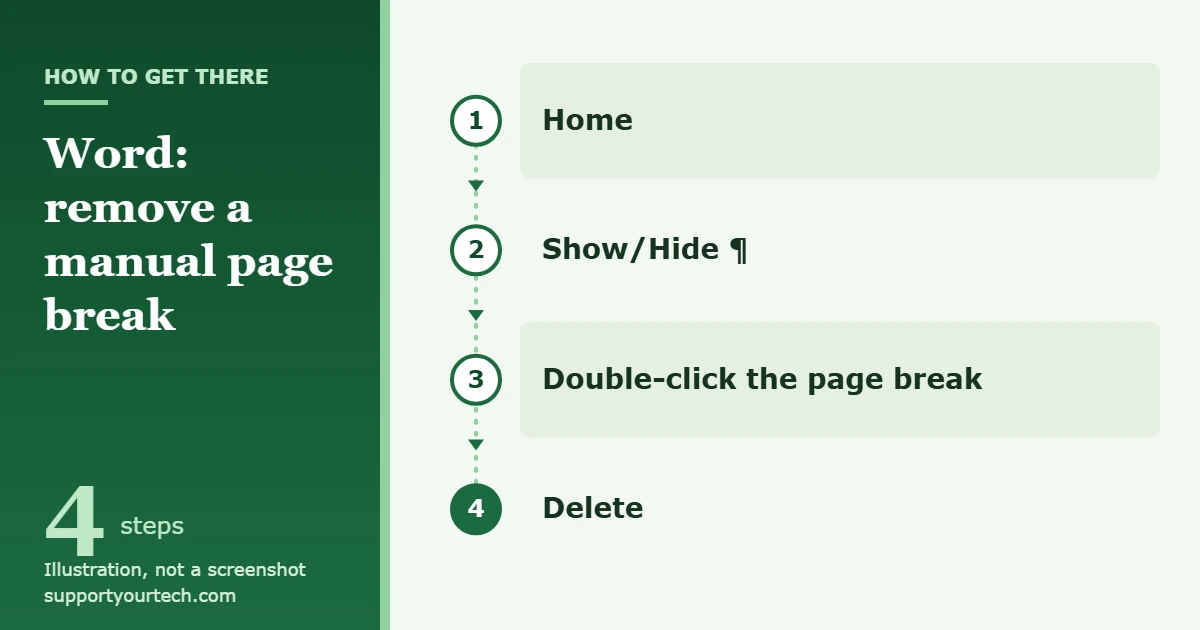
To get rid of a page break in Word, go to Home and select Show/Hide ¶, double-click the page break to select it, and press Delete. That works for manual page breaks, which are the ones a person inserted. Word’s automatic page breaks cannot be deleted, but you can change where they fall.
Applies to: Word for Microsoft 365, Word 2024, Word 2021, Word 2019 and Word 2016 on Windows, with a separate section for Word for Mac. Checked against Microsoft Support on October 6, 2026.
Before you start: which kind of break do you have?
Microsoft describes two types of page breaks in Word, and only one of them can be removed.
- Manual page break: a break someone added on purpose, for example with Insert > Page Break or the Ctrl+Enter shortcut. It appears as a marked line in the document once formatting marks are turned on, and it can be deleted.
- Automatic page break: the break Word adds by itself when a page is full. There is nothing to select or delete. You can only adjust where it occurs by changing paragraph settings.
A third thing often gets mistaken for a page break: a section break. It also pushes text to a new page in many documents, but it carries formatting for the section, so it needs more care. It has its own section below.
Deleting a page break does not delete any of your text. It only removes the instruction to start a new page, so the text that followed the break moves up to fill the available space. If you want to remove whole pages of text instead, see how to delete multiple pages in Word.
Remove a manual page break in Word for Windows
- Open the document and select the Home tab.
- Select Show/Hide ¶. Word now displays paragraph marks and other normally hidden formatting marks, including page breaks. You can also press Ctrl+Shift+8 to switch these marks on and off.
- Scroll to the place where the unwanted new page begins and look just above it, at the end of the previous page, for the page break.
- Double-click the page break to select it.
- Press Delete. The break disappears and the text below it moves up onto the previous page if there is room.
- Select Show/Hide ¶ again to hide the formatting marks.
If the wrong thing was removed, press Ctrl+Z right away to undo it.
Remove a manual page break in Word for Mac
- Open the document and press ⌘+8 to show paragraph marks.
- Find the page break at the point where the new page starts.
- Select the page break and press Delete.
- Press ⌘+8 again to hide the marks.
The same view also shows empty paragraphs. If a run of empty paragraph marks is what pushes your text down, select those marks and delete them the same way.
Remove every manual page break at once
In a long document, deleting breaks one by one is slow. Word’s Replace feature can find the special item that represents a manual page break and replace it with nothing. This removes all manual page breaks, including ones you may want to keep before chapters or headings, so save a copy of the document first.
- On the Home tab, go to Editing > Replace, or press Ctrl+H. The Replace dialog box opens.
- Click inside the Find what box.
- Select More to expand the dialog box, then select Special and choose Manual Page Break. Word enters the code ^m in the Find what box. You can also type ^m yourself.
- Leave the Replace with box empty.
- Select Replace All to remove every manual page break. To review them one at a time instead, select Find Next and then Replace only for the breaks you want gone.
This search only finds manual page breaks. It cannot find the automatic page breaks that Word creates, and it does not remove section breaks.
If there is no page break to delete
Sometimes text jumps to a new page and no page break shows up, even with formatting marks on. In that case a paragraph setting is usually responsible. One clue from Microsoft: when formatting marks are showing, a small square bullet next to a paragraph can mean that the Page break before option is turned on for it.
- Select the paragraph that starts on the new page. If several paragraphs behave this way, select all of them.
- Go to Layout (called Page Layout in some versions) and select the Paragraph dialog box launcher, the small arrow in the corner of the Paragraph group. The same launcher is on the Home tab.
- Select the Line and Page Breaks tab.
- Under Pagination, review the four options described in the table below and clear the ones you do not need.
- Select OK. The text reflows right away.
| Option | What it does | When to clear it |
|---|---|---|
| Page break before | Adds a page break before the paragraph | The paragraph always starts a new page and you do not want it to |
| Keep with next | Prevents a break between this paragraph and the one after it | A group of paragraphs moves to the next page together and leaves a gap |
| Keep lines together | Prevents a page break in the middle of the paragraph | A long paragraph jumps to the next page instead of splitting |
| Widow/Orphan control | Keeps at least two lines of a paragraph at the top or bottom of a page | Rarely; it is on by default and only moves a line or two |
These same settings are how you adjust an automatic page break. If Word splits a page in an awkward spot, turning on Keep with next or Keep lines together for the affected paragraphs moves the break without adding a manual one. Microsoft documents the options on its Line and Page Breaks settings page.
If the break is a section break
A section break can be deleted in much the same way, but read this before you do it. When you delete a section break, Word combines the text before and after it into one section, and the combined section uses the formatting of the section that followed the break. Margins, columns, orientation, headers and footers in the earlier part can change as a result.
- Select Home > Show/Hide ¶ so section breaks are visible.
- Place your cursor just before the section break.
- Press Delete, then check the pages before the break for layout changes. Press Ctrl+Z if the result is not what you wanted.
If your goal is only to make headers or footers match the previous section, Microsoft suggests using Link to previous instead of removing the break. For more detail, see our guide on how to get rid of a section break in Word.
Confirm it worked, or put the break back
With formatting marks still showing, check that the page break is gone and that the text now continues on the previous page. Scroll through the pages that follow as well, because everything after the deleted break shifts up.
To undo the change, press Ctrl+Z. To add a break back later, place your cursor where the new page should begin and go to Insert > Page Break, or press Ctrl+Enter (Cmd+Return on a Mac).
Troubleshooting
- You cannot see any page break. Formatting marks are probably off. Select Home > Show/Hide ¶ or press Ctrl+Shift+8. If still nothing appears, the break is automatic or comes from a paragraph setting, so follow the Paragraph dialog box steps above.
- The text still starts on a new page after you delete the break. Check the first paragraph on that page for Page break before, and the paragraphs above it for Keep with next.
- A blank page remains at the end of the document. Word always keeps one final paragraph that cannot be deleted, and it can be pushed onto a page of its own. Microsoft’s fix is to select that last paragraph mark, select inside the Font size box, type 01 and press Enter so the paragraph fits on the preceding page. Our article on deleting a blank page in Word that won’t go away covers the other causes.
- Headers, margins or columns changed after you pressed Delete. You removed a section break, not a page break. Press Ctrl+Z to restore it.
- Replace All removed breaks you wanted. Press Ctrl+Z to reverse the replacement, then use Find Next and Replace to go through the breaks individually.
Frequently asked questions
Can I remove an automatic page break in Word?
No. Microsoft states that automatic page breaks cannot be removed. You can only adjust where they occur by using the options on the Line and Page Breaks tab of the Paragraph dialog box, or by changing how much content fits on the page.
Will deleting a page break delete my text?
No. Only the break is removed. The text after it moves up to join the text before it.
Why can’t I see the page break I want to delete?
Page breaks are hidden until formatting marks are turned on. Select Home > Show/Hide ¶, or press Ctrl+Shift+8 on Windows or ⌘+8 on a Mac.
How do I delete all page breaks in a Word document?
Open Replace with Ctrl+H, put ^m in Find what, leave Replace with empty and select Replace All. This removes manual page breaks only.
What is the difference between a page break and a section break?
A page break only starts a new page. A section break divides the document into parts that can each have their own layout and formatting, such as columns or headers and footers, so deleting one can change how the surrounding pages look.
How do I delete a whole page instead of just the break?
Microsoft’s method on Windows is to click anywhere in the page, press Ctrl+G, type \page in the Enter page number box, press Enter, select Close, and then press Delete once you have confirmed the page’s content is selected.
Microsoft’s own instructions are on its Remove a page break in Word page. Once the unwanted breaks are gone, turn formatting marks off and scroll through the document once to make sure each chapter or heading still starts where you expect.
Related: how to copy a page from one Word document to another.
Related: remove all page breaks in Excel.
Related: delete a page in Word.
Related: insert a page break in Word.

Matt Jacobs has been working as an IT consultant for small businesses since receiving his Master’s degree in 2003. While he still does some consulting work, his primary focus now is on creating technology support content for SupportYourTech.com.
His work can be found on many websites and focuses on topics such as Microsoft Office, Apple devices, Android devices, Photoshop, and more.