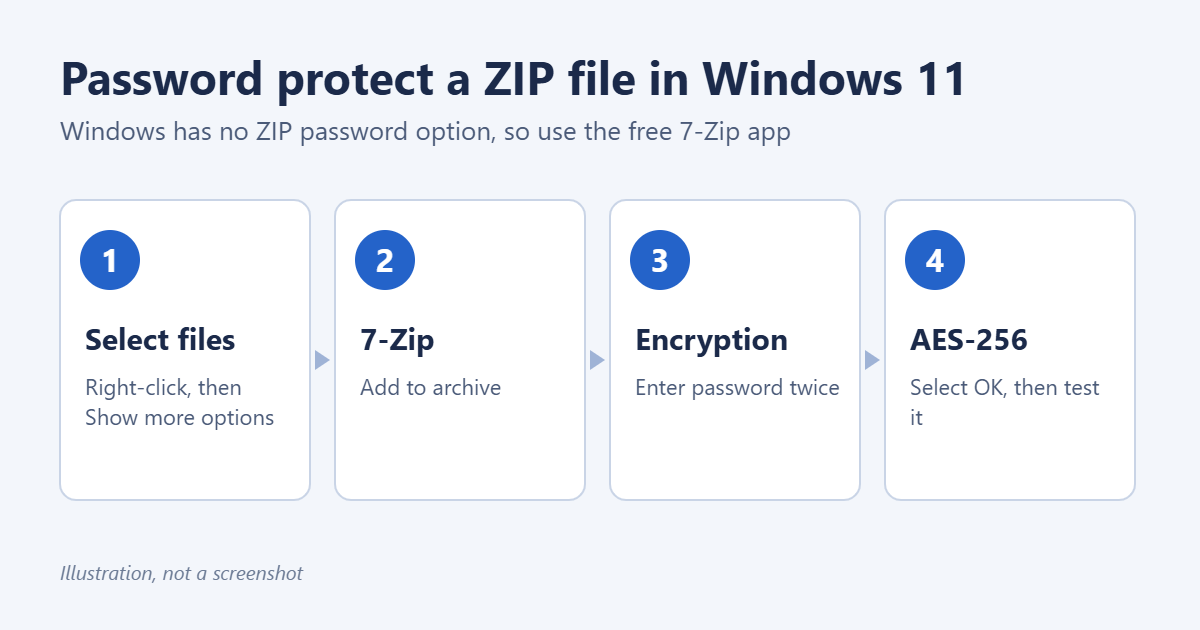
Windows 11 can make ZIP files on its own, but it can’t put a password on them. The built-in Compress to option in File Explorer has no password or encryption setting. To password protect a ZIP file on Windows 11, install the free 7-Zip app, right-click your files, choose 7-Zip > Add to archive, type a password, and set the encryption method to AES-256. Anyone who opens the ZIP will then need that password to see or extract the files inside.
Applies to: Windows 11 Home and Pro, version 24H2 and later (the 7-Zip steps also work in Windows 10). Last reviewed October 7, 2026.
Can Windows 11 password protect a ZIP file by itself?
No. File Explorer can create ZIP archives, and since version 24H2 it can also create 7z and TAR archives through Compress to > Additional options. None of these options include a password. Microsoft’s support moderators give the same answer in the Microsoft Q&A thread on this question: the password feature people remember came from a third-party app, not from Windows.
You may see an Encrypt contents to secure data checkbox in a ZIP file’s properties. That is the Encrypting File System (EFS), and it is not a ZIP password. It’s covered later in this guide, along with why it usually isn’t what you want.
So you have two practical choices:
- 7-Zip (recommended): free, open source, and it creates standard ZIP files with AES-256 encryption that other apps can open.
- WinRAR: a paid app with a free trial. It can also create password-protected ZIP files.
Before you start
- Pick a strong password. Use at least 12 characters, or a passphrase of four or five unrelated words. ZIP passwords can be guessed offline by software that tries millions of combinations, so length matters more than symbols.
- Store the password somewhere safe. There is no reset or recovery. If you forget it, the files are gone.
- Keep the originals until you’ve tested the ZIP. Open the new archive with the password once before you delete anything.
Password protect a ZIP file with 7-Zip
Step 1: Install 7-Zip
- Go to the official 7-Zip website. Download from 7-zip.org only. Look-alike download sites often bundle unwanted software.
- Choose the 64-bit Windows x64 download. Almost every Windows 11 PC is 64-bit. If yours uses an ARM processor, such as a Snapdragon laptop, pick the ARM64 version instead.
- Open the downloaded file, select Yes if User Account Control asks for permission, and then select Install.
Step 2: Open the Add to Archive window
- In File Explorer, select the files or folder you want to protect. To select several files, hold Ctrl while you click them.
- Right-click the selection and choose Show more options. You can also press Shift + F10. 7-Zip appears in this classic menu rather than in the shorter Windows 11 menu.
- Point to 7-Zip and select Add to archive.
Step 3: Choose the format and the password
- Set Archive format to zip. Choose 7z instead if you also want to hide the file names (see the next section).
- Under Encryption, type your password in Enter password and again in Reenter password. Select Show Password if you want to check what you typed.
- Set Encryption method to AES-256. The other choice, ZipCrypto, is an old method that can be broken with free tools.
- Optionally, change the name in the Archive box at the top. The ZIP is saved in the same folder as your files.
- Select OK.
7-Zip creates the new ZIP file next to your originals. Your original files are not changed or deleted.
Step 4: Test the password
- Right-click the new ZIP file and choose Show more options > 7-Zip > Open archive.
- Double-click a file inside. 7-Zip asks for the password.
- Enter it. If the file opens, the archive works.
Once you’ve confirmed it works, you can delete the unprotected originals. Empty the Recycle Bin afterward, because deleted files stay there until you do.
ZIP or 7z: which one should you use?
A password-protected ZIP still shows the names of the files inside. Anyone can open it and see a list such as tax-return-2025.pdf, even though they can’t open the files. The 7z format can hide the file names as well.
- Use ZIP when you’re sending the file to someone else. Most people can open ZIP files with any archive app.
- Use 7z when the file names themselves are sensitive or the archive is only for you. In the Add to archive window, choose 7z as the format, enter the password, and select Encrypt file names. Windows 11 version 24H2 and later can open 7z files, but the recipient may need 7-Zip to enter the password.
AES-256 vs. ZipCrypto
7-Zip offers two encryption methods for ZIP files.
- AES-256 is modern, strong encryption. With a long password, it can’t realistically be broken. Use it for anything sensitive.
- ZipCrypto is the original ZIP encryption from the 1990s. Known attacks can recover the contents, sometimes without guessing the password at all. It only keeps out casual snooping.
The trade-off is compatibility. Every archive app can open ZipCrypto files, but some older tools can’t open AES-256 ones. If the person you’re sending the file to can’t open it, have them install 7-Zip rather than switching to ZipCrypto.
Password protect a ZIP file with WinRAR
If you already use WinRAR, you can make a password-protected ZIP without installing anything else.
- Select your files, right-click, and choose WinRAR > Add to archive. In older versions, look under Show more options.
- Under Archive format, select ZIP.
- Select Set password.
- Enter the password twice, then select OK.
- Select OK again to create the archive.
WinRAR is trialware. It keeps working after the 40-day trial but shows a reminder to buy a license. For an occasional password-protected ZIP, 7-Zip does the same job for free.
What about “Encrypt contents to secure data”?
If you right-click a ZIP file, choose Properties > Advanced, you’ll see Encrypt contents to secure data. This turns on the Encrypting File System, and it works differently from a ZIP password:
- It doesn’t ask for a password. The file is locked to your Windows user account instead.
- When you’re signed in, the file opens normally, so it doesn’t protect anything from someone using your account.
- If you email the file or copy it to a USB drive formatted as FAT32 or exFAT, the encryption is removed.
- It’s only available in Windows 11 Pro, Enterprise and Education. On Windows 11 Home the checkbox is grayed out.
EFS is useful for protecting files from other user accounts on a shared PC. For a ZIP you plan to send, store in the cloud or keep on a USB drive, use a 7-Zip password instead.
How to open a password-protected ZIP file
- Double-click the ZIP file, or right-click it and choose Show more options > 7-Zip > Extract files.
- Enter the password when asked.
- Choose where to save the extracted files and select OK.
File Explorer can sometimes list the contents of an encrypted ZIP, but it may fail to extract files protected with AES-256. If that happens, use 7-Zip.
Tips for sharing a password-protected ZIP
- Send the password separately. If you email the ZIP, share the password by text message or phone call. Sending both in the same email defeats the purpose.
- Check attachment limits. Many email services reject encrypted archives because they can’t scan them for viruses, and most cap attachments at about 20 to 25 MB. A cloud storage link is often easier for large or blocked files.
- Use a new password for each recipient if the files are sensitive, so one leaked password doesn’t expose everything.
Other ways to protect files on Windows 11
A password-protected ZIP is the most portable option, but it isn’t the only one. Depending on what you’re protecting, one of these may fit better:
- Office documents: Word, Excel and PowerPoint can encrypt a single file. Open it and select File > Info > Protect Document > Encrypt with Password. See how to password protect a Word document.
- OneDrive Personal Vault: a protected folder in OneDrive that needs a second identity check to open and locks itself after 20 minutes of inactivity. Free OneDrive plans can store up to three files in it.
- BitLocker To Go: encrypts a whole USB drive with a password. Turning it on requires Windows 11 Pro, Enterprise or Education, but a Windows 11 Home PC can unlock the drive.
Troubleshooting
7-Zip isn’t in the right-click menu
In Windows 11, 7-Zip only appears in the classic menu. Right-click, then choose Show more options or press Shift + F10. If it’s still missing, open 7-Zip File Manager from the Start menu, select Tools > Options > 7-Zip, and make sure Integrate 7-Zip to shell context menu is selected. If that option won’t stay on, reinstall 7-Zip with the correct 64-bit or ARM64 installer.
The Encryption section is grayed out
Encryption is only available for the zip and 7z formats. Check that Archive format is set to one of them. Formats such as tar, wim and xz don’t support passwords.
The recipient gets an “unsupported compression method” error
Their archive app can’t read AES-256. Ask them to install 7-Zip, or another current archive tool, and open the file with it.
Windows says the password is wrong
Passwords are case-sensitive. Check that Caps Lock is off and that your keyboard layout hasn’t changed, which can swap characters like @ and “. If you copied the password, make sure no space was copied at the start or end.
I forgot the ZIP password
There’s no reset option. Your best chance is the original, unencrypted files, which may still be in their original folder, in the Recycle Bin, or in a backup such as OneDrive or File History.
The “Encrypt contents to secure data” box is grayed out
You’re on Windows 11 Home, which doesn’t include EFS. That’s fine, because a 7-Zip password is the better choice for ZIP files anyway.
Frequently asked questions
Is 7-Zip safe to use?
Yes, as long as you download it from 7-zip.org. It’s free, open source, and has been around since 1999. Keep it updated, because older versions have had security fixes.
Can I password protect a folder instead of a ZIP file?
Windows 11 has no built-in way to put a password on a folder. Zipping the folder with 7-Zip is the simplest free method. See how to lock a folder in Windows 11 for other options.
Does a password-protected ZIP hide the file names?
No. A ZIP shows the file names to anyone who opens it. Use the 7z format with Encrypt file names selected if the names are sensitive.
Can I add a password to a ZIP file I already made?
Not directly. Extract the files, then create a new archive with a password using the steps above. Delete the old, unprotected ZIP afterward.
Do the steps differ on Windows 10?
The 7-Zip steps are the same. Windows 10 shows 7-Zip directly in the right-click menu, so you won’t need Show more options. See how to password protect a ZIP file on Windows 10.
Related: How to send an entire folder as an attachment in Outlook.
Related: How to put a password on a folder in Windows 11.
Related: how to use 7-Zip on Windows 11.

Matt Jacobs has been working as an IT consultant for small businesses since receiving his Master’s degree in 2003. While he still does some consulting work, his primary focus now is on creating technology support content for SupportYourTech.com.
His work can be found on many websites and focuses on topics such as Microsoft Office, Apple devices, Android devices, Photoshop, and more.