To turn off Fn Lock on most Windows 11 laptops, hold the Fn key and press the key that shows a padlock or FnLk. On many laptops that’s Esc, so the shortcut is Fn + Esc. The top row then switches back between F1–F12 and media keys such as volume and brightness.
Fn Lock is controlled by the keyboard, not by Windows, so there’s no switch for it in Windows 11 Settings.
Applies to: Windows 11 laptops and keyboards with an Fn key. Checked on September 24, 2026.
What Fn Lock does
Most laptop keys in the top row do two jobs: an F-key action (such as F5 to refresh) and a special action (such as volume or brightness). Fn Lock decides which one happens when you press the key on its own.
- Fn Lock on: the key does one job without Fn, usually the F-key action.
- Fn Lock off: the key does the other job, and you hold Fn for the F-key action.
The exact behavior depends on your laptop, so test a key after each change.
Turn off Fn Lock with the keyboard
- Find the key with a padlock icon or the letters FnLk or Fn Lock. It’s usually Esc, but some keyboards put it on Caps Lock, Shift, or one of the F keys.
- Hold down Fn.
- Press the key with the lock icon, then let go of both.
- Press F5 or F2 to test. If the key now changes brightness or volume instead of doing its F-key action (or the other way round), Fn Lock has switched.
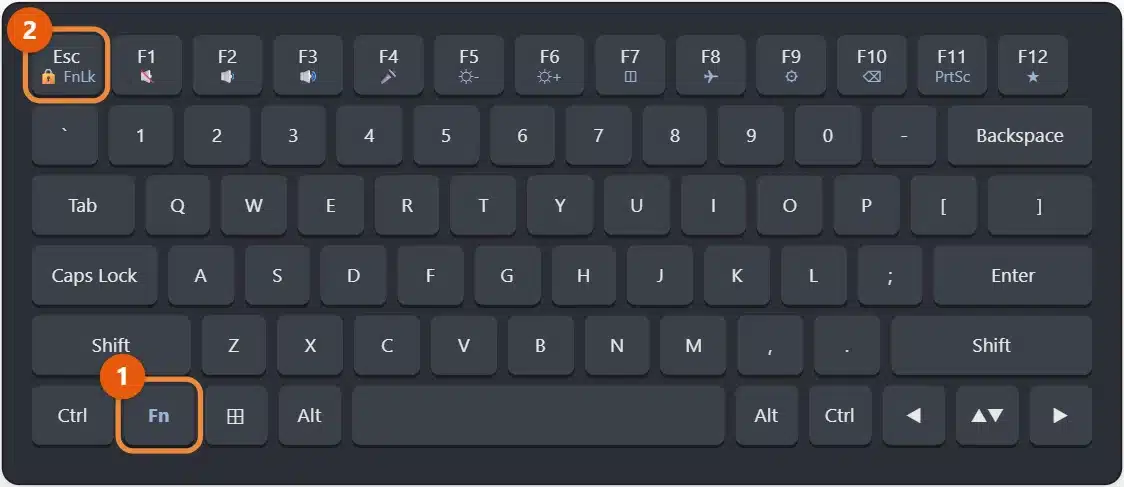
Many laptops have a small light on the lock key that turns on when Fn Lock is on.
Some keyboards have an F Lock key instead
Some desktop keyboards have a separate F Lock or F-Lock key near the top row. Press it once to switch the F keys between their standard and special actions.
If the shortcut doesn’t work: change it in BIOS
On many laptops, you set how the top row works in the BIOS or UEFI setup instead:
- Restart the PC and open the BIOS or UEFI setup. The key to press appears briefly at startup and is often F2, F10, Del, or Esc. On Windows 11, you can also go to Settings > System > Recovery, select Restart now next to Advanced startup, then choose Troubleshoot > Advanced options > UEFI Firmware Settings.
- Look for a setting named something like Action Keys Mode, Function Key Behavior, Fn Lock, or HotKey Mode. It’s often on a Configuration, Advanced, or Keyboard tab.
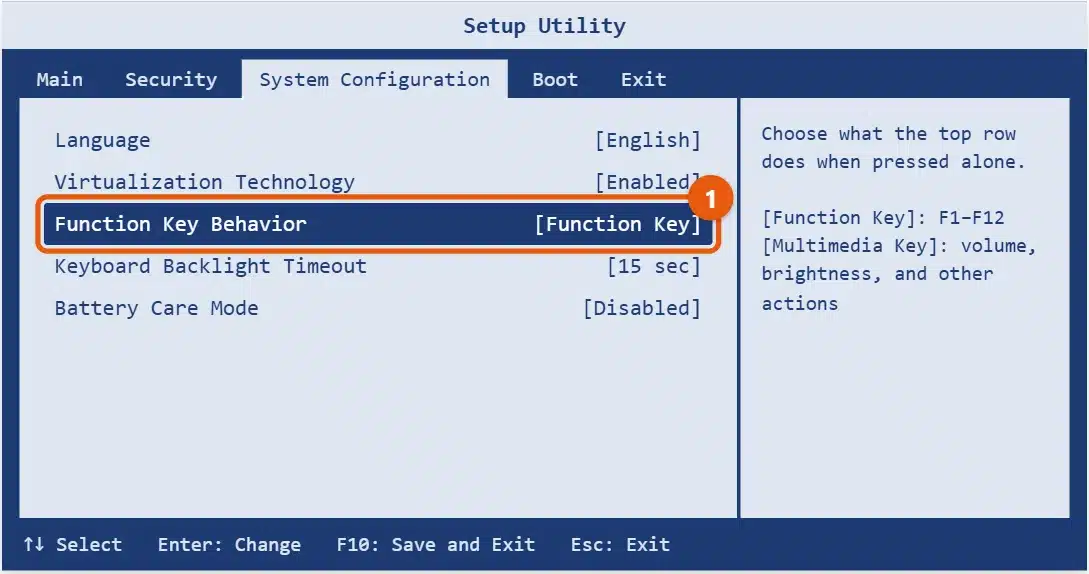
- Change the setting, then save and exit (often F10).
Don’t change other BIOS settings you’re not sure about. If you’re unsure, check your laptop’s manual or support page first.
Use your laptop maker’s app
Some makers include a top-row setting in their own app, such as Lenovo Vantage on Lenovo laptops. Look for a setting called Hotkey Mode, Fn Lock, or Function keys in the app that came with your PC. Your laptop maker’s support page lists the right app for your model.
If only some keys act strangely
- Number keys typing symbols: the keyboard language may be wrong. Check it with Windows + Space.
- Letters typing numbers: on some small laptops, Num Lock turns part of the letter keys into a number pad. Press Fn + Num Lock (or Num Lk) to turn it off.
- Keys not working at all: restart the PC, then try an external keyboard to rule out a hardware fault.
- Keys stopped working after an update: reinstall your laptop maker’s hotkey or keyboard driver from their support site.
Frequently asked questions
Is Fn Lock a Windows 11 setting?
No. It’s built into the keyboard or laptop, so it works the same in any version of Windows.
Why does Fn Lock turn back on after a restart?
Some laptops reset it at startup. Set your preferred behavior in the BIOS or the maker’s app instead, so it sticks.
How do I use F1–F12 without pressing Fn?
Turn Fn Lock on, or change the BIOS setting so the F-key action is the default. See how to use function keys without pressing Fn in Windows 11.
Using Windows 10? If Fn Lock stops Print Screen from working, see how to take a screenshot on Windows 10.
Using an HP laptop? See how to turn off Fn Lock on HP laptops in Windows 11. Want a lit keyboard too? See how to turn on the keyboard light in Windows 11. More help is on our Windows 11 Help & Guides page.
To make the mouse pointer easier to see, see how to change the cursor in Windows 11.
If your keys stick or a beep plays when you press Shift, see how to turn off Sticky keys in Windows 11.
To stop the Caps Lock pop-up, see how to turn off the Caps Lock notification in Windows 11.
If your WASD and arrow keys have swapped instead, see how to fix WASD swapped with arrow keys in Windows 11.

Matt Jacobs has been working as an IT consultant for small businesses since receiving his Master’s degree in 2003. While he still does some consulting work, his primary focus now is on creating technology support content for SupportYourTech.com.
His work can be found on many websites and focuses on topics such as Microsoft Office, Apple devices, Android devices, Photoshop, and more.