The quickest way to convert a PDF to Word on a Mac is to open it in Microsoft Word: in Word, choose File > Open, select the PDF, and confirm when Word asks to convert it. Word builds an editable copy, and you then choose File > Save As and save it as a Word Document (.docx). The original PDF isn’t changed. If you don’t have Word, Google Docs converts PDFs for free, and if you only need the words, you can copy them out of Preview.
Applies to: Word for Microsoft 365 for Mac, macOS 27 Golden Gate and earlier versions of macOS, Google Docs in any Mac browser, and Adobe Acrobat. Preview, the PDF viewer that comes with every Mac, can’t save a PDF as a Word file. Its File > Export menu offers image formats and PDF, not .docx.
Which method should you use?
Every converter has to guess where paragraphs, tables and columns are, because a PDF stores where things sit on the page, not what they are. So the right tool depends on your file and on whether you can upload it.
| Your situation | Best method | Watch out for |
|---|---|---|
| You have Microsoft 365 | Word for Mac | The file is sent to a Microsoft online service for conversion |
| No Word, and the PDF is simple text | Google Docs | Files over 2 MB; tables and columns are often lost |
| Forms, brochures, many tables | Adobe Acrobat | Exporting needs a paid Acrobat plan |
| You only need the words, or the file is confidential | Copy from Preview | Formatting is lost; works on your Mac with no upload |
| The PDF is a scan or photo of pages | Text recognition | Check names and numbers carefully afterward |
Not sure if your PDF is a scan? Open it in Preview, choose Tools > Text Selection and try to drag across a line. If the words highlight one by one, the PDF has real text. If nothing highlights, or a whole box gets selected, it’s an image of text.
Method 1: Open the PDF in Word for Mac
Microsoft added PDF opening to Word for Mac in 2019 for Microsoft 365 subscribers, as announced on the Microsoft 365 Insider blog. You need an internet connection, because Word uses a Microsoft cloud service to do the conversion.
- Open Microsoft Word from the Dock, Launchpad or your Applications folder.
- In the menu bar at the top of the screen, choose File > Open. You can also press Command + O.
- Find the PDF, select it and click Open. If the PDF is grayed out, see Troubleshooting.
- Word tells you it will convert the PDF into an editable document using an online service. Confirm to continue. The conversion takes a few seconds for a short file and longer for a big one.
- When the converted document opens, scroll through it. Headings, paragraphs and simple tables should be editable text.
- Choose File > Save As, give the file a name, set File Format to Word Document (.docx) and click Save.
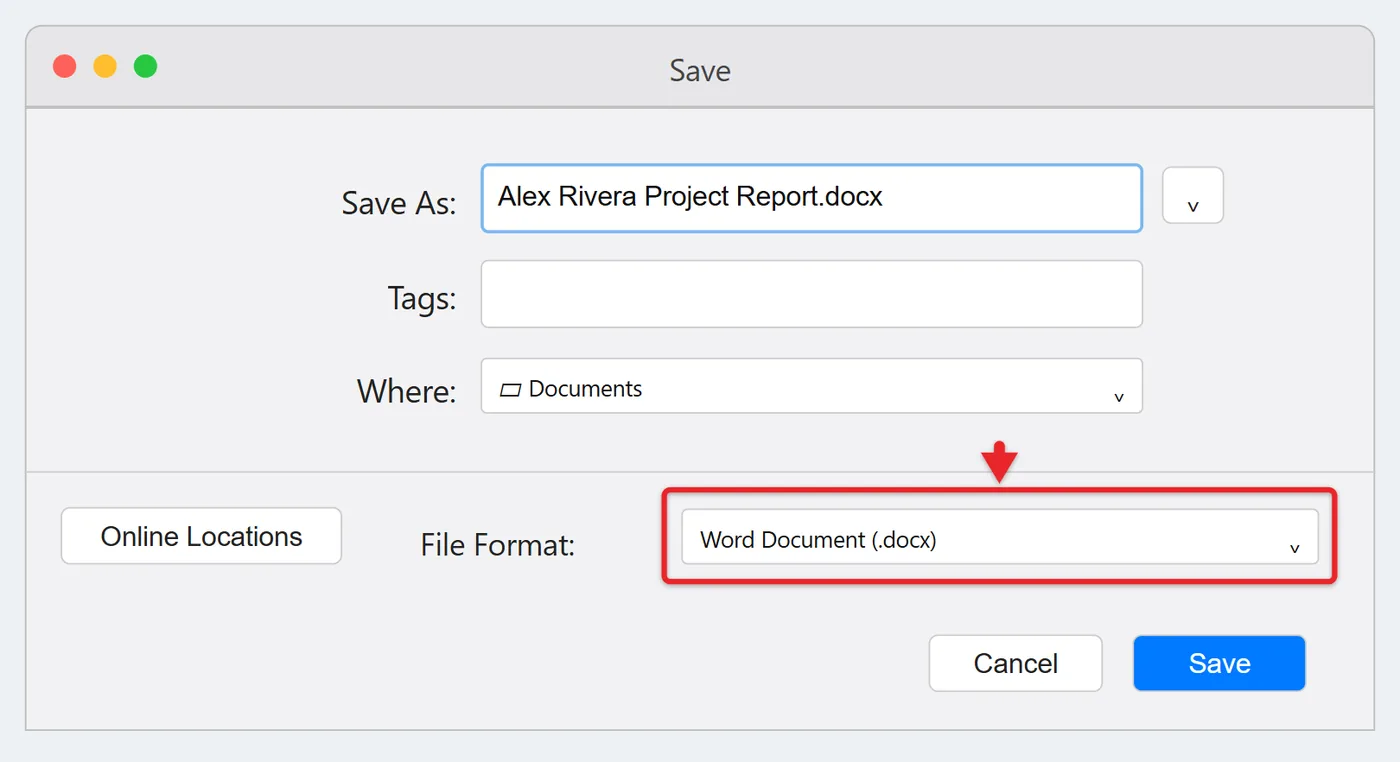
Save soon after converting. Until you do, the document exists only in Word, and if Word quits unexpectedly you’d have to recover the unsaved Word document or simply convert the PDF again.
Microsoft’s guide to opening PDFs in Word says conversion works best with documents that are mostly text, such as business, legal or scientific files. Pages made mostly of charts or graphics may come through as a single picture you can’t edit. Footnotes can turn into ordinary text, and these elements convert poorly: If your PDF started life as a Canva design, see how to convert a Canva design to Word, which also covers the DOCX download for Canva Docs.
- Tables with cell spacing
- Page colors and page borders
- Tracked changes, frames, and endnotes
- Footnotes that run onto a second page
- PDF bookmarks, tags and comments
- Text effects such as glow or shadow, which become graphics
Because the file is uploaded for conversion, skip this method for documents your company or client says must stay on your Mac. If you bought Word as a one-time purchase (Word 2021 or Word 2024 for Mac) rather than through Microsoft 365, try File > Open anyway; Microsoft’s Mac documentation doesn’t spell out whether those versions include it.
Method 2: Use Google Docs (free)
All you need is a Google account and a browser such as Safari or Chrome. Google Drive turns the PDF into a Google Doc, and Docs can then download it as a Word file.
- Go to drive.google.com and sign in.
- Click New > File upload, choose the PDF and wait for the upload to finish.
- Right-click (or Control-click) the PDF in your file list and choose Open with > Google Docs. A new tab opens with an editable document. The PDF stays in Drive as a separate file.
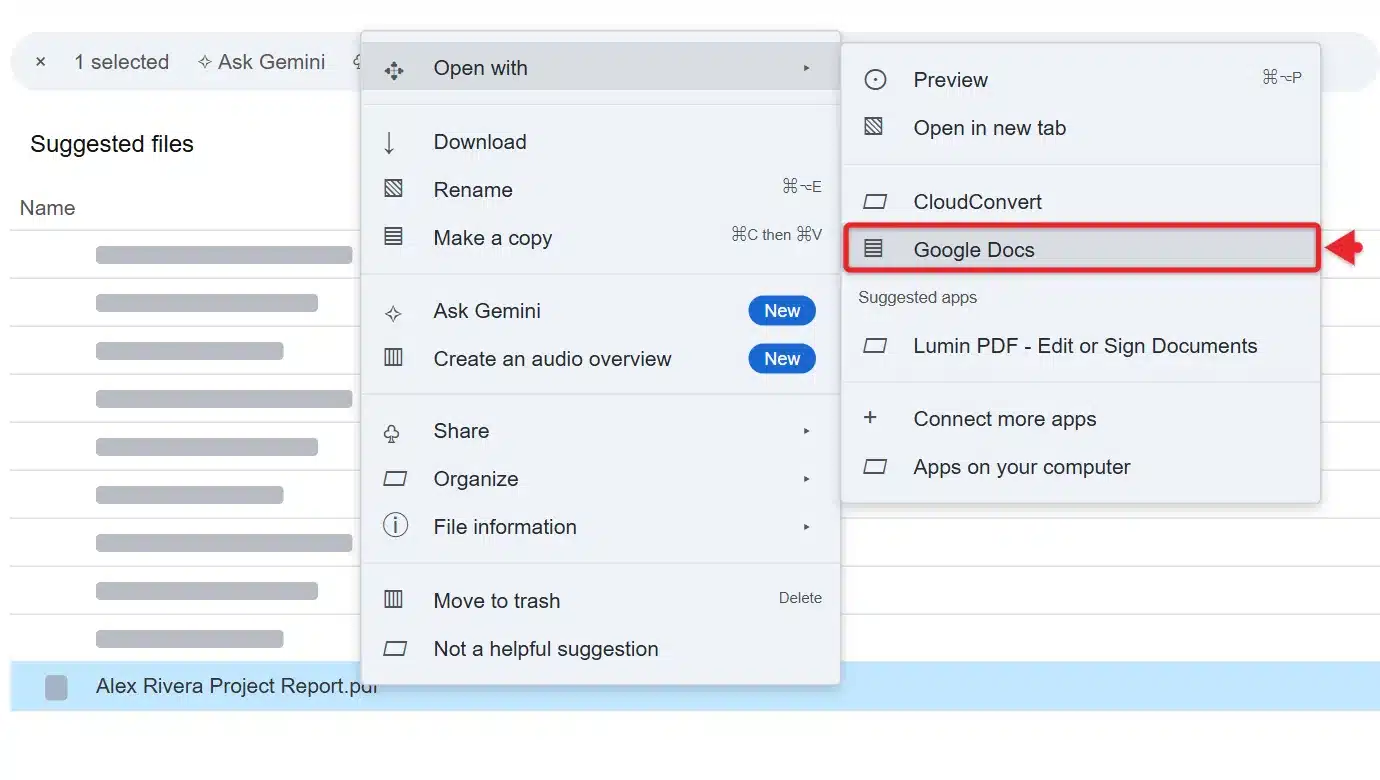
- Check the text, then choose File > Download > Microsoft Word (.docx). The file lands in your Downloads folder.
Google’s help page on converting PDF and photo files to text sets the limits: keep the file at 2 MB or smaller, and text should be at least 10 pixels tall. Bold, italics, font size, font type and line breaks usually survive. Lists, tables, columns, footnotes and endnotes usually don’t, and pictures are often left out. Docs also recognizes text in scanned pages, so it’s a good free choice for a scan. If the result keeps odd fonts and spacing you don’t want, clear the formatting in Google Docs before downloading.
Method 3: Export from Adobe Acrobat
Acrobat is the most capable choice for complex layouts, such as forms, brochures and reports full of tables. Exporting to Word needs a paid plan, such as Acrobat Standard, Acrobat Pro or Adobe’s Export PDF subscription. The free Acrobat Reader opens the export tool but asks you to sign in and pay before it converts. For a brochure or magazine that was designed in InDesign, it’s usually quicker to count the words in InDesign itself than to convert the exported PDF.
- Open the PDF in Acrobat.
- Go to All tools > Export a PDF. In older Acrobat layouts, choose File > Export To or Tools > Export PDF.
- Choose Microsoft Word and then Word Document (.docx).
- Optional: click the gear icon for settings. Retain Flowing Text gives you text that’s easy to edit, while Retain Page Layout keeps the look but may split text into boxes. Make sure Recognize Text is on for scanned pages.
- Click Export, pick a folder and click Save.
Adobe’s page on keeping page layout when converting a PDF explains each export option. Adobe also has a free online PDF to Word converter that works in any browser, but like Google Docs, it means uploading the file.
Method 4: Copy the text from Preview
This is the fastest route for a short document where only the words matter, and nothing leaves your Mac. The steps follow Apple’s guide to selecting and copying text in a PDF.
- Control-click the PDF in Finder and choose Open With > Preview.
- Choose Tools > Text Selection.
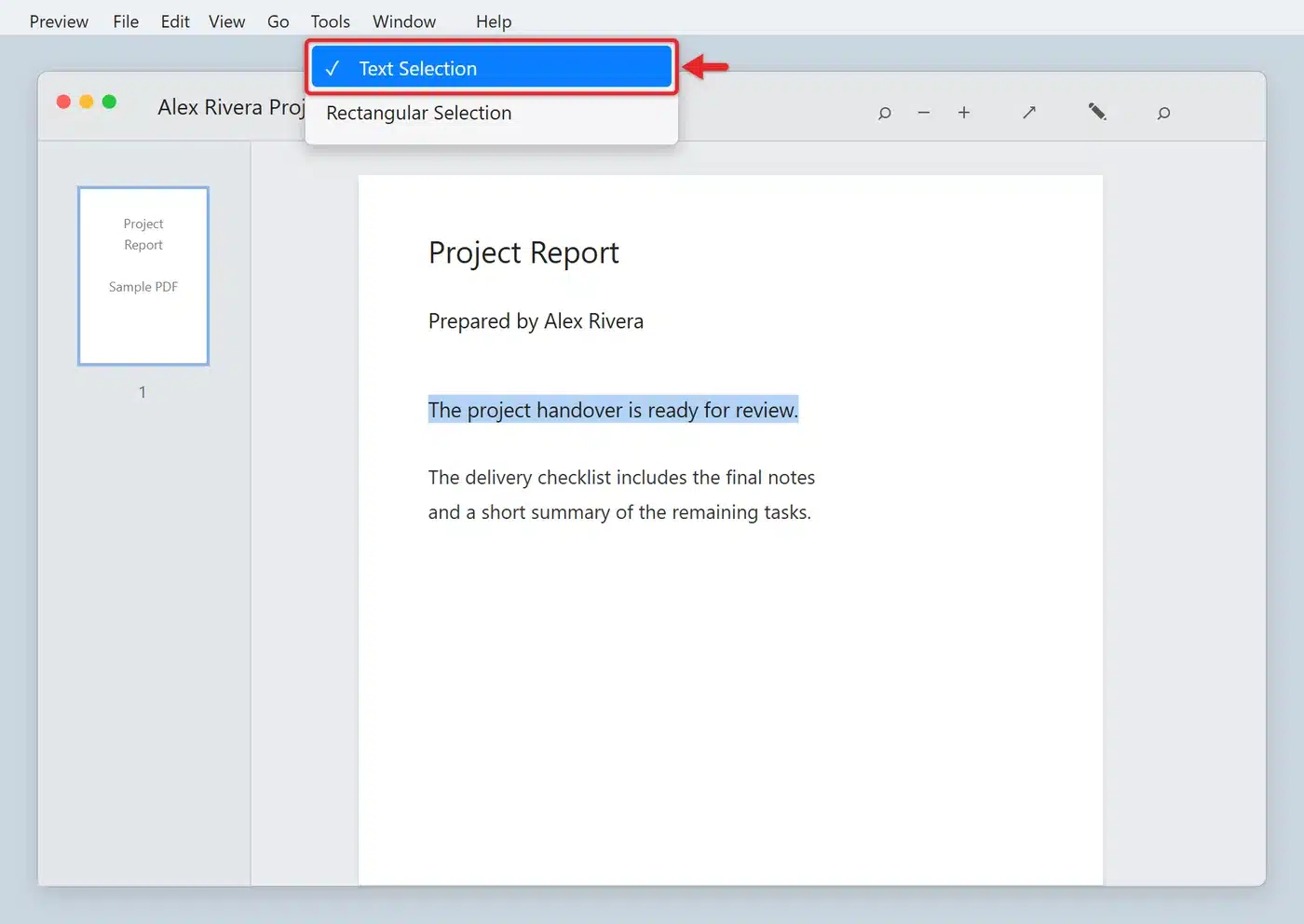
- Drag over the text you want, or press Command + A to select all of the text on the pages.
- Choose Edit > Copy (or press Command + C).
- Open a new document in Word or Pages and press Command + V to paste.
Two handy tricks: hold Option while dragging to select a vertical block, such as one column of a table, and use Tools > Rectangular Selection to copy a chart or logo as a picture you can paste alongside the text.
Pages can’t open a PDF for editing, but it can save what you pasted as a Word file. Click the Share button in the toolbar, choose Export and Send, then Word, as described in Apple’s guide to converting Pages files. In older versions of Pages, the same option is under File > Export To > Word.
Automator, which still comes with macOS, has an Extract PDF Text action that saves a PDF’s text as a rich text (.rtf) file. Word opens .rtf files, so it’s an option if you have many PDFs to pull text from, but it gives you text, not a formatted Word layout.
Converting a scanned PDF
A scanned PDF is a picture of text, so it needs text recognition (often called OCR, optical character recognition) before any of it becomes editable. Word for Mac can’t read it as text and may show the whole page as an image. Your options:
- Google Docs recognizes the text automatically when you choose Open with > Google Docs. Straight, sharp, evenly lit scans give the best results.
- Acrobat runs Recognize Text during export. For a scan, set the document language to match the text when Acrobat asks.
- Live Text on your Mac works without uploading anything. Apple documents it for images, so if you can’t select words in the scanned PDF itself, choose File > Export in Preview, pick PNG as the format and open the image. Then drag over the text, Control-click and choose Copy Text, as shown in Apple’s guide to using Live Text in Preview. Live Text isn’t available in every language or region.
Text recognition makes mistakes, especially with names, numbers, accented letters and faint scans. Compare the converted text against the original before you send it anywhere.
Troubleshooting
Word won’t open the PDF, or the PDF is grayed out
Update Word with Help > Check for Updates, and make sure you’re signed in with your Microsoft 365 account. If it still won’t convert, use Google Docs or Acrobat instead.
The PDF asks for a password, or text won’t select in Preview
Apple lists two causes: the Text Selection tool isn’t turned on (choose Tools > Text Selection), or the PDF is password protected. To unlock it, choose Tools > Show Inspector, click the Encryption (lock) button and enter the password. Only remove protection from files you have permission to change.
The converted document is one big picture
The PDF is a scan or a mostly graphic page. Use one of the text recognition options above.
Strange characters or missing letters
The PDF’s embedded fonts didn’t map to real letters. Try another method, since Google Docs, Acrobat and Live Text each read the page differently.
Check and clean up the Word file
- Press Command + 8 in Word to show formatting marks, which reveals stray line breaks, extra spaces and section breaks.
- Choose Edit > Find > Replace, type ^l (a lowercase L) in the Find box and a space in the Replace box to turn manual line breaks into spaces.
- Apply Word’s built-in heading styles so headings are consistent and the document is easy to navigate.
- Delete any blank pages left behind by the PDF’s page layout.
- Have Word read the converted text aloud while you follow along in the original PDF. It’s an easy way to catch dropped words. For long editing sessions, you can switch Word for Mac to a dark interface while keeping a white page.
You’ll know the conversion worked when you can click into a paragraph, type, and see the text reflow. To undo, just close the Word file without saving or delete the .docx; every method here leaves the original PDF untouched.
Frequently asked questions
Is there a free way to convert a PDF to Word on a Mac?
Yes. Google Docs is free with a Google account and downloads a real .docx file. Copying text from Preview into Pages and exporting to Word is also free and keeps the file on your Mac, though you lose the original layout.
Can I convert a PDF to Word on a Mac without the internet?
Word for Mac and Google Docs both need a connection, since the conversion happens online. Offline, you can copy text from Preview, use Live Text on an exported image, or use Automator’s Extract PDF Text action.
Will the Word file look exactly like the PDF?
Rarely. Text-heavy documents come close, but line and page breaks often move, and multi-column layouts, text boxes and unusual fonts shift. Acrobat’s Retain Page Layout setting gets closest when appearance matters more than easy editing.
Can I pull just a table out of a PDF?
For a single column, hold Option and drag in Preview. For whole tables, Excel is often better than Word; see how to convert a PDF to Excel without losing formatting.
How do I turn the edited Word file back into a PDF?
In Word for Mac, choose File > Save As, set File Format to PDF and click Export. Use a new name so you keep the editable .docx too.
If you have Microsoft 365, start with Word’s File > Open; if the result looks wrong or the file is a scan, try Google Docs next.

Matt Jacobs has been working as an IT consultant for small businesses since receiving his Master’s degree in 2003. While he still does some consulting work, his primary focus now is on creating technology support content for SupportYourTech.com.
His work can be found on many websites and focuses on topics such as Microsoft Office, Apple devices, Android devices, Photoshop, and more.