To remove extra spaces between words in Word, press Ctrl+H (or go to Home > Editing > Replace), type two spaces in Find what, type one space in Replace with, and select Replace All. If the gap is between paragraphs instead, go to Design > Paragraph Spacing and choose No Paragraph Space.
Applies to: Word for Microsoft 365, Word 2024, Word 2021, Word 2019 and Word 2016 on Windows. Checked against Microsoft Support on October 6, 2026.
Find out what kind of extra space you have
“Extra space” in Word can be five different things, and each one has its own fix: repeated spaces between words, tab characters, empty paragraphs (blank lines made with the Enter key), paragraph spacing that Word adds before or after each paragraph, and line spacing inside a paragraph. Deleting characters will not shrink a gap that is really a formatting setting, so identify the cause first. If the gaps are uneven only between words, for example in justified text, see how to fix weird spacing between words in Word.
- Open the document and select the Home tab.
- In the Paragraph group, select Show/Hide ¶. You can also press Ctrl+Shift+8, which displays all nonprinting characters.
- Look at the gap. Word shows spaces between words as dots, tab characters as arrows, and the end of each paragraph with the paragraph symbol (¶).
- Select Show/Hide ¶ again when you are finished to hide the marks. They are only an on-screen aid.
Use this table to match what you see to the right section of this article.
| What you see with marks turned on | Cause | Fix |
|---|---|---|
| Two or more dots in a row between words | Repeated spaces | Find and Replace two spaces with one |
| An arrow in the gap | Tab character | Find and Replace ^t |
| A ¶ on a line by itself | Empty paragraph | Find and Replace ^p^p with ^p |
| A gap between paragraphs with no marks in it | Paragraph spacing (Before or After) | Design > Paragraph Spacing, or the Before and After boxes |
| Lines inside one paragraph sit far apart | Line spacing | Home > Line and Paragraph Spacing |
| Single dots, but words are stretched across the line | Justified alignment | Align the text to the left |
Remove extra spaces between words with Find and Replace
This is the main method for documents with double spaces after periods or stray spaces left over from typing and pasting. Save the document first so you have a clean copy to go back to.
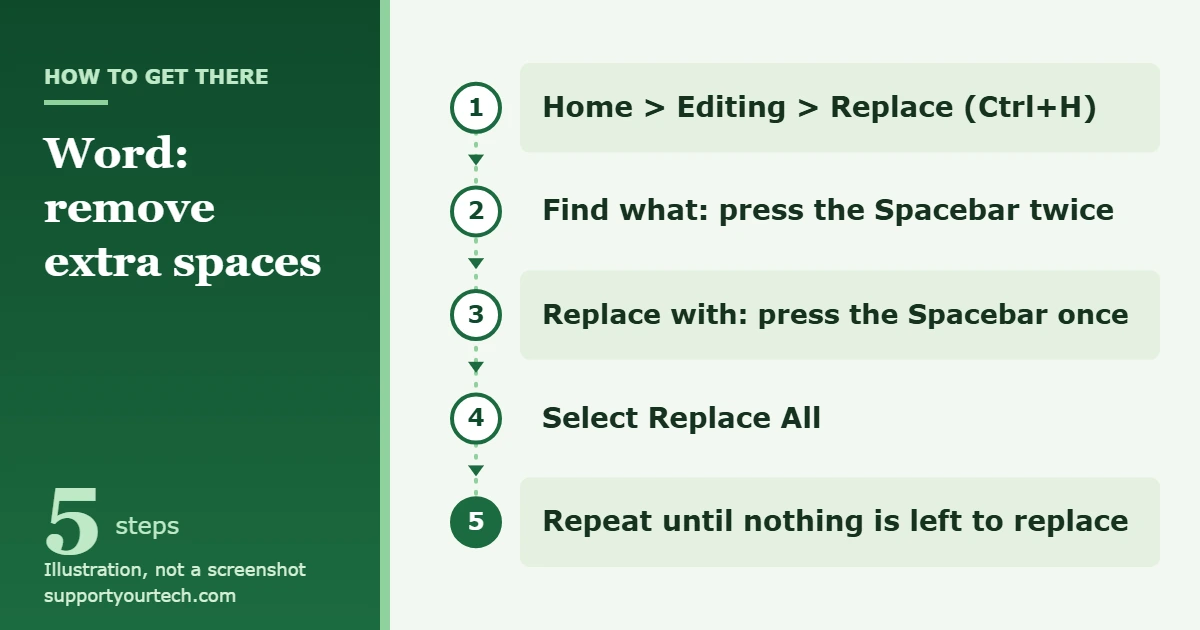
- Press Ctrl+H, or select Home > Editing > Replace. The Find and Replace dialog box opens.
- Click in the Find what box and press the Spacebar twice. The box looks empty, but it now holds two spaces.
- Click in the Replace with box and press the Spacebar once.
- Select Replace All to change every match at once. To review matches one at a time instead, select Find Next and then Replace on each one you want to change.
- Select Replace All again. One pass turns a run of four spaces into two, so repeat until Word finds nothing more to replace.
Clear every run of spaces in one pass with wildcards
If the document has runs of three, four or more spaces, a wildcard search removes them all in a single pass. In Word’s wildcard syntax, {n,} means “at least n occurrences of the previous character.”
- Press Ctrl+H to open the Replace dialog box.
- Select More to show the search options, and then select the Use wildcards check box.
- In Find what, press the Spacebar once and then type {2,} immediately after it.
- In Replace with, press the Spacebar once.
- Select Replace All. Every run of two or more spaces becomes one space.
- Clear the Use wildcards check box before you close the dialog box, so that your next ordinary search behaves normally.
Remove tabs and blank lines
Find and Replace understands short codes for characters you cannot type into the boxes. Microsoft documents ^t for a tab mark, ^p for a paragraph mark and ^l (a lowercase L) for a manual line break. You can type the codes yourself or select More and use the Special button to insert them.
- Tabs used as spacing: put ^t in Find what and one space in Replace with. Use Find Next and Replace rather than Replace All if the document also uses tabs on purpose, for example to line up columns.
- Blank lines: put ^p^p in Find what and ^p in Replace with, and then select Replace All. Repeat until no empty paragraphs remain. Our guide on how to delete blank lines in Word walks through this in more detail.
- Manual line breaks: text copied from email or a PDF often ends every line with a line break (the kind you get by pressing Shift+Enter). Replace ^l with a space to rejoin the lines.
Warning: never replace a single ^p with nothing across a whole document. That joins every heading, list item and paragraph into one block of text. Always search for the doubled code.
Remove extra space between paragraphs
If the gap between paragraphs is empty when formatting marks are on, it is paragraph spacing, not a blank line. According to Microsoft, Word’s default is 1.15 line spacing with 10 points of space after each paragraph, so new documents have this gap by design.
Whole document
- Select the Design tab.
- Select Paragraph Spacing.
- Choose No Paragraph Space. The document becomes single-spaced with no added gap between paragraphs.
To go back, open Design > Paragraph Spacing again and pick a different option.
Selected paragraphs only
- Select the paragraphs you want to tighten, or press Ctrl+A to select everything.
- Go to Home > Line and Paragraph Spacing and choose Line Spacing Options. The Paragraph dialog box opens.
- Under Spacing, set Before and After to 0 pt.
- Select OK.
The same Before and After controls are on the Layout tab under Spacing, where you can adjust them with the up and down arrows. The Paragraph dialog box also has a check box that starts with Don’t add space between paragraphs, which is useful for lists and addresses where you want lines of the same kind to sit together.
If you want new documents to start without the gap, select Set as Default in the Paragraph dialog box, and then choose This document only or All documents based on the Normal template.
Reduce the space between lines
When lines inside one paragraph are too far apart, the setting to change is line spacing.
- Select the text, or press Ctrl+A.
- Go to Home > Line and Paragraph Spacing.
- Pick a smaller value from the list. For exact control, choose Line Spacing Options and use the Line spacing box, which offers Single, 1.5 lines, Double, At least, Exactly and Multiple.
Keyboard shortcuts work too: Ctrl+1 applies single spacing to the paragraph, Ctrl+5 applies 1.5-line spacing and Ctrl+2 applies double spacing. For a fuller tour of these settings, see our article on how to adjust spacing in Word.
Fix wide gaps that are not extra spaces
- Justified text. Microsoft describes Justify as aligning text on both the left and right “adding space between words.” Those gaps are not characters, so Find and Replace cannot remove them. Select the paragraph and press Ctrl+L to align it to the left. We cover other options in removing space between words in justified text.
- Expanded character spacing. If every letter looks spread out, select the text and press Ctrl+D to open the Font dialog box, and then select the Advanced tab. Check whether the Spacing box is set to Expanded and whether Scale is above 100%; a scale above 100% stretches text.
- Formatting carried in by a paste. Text copied from a web page or another document can bring its spacing with it. After you paste, select the Paste Options button and choose Keep Text Only, which discards all formatting, or Merge Formatting, which keeps only emphasis such as bold and italic.
Check the result and undo mistakes
Turn Show/Hide ¶ on and scroll through the document. You should see a single dot between words and one ¶ at the end of each paragraph. Look closely at tables, lists, addresses and anything lined up in columns, because those are the places where spacing was most likely intentional.
If a replacement went too far, press Ctrl+Z right away to undo the previous action. If you have already made other changes, close the document without saving and reopen the copy you saved before you started.
Troubleshooting
- Replace All changes nothing, but you can still see a gap. The gap may be a nonbreaking space, which keeps two words on the same line and does not match an ordinary space. Put ^s in Find what and one space in Replace with. To catch any mix of spaces and tabs, search for ^w, the code for white space. If neither finds anything, the gap is formatting; go back to the table at the top.
- The search behaves strangely or finds unexpected text. Select More and check the search options. Use wildcards may still be turned on from an earlier search. Also check the Search setting, which controls whether Word looks through the whole document or only up or down from the cursor.
- You cannot see dots or ¶ symbols. Select Show/Hide ¶ on the Home tab. To keep certain marks visible all the time, go to File > Options > Display and select the check boxes you want under Always show these formatting marks on the screen, such as Spaces, Tab characters and Paragraph marks.
- The gap between paragraphs comes back in new documents. The setting was changed for one document only. Use Set as Default and choose All documents based on the Normal template.
- One paragraph refuses to match the rest. Click in it and press Ctrl+Q to remove paragraph formatting that was applied by hand, so the paragraph falls back to its style’s spacing.
Frequently asked questions
Why does Word keep adding space after every paragraph?
It is the default. Microsoft’s documentation says Word starts with 1.15 line spacing and 10 points of space after each paragraph for readability. Change it with Design > Paragraph Spacing > No Paragraph Space, or make your own setting the default with Set as Default.
Is there a shortcut to remove extra spaces in Word?
There is no single key that deletes them, but Ctrl+H opens the Replace dialog box directly, and the wildcard search described above clears every run of spaces in one pass.
Will Find and Replace change spaces inside tables and lists?
It can. Replace All changes every match it finds. If some spacing is deliberate, step through the matches with Find Next and select Replace only where you want the change.
How do I remove double spaces after periods only?
Type a period followed by two spaces in Find what and a period followed by one space in Replace with, and then select Replace All. Repeat with a question mark and an exclamation point if needed.
Does this work in Word for Mac?
The same Find and Replace approach applies. Microsoft’s shortcut list for Mac gives Control+H to display the Find and Replace pane, Command+1 for single spacing and Command+L to align a paragraph to the left. Menu names differ from the Windows steps above, so follow Microsoft’s Find and replace text instructions and choose the macOS tab.
Once the spacing is clean, save the document under its normal name. For more detail on the spacing settings themselves, see Microsoft’s guide to changing line and paragraph spacing in Word.
Related: How to set multiple tabs in Word.
Related: How to reduce the gap between lines in Word.
Related: how to double space in Word.
Related: How to Turn On Automatic Hyphenation in Word.

Matt Jacobs has been working as an IT consultant for small businesses since receiving his Master’s degree in 2003. While he still does some consulting work, his primary focus now is on creating technology support content for SupportYourTech.com.
His work can be found on many websites and focuses on topics such as Microsoft Office, Apple devices, Android devices, Photoshop, and more.