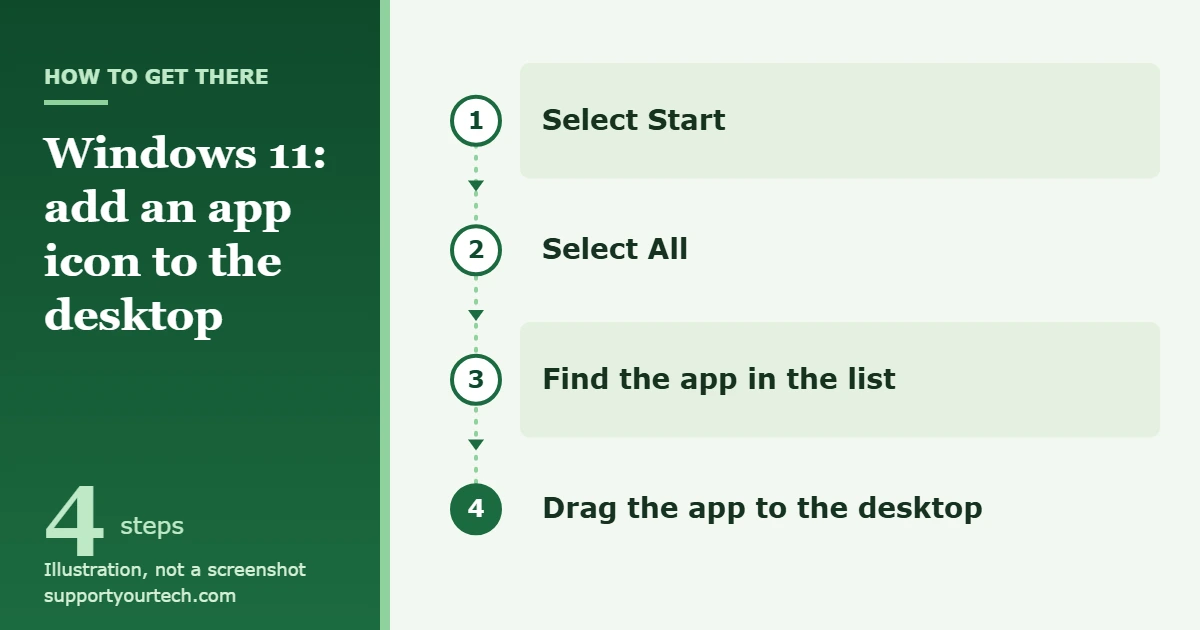
To add an app icon to the Windows 11 desktop, select Start, select All, and drag the app from the list onto the desktop. For a file or folder, right-click it and select Show more options > Send to > Desktop (create shortcut). For built-in icons such as This PC, go to Settings > Personalization > Themes > Desktop icon settings.
Applies to: Windows 11. Checked against Microsoft Support on October 7, 2026.
Which method to use
Desktop icons in Windows 11 are added in different ways, depending on what the icon opens. Pick the row that matches what you want the icon to open.
| You want an icon for | Use this method |
|---|---|
| An installed app | Drag it from the All list in Start |
| A file or folder | Send to > Desktop (create shortcut) |
| Anything you know the location of | New > Shortcut on the desktop |
| A website | Drag the View site information icon from the browser |
| This PC, Recycle Bin, Network or your user folder | Desktop icon settings |
Most of these icons are shortcuts. A shortcut is a small pointer that opens an item stored somewhere else on the computer. It does not copy or move the app, file or folder, so it takes almost no space, and Microsoft notes that deleting a shortcut removes only the shortcut, not the original item.
This is the route Microsoft documents for apps. It needs no typing and no file paths.
- Select Start on the taskbar. The Start menu opens.
- Select All. Start switches to a list of every installed app.
- Scroll through the list until you find the app you want.
- Drag the app out of the list and drop it on an empty part of the desktop. A shortcut with the app’s icon appears where you let go.
The app stays in the Start menu after you drag it. You have added a second way to open it, not moved it. If the app you want is pinned to the taskbar instead, see how to move apps from the taskbar to the desktop in Windows 11.
Add a file or folder icon to the desktop
Use this when you open the same document, spreadsheet or folder every day and want it one double-click away without moving it out of its real location.
- Open File Explorer and go to the file or folder you want on the desktop.
- Right-click the file or folder. A short menu opens.
- Select Show more options. The longer, classic menu opens.
- Select Send to > Desktop (create shortcut). A shortcut to the item appears on the desktop.
Microsoft notes that on some Windows installations the right-click menu already shows every option. In that case you will not see Show more options. Go straight to Send to.
Choosing Desktop (create shortcut) matters. The original file stays in its folder, so backups, sharing and syncing that depend on that folder keep working.
Create a shortcut from the desktop itself
The desktop has its own shortcut tool. It works for a file, a folder or a web page, as long as you can type the location or browse to it.
- Right-click an empty area of the desktop.
- Select New > Shortcut. A setup window opens and asks for the location of the item.
- Enter the location of the item, or select Browse to find the item in File Explorer. For a web page, the location is the page’s full address.
- Follow the remaining prompts to name the shortcut and finish. The new icon appears on the desktop.
One limit to know about: Microsoft states that you can’t create shortcuts for Microsoft Store apps with this tool. For those apps, use the Start menu method above.
Add a website icon to the desktop
- Open your web browser and go to the page you want.
- Find the View site information icon next to the address. It looks like a padlock or a pair of sliders.
- Drag that icon onto the desktop. A shortcut to the page appears, and double-clicking it opens the page in your browser.
If the browser window covers the whole screen, make the window smaller first so that part of the desktop is visible to drop the icon on.
Add This PC, Recycle Bin and other built-in icons
The built-in Windows icons are not shortcuts, so none of the methods above create them. They are switched on in Settings.
- Open the Settings app and select Personalization > Themes.
- Select Desktop icon settings. A small window opens with a check box for each built-in icon.
- Select the icons you want on the desktop, then select OK. The icons appear on the desktop.
Microsoft describes the icons in this window as follows:
- This PC gives access to the computer’s drives and connected devices.
- Recycle Bin is where deleted files are stored temporarily.
- Network lets you view and connect to network resources.
- User’s Files is a shortcut to your personal folders.
The same window has an option called Allow themes to change desktop icons. It decides whether a theme is allowed to change the pictures used for these icons. It does not add or remove them. For more detail on the first icon, see how to show This PC on the desktop in Windows 11.
Confirm it worked, or undo it
Double-click the new icon. The app, file, folder or web page should open. If it does, you are done.
To take a shortcut off the desktop, right-click it and select Delete. Only the shortcut goes; the original item stays where it was. To take away a built-in icon such as This PC, go back to Desktop icon settings, clear its check box and select OK. There is more on this in how to remove desktop shortcuts in Windows 11.
Be careful with one thing. A file you saved directly to the desktop is the real file, not a shortcut. Deleting it deletes the file. If you are not sure which one you have, think about how the icon got there: icons made with the methods in this article are shortcuts.
Desktop icon or taskbar pin?
The desktop is covered by whatever windows you have open, and the taskbar is not. For an app you use many times a day, a taskbar pin can be quicker than a desktop icon. Microsoft’s instructions are to type the app’s name in the Search box, right-click the app, then select Pin to taskbar. If the app is already open, right-click its icon on the taskbar and select Pin to taskbar. To reverse it, right-click the icon on the taskbar and select Unpin from taskbar.
You can have both. A pin and a desktop shortcut open the same single installed app.
Troubleshooting
The new icon does not appear, or every icon is gone
Desktop icons can be hidden all at once. Right-click an empty area of the desktop, select View, and make sure Show desktop icons is checked. Icons you added while they were hidden show up as soon as you turn the option back on. If that does not bring them back, work through how to get missing desktop icons back in Windows 11.
There is no Send to option in the right-click menu
In Windows 11 the first right-click menu is a shortened one. Select Show more options to open the full menu, which contains Send to.
The app will not drag out of the Start menu
Microsoft’s steps start from the All list, so make sure you have selected All and are dragging from that list. Drop the app on a visible, empty part of the desktop, not on another window.
The New > Shortcut tool cannot find a Microsoft Store app
That is expected. Microsoft says shortcuts to Store apps cannot be created this way. Drag the app from the All list in Start instead.
The icons are too small or too large
Right-click an empty area of the desktop, select View, then choose Large icons, Medium icons or Small icons. You can also press and hold Ctrl on the desktop while you scroll the mouse wheel.
Settings or the desktop is locked down on a work or school PC
Organizations can manage personalization settings and the desktop on the computers they own. If Desktop icon settings will not open, or icons you add do not stay, ask your IT administrator. This is a restriction to raise with them, not something to work around.
Frequently asked questions
Does adding a desktop icon move or copy the app?
No. The methods here create a shortcut that points to the app, file or folder. The item itself stays where it is, and deleting the shortcut later does not uninstall or delete it.
Why does a new Windows 11 desktop have so few icons?
The built-in icons are optional and are controlled by the check boxes in Desktop icon settings. Any that are not checked there are not shown until you select them.
Can I change what an icon looks like after adding it?
Yes. The steps are in how to change desktop icons in Windows 11.
Can I still reach the desktop when the icons are hidden?
Yes. Microsoft points out that you can get to the desktop through File Explorer while the icons are hidden, so nothing stored there is lost.
Where does Microsoft document these steps?
The methods above follow Microsoft Support’s pages on customizing the desktop icons in Windows and pinning apps and folders to the desktop or taskbar.
Once your icons are in place, set their size from the desktop’s View menu so they are easy to see and click.

Matt Jacobs has been working as an IT consultant for small businesses since receiving his Master’s degree in 2003. While he still does some consulting work, his primary focus now is on creating technology support content for SupportYourTech.com.
His work can be found on many websites and focuses on topics such as Microsoft Office, Apple devices, Android devices, Photoshop, and more.