The quickest way to check whether you have admin rights on Windows 10 is to open Settings > Accounts > Your info. If the word Administrator appears under your name, your account has admin rights. If it doesn’t, you have a standard account. You can also check in Control Panel, or run net user %username% in Command Prompt and look for Administrators under Local Group Memberships. Here are all the methods, plus how to see every administrator on the PC.
Microsoft ended Windows 10 support on October 14, 2025, so a PC without Extended Security Updates no longer receives security fixes; that program runs until October 12, 2027.
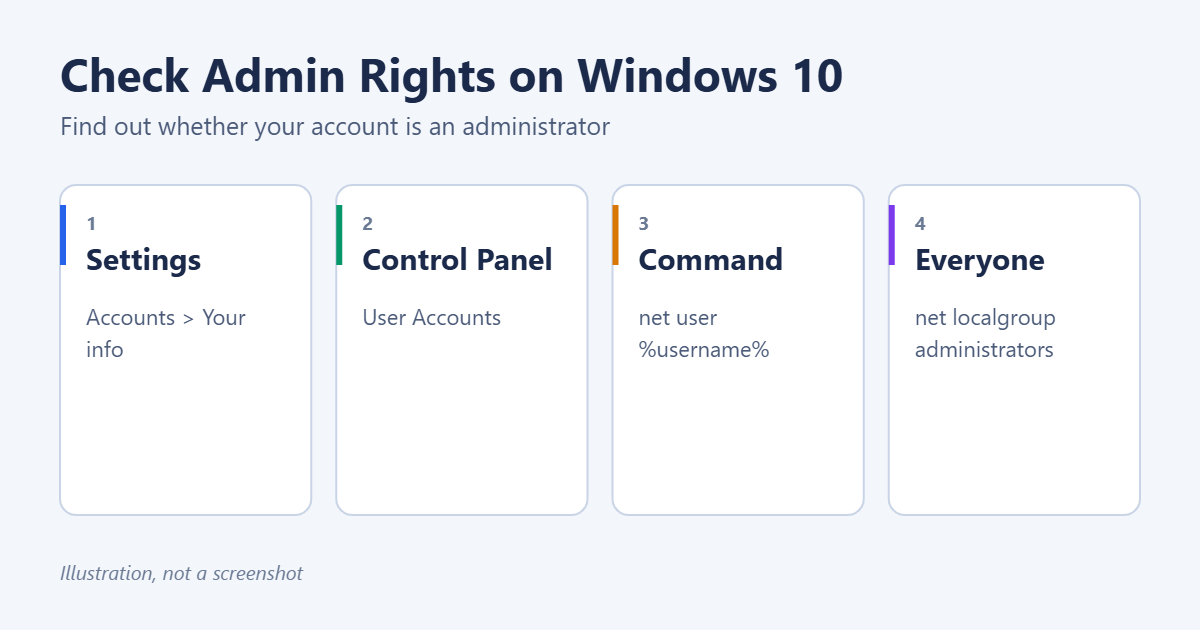
Method 1: Settings
- Press Windows + I.
- Click Accounts > Your info.
- Look under your name and email address. Administrator means you have admin rights. If you see only Local Account or your email, you’re a standard user.
Method 2: Control Panel
- Open Control Panel and click User Accounts > User Accounts.
- Your account is shown on the right, with Administrator or Standard under the name.
- Click Manage another account to see the type of every account on the PC. You’ll be asked for admin approval.
Method 3: Command Prompt
- Click Start, type cmd and open Command Prompt. It doesn’t need to run as administrator.
- Type
net user %username%and press Enter. - Look at Local Group Memberships. If it lists *Administrators, you’re an admin.
For a domain (work) account, use whoami /groups instead, and look for BUILTIN\Administrators in the list.
Method 4: See every administrator on the PC
In Command Prompt, run:
net localgroup administrators
It lists every account and group with admin rights. On a work PC, you may see domain groups such as Domain Admins, which means IT staff can manage the PC.
Admin account vs running as administrator
Even with an administrator account, Windows runs apps with standard rights until you approve a User Account Control (UAC) prompt. That’s why you can be an admin and still see “Access denied” in a normal Command Prompt. To run a program with full rights, right-click it and choose Run as administrator. If those prompts get in the way during a big setup job, you can turn off User Account Control on Windows 10 for a while and switch it back on afterward.
To check whether the current window is elevated, run net session in Command Prompt. If it says “Access is denied”, the window isn’t running as administrator.
What if I’m not an administrator?
- Home PC: Ask whoever has an admin account to change your account type. They’ll find the steps to change the administrator in Windows 10 in Settings.
- Work or school PC: Admin rights are controlled by IT. Ask them to install software or make changes for you.
- Your own PC, but you’ve lost access to the admin account: You can recover a Windows 10 administrator password safely.
Should you use an admin account every day?
Security experts recommend a standard account for everyday use, with a separate admin account for installing software and changing settings. It limits what malware can do if something slips through. Setting that up means you make another account on Windows 10 and keep one of the two as the admin.
Troubleshooting
Settings shows “Administrator” but I still get blocked
The action needs elevation. Approve the UAC prompt, or right-click the program and choose Run as administrator. On a managed PC, a policy may block it anyway.
net user says the user name could not be found
You’re signed in with a domain or Microsoft account. Use whoami /groups instead.
Frequently asked questions
Is the account that set up the PC always an administrator?
Yes. The first account created during Windows setup is an administrator. Accounts added later are standard users unless someone changes them.
Is this the same on Windows 11?
Yes. All the methods work on Windows 11. In Settings, look under Accounts at the top of the page. The Settings pages are arranged a little differently there, though, so for a walkthrough use the steps to check admin rights on Windows 11.
Can I give myself admin rights?
Only an existing administrator can do that. This is deliberate, so standard users can’t take control of the PC.
Related guides
- How to find the administrator password
- How to change file permissions
- How to remove an administrator account in Windows 10

Matt Jacobs has been working as an IT consultant for small businesses since receiving his Master’s degree in 2003. While he still does some consulting work, his primary focus now is on creating technology support content for SupportYourTech.com.
His work can be found on many websites and focuses on topics such as Microsoft Office, Apple devices, Android devices, Photoshop, and more.