Last updated on November 13th, 2026 at 12:02 pm
Windows 10 doesn’t keep a print history by default. To start one, open Event Viewer and turn on the PrintService Operational log. After that, each document you print is saved as an event with its name, the user, the printer and the number of pages.
Applies to: Windows 10. Microsoft doesn’t have a support page for this task, so these steps follow Event Viewer in Windows 10.
Turn on print history in Event Viewer
You need to be signed in as an administrator to do this.
- Right-click Start and select Event Viewer.
- On the left, go to Applications and Services Logs > Microsoft > Windows > PrintService.
- Select Operational.
- On the right, under Actions, select Enable Log.
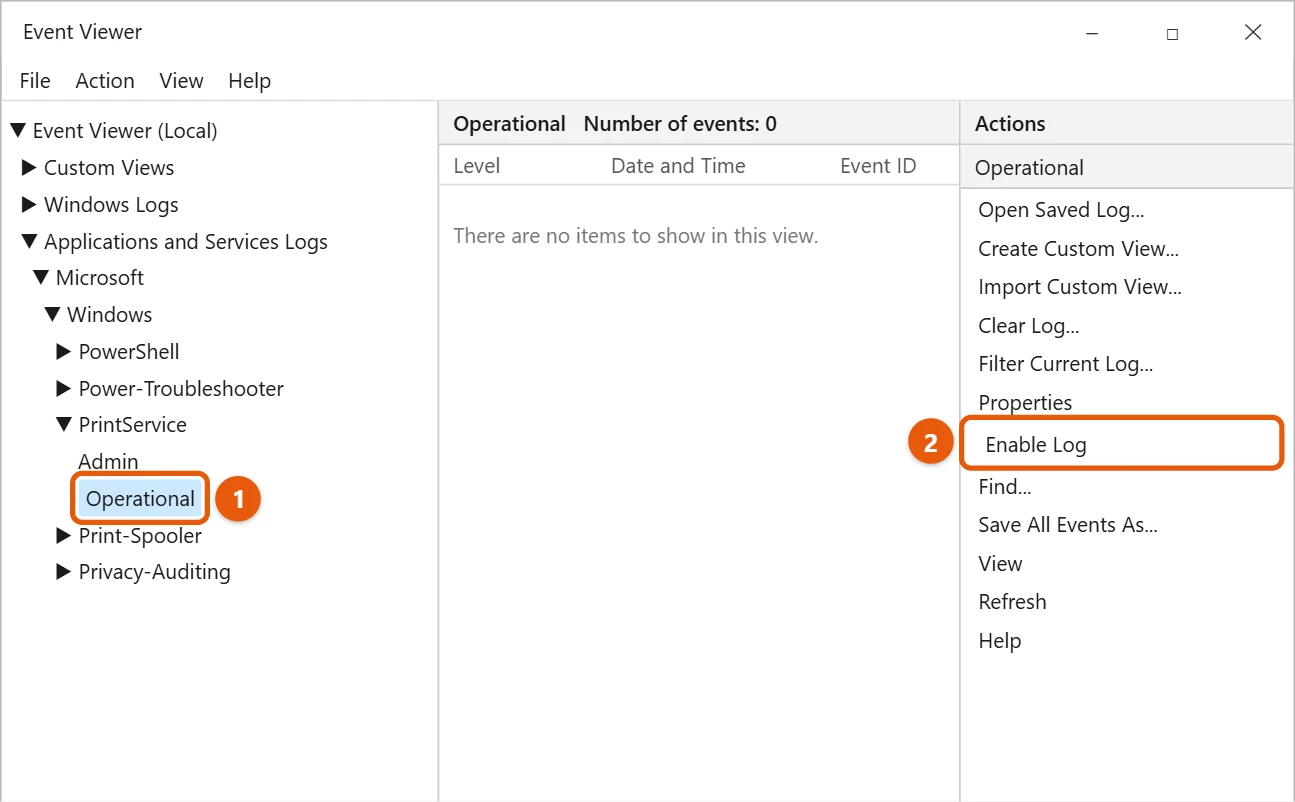
Windows starts recording from now on. It can’t show documents printed before you turned the log on. Print logs pair well with the other activity records Windows 10 keeps, such as sign-in times and recently opened files.
Can I see print history in Windows 11 the same way?
Yes. The PrintService Operational log and event 307 work the same in Windows 11, as shown in checking print history in Windows 11.
Does print history slow down my PC?
No. Each print adds one small entry to the log, so the effect on speed and storage is tiny.
See what was printed
- In Event Viewer, select the Operational log under PrintService.
- Under Actions, select Filter Current Log.
- In the Event IDs box, type
307and select OK. - Select an event. The General tab shows the document name, who printed it, the printer and the pages printed.
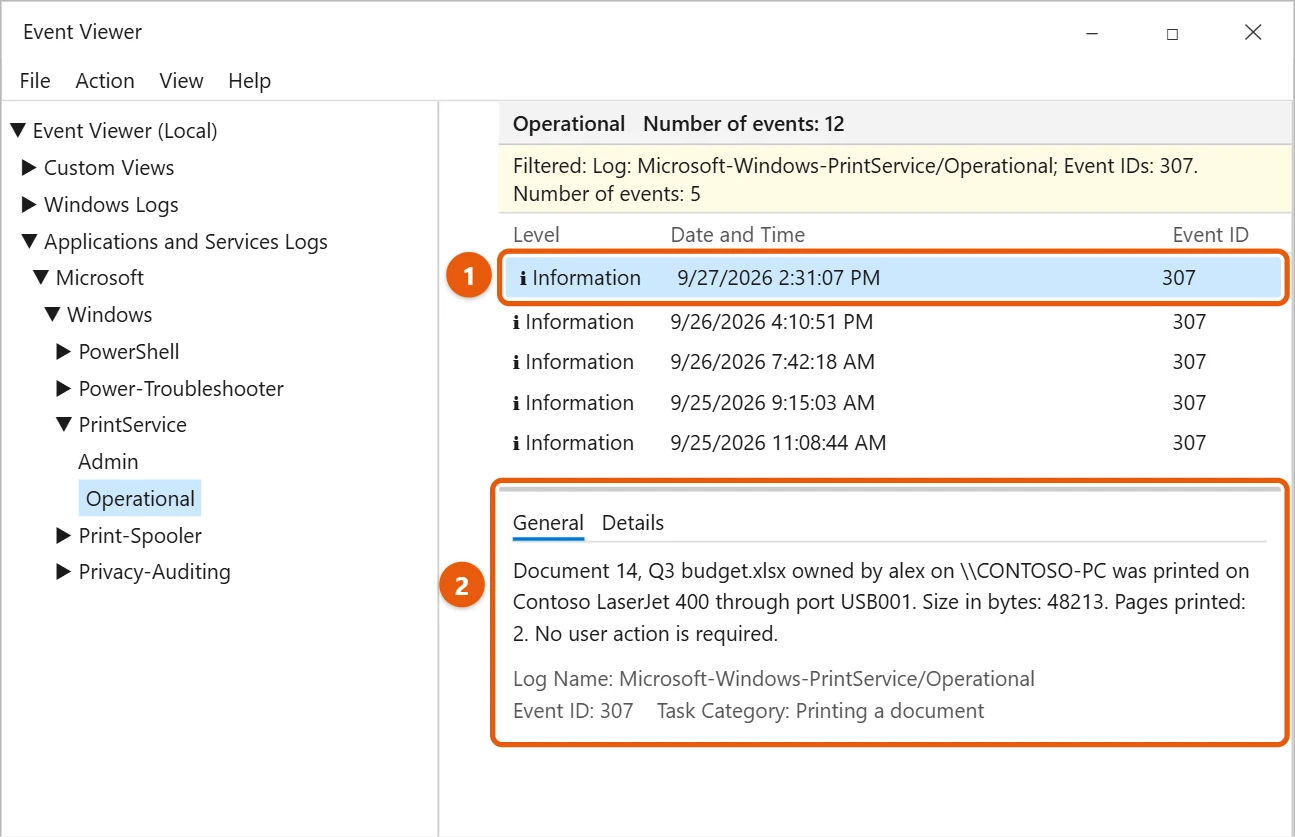
To keep more history, right-click Operational, select Properties, and raise Maximum log size.
Save a shortcut view of your print history
Instead of filtering each time, create a custom view. In Event Viewer, select Create Custom View on the right. Choose By log, pick Microsoft-Windows-PrintService/Operational, type 307 in the Event IDs box, and select OK. Give it a name such as Print history. It appears under Custom Views on the left, ready whenever you need it.
Export the history to a spreadsheet
With the 307 filter or custom view open, select Save Filtered Log File As on the right. Choose CSV (Comma Separated) as the file type and save it. You can open the file in Excel to sort by date, user or printer, or to add up the pages printed.
See the print queue
To see documents waiting to print, go to Settings > Devices > Printers & scanners, select the printer, and select Open queue.
To keep finished documents in the queue, open Control Panel > Hardware and Sound > Devices and Printers. Right-click the printer, select Printer properties, select the Advanced tab, and check Keep printed documents. They stay until you delete them. This uses disk space, so turn it off when you’re done. On Windows 11, a job that will not leave the queue is covered in how to clear the printer queue in Windows 11.
Can I see what was printed last week?
Only if the log was already on. Some office printers also keep their own job list on their built-in web page. Check your printer’s manual.
No print events in Event Viewer
- Event Viewer shows Disable Log instead of Enable Log. The log is already on. Your history starts from when it was first turned on.
- There are no 307 events. Print a test page, then select Refresh. If you print through a shared printer on another PC or a print server, the history is recorded there instead.
- Old entries keep disappearing. The log reached its size limit. Raise Maximum log size in the log’s Properties, or export the history regularly.
- You can’t enable the log. Sign in with an administrator account and open Event Viewer again.
My printer stopped printing. What should I try?
If it shows as offline, start by getting the printer back online. When that fails, remove the printer and add it again.

Matt Jacobs writes and maintains the guides on Support Your Tech, which he started in 2017. He spent most of his career keeping small-business PCs running and still takes the occasional consulting job, so the steps here come from fixing the same problems on other people’s computers. Every guide is checked on his own Windows 11, Windows 10, Mac, iPhone and iPad before it goes up.