The quickest way is to plug the PS5 controller into your PC with a USB-C data cable. To go wireless, hold the Create button and the PS button until the light bar flashes, then go to Settings > Bluetooth & devices > Add device > Bluetooth and select Wireless Controller.
Applies to: Windows 11 and the PS5 DualSense controller. Checked against Microsoft Support on September 29, 2026.
Connect with a USB cable
- Plug a USB-C cable into the controller and a USB port on your PC.
- Windows sets it up by itself. The controller also charges while it’s plugged in.
Use a cable that carries data, not only power.
Connect with Bluetooth
- Make sure the controller is off, or not connected to a PS5 nearby.
- Hold the Create button (top left of the touch pad) and the PS button together until the light bar flashes.
- On your PC, select Start > Settings > Bluetooth & devices > Add device.
- Select Bluetooth.
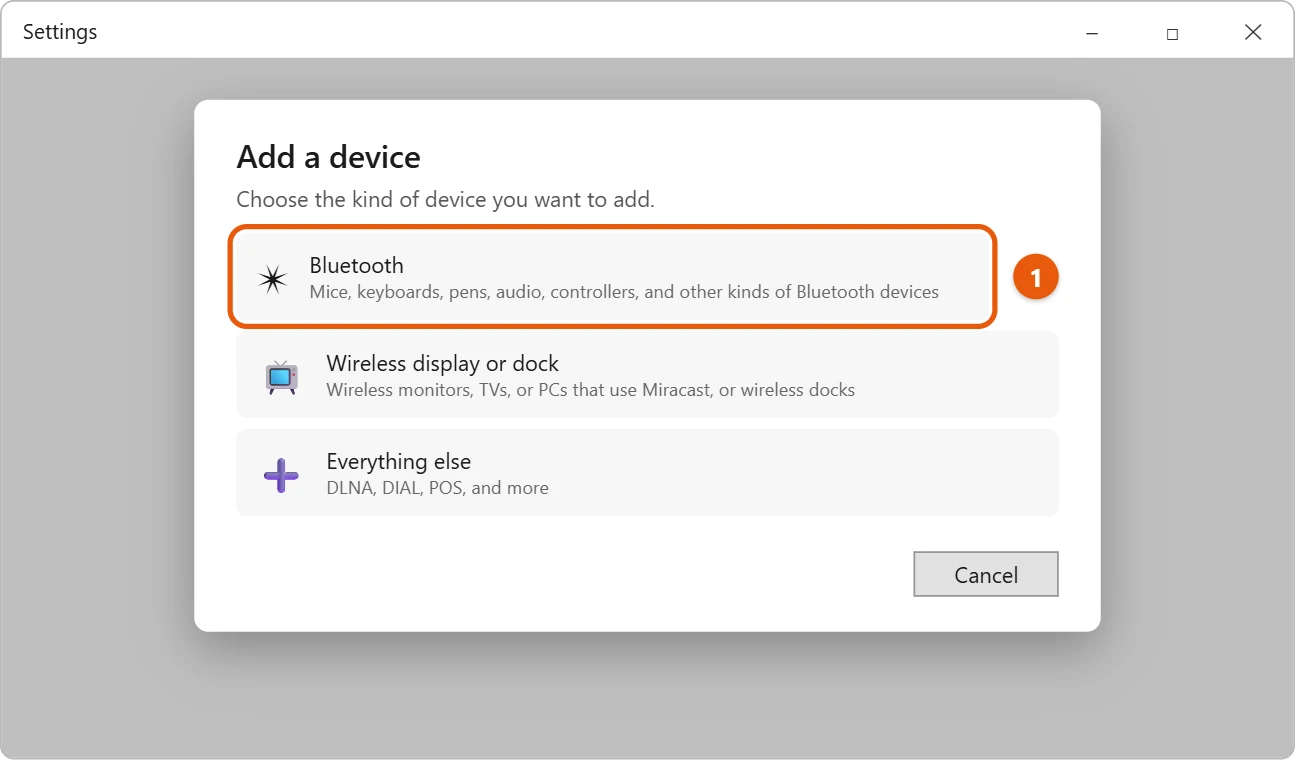
- Select Wireless Controller when it appears.
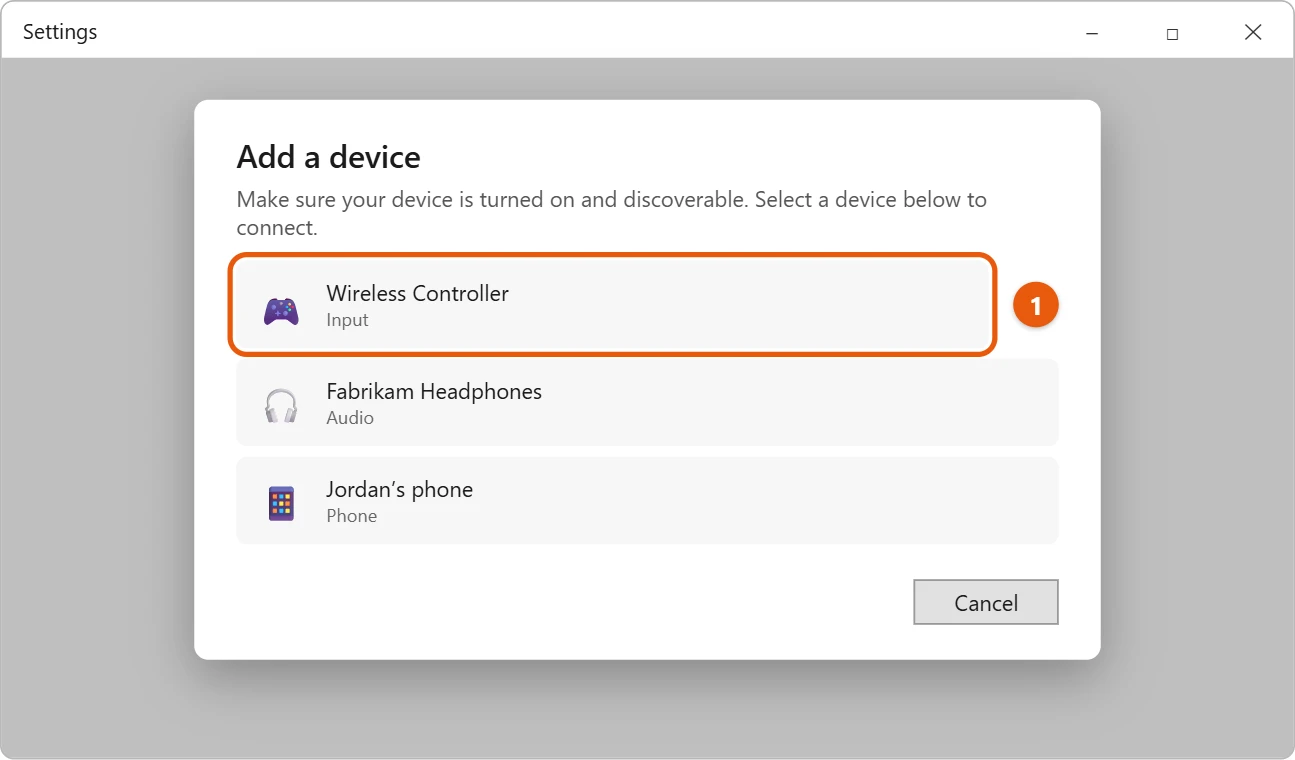
- When the light bar stays on, it’s connected. Select Done.
If Bluetooth is off, see how to turn on Bluetooth in Windows 11.
Use it in games
Many PC games support the PS5 controller, including its buttons shown on screen. Some games only support Xbox-style controllers. Check the game’s settings or its store page for controller support.
Use it with Steam
Steam has the best PS5 controller support on PC, and it can make the controller work in games that only expect an Xbox controller. Open Steam, go to Settings > Controller, and turn on Enable Steam Input for PlayStation controllers. Steam then shows PlayStation button icons where games support them and lets you remap buttons per game.
What works on a PC
- Always: sticks, buttons, triggers, and the touch pad as a button.
- In supported games: the touch pad as a touch surface, motion controls, and the light bar.
- Mostly with a cable: haptic feedback and adaptive triggers. Most PC games that support them only do so over USB.
- Headset jack: works over USB in many cases, but not over Bluetooth.
If it won’t connect or games don’t see it
- The light bar doesn’t flash. The controller isn’t in pairing mode. Hold Create and PS together for about five seconds until it flashes twice quickly and repeatedly.
- It paired before but won’t reconnect. In Settings > Bluetooth & devices, select Wireless Controller > Remove device, then pair it again.
- It keeps connecting to your PS5. Turn the console off fully, or use a USB cable on the PC.
- A game ignores it. Launch the game through Steam with Steam Input on, as described above.
- It disconnects often over Bluetooth. Move closer to the PC or use a USB Bluetooth adapter on a front port. A USB cable is the most reliable option.
Frequently asked questions
How do I turn the controller off?
Hold the PS button for about 10 seconds, or turn off Bluetooth on the PC. To use it with your PS5 again, plug it into the console with the cable and press the PS button.
Can I use an Xbox controller instead?
Yes, and Windows supports it widely. See how to connect an Xbox controller to Windows 10; the steps are the same on Windows 11.
Do I need to install drivers?
No. Windows 11 recognizes the PS5 DualSense controller on its own, over USB or Bluetooth. Apps such as Steam add extra features, but you don’t need anything else for it to work.
How do I check the battery level?
Steam shows it in its Big Picture mode when the controller is connected. Windows may show a percentage under the controller in Bluetooth & devices, depending on your Bluetooth adapter. The controller lasts several hours per charge and charges from any USB port.
Can I use the PS5 Edge controller?
Yes. It connects the same way and shows as a wireless controller. Its back buttons need Steam Input or game support to be remapped.
Microsoft’s reference is Pair a Bluetooth device in Windows, and Sony’s PlayStation Support explains the Create and PS button pairing. More help is on our Windows Help & Guides page.

Matt Jacobs has been working as an IT consultant for small businesses since receiving his Master’s degree in 2003. While he still does some consulting work, his primary focus now is on creating technology support content for SupportYourTech.com.
His work can be found on many websites and focuses on topics such as Microsoft Office, Apple devices, Android devices, Photoshop, and more.