To find all Word documents on your computer, open File Explorer, select This PC in the left pane, and type ext:.docx OR ext:.doc in the search box. Windows lists every Word file on all your drives, and you can sort the results by Date modified to find recent ones. Also check File > Open in Word and your OneDrive, because documents saved to the cloud may not be on the PC at all.
Applies to: Windows 11 and Windows 10 with Word for Microsoft 365, Word 2024, 2021 or 2019. Last reviewed October 7, 2026.
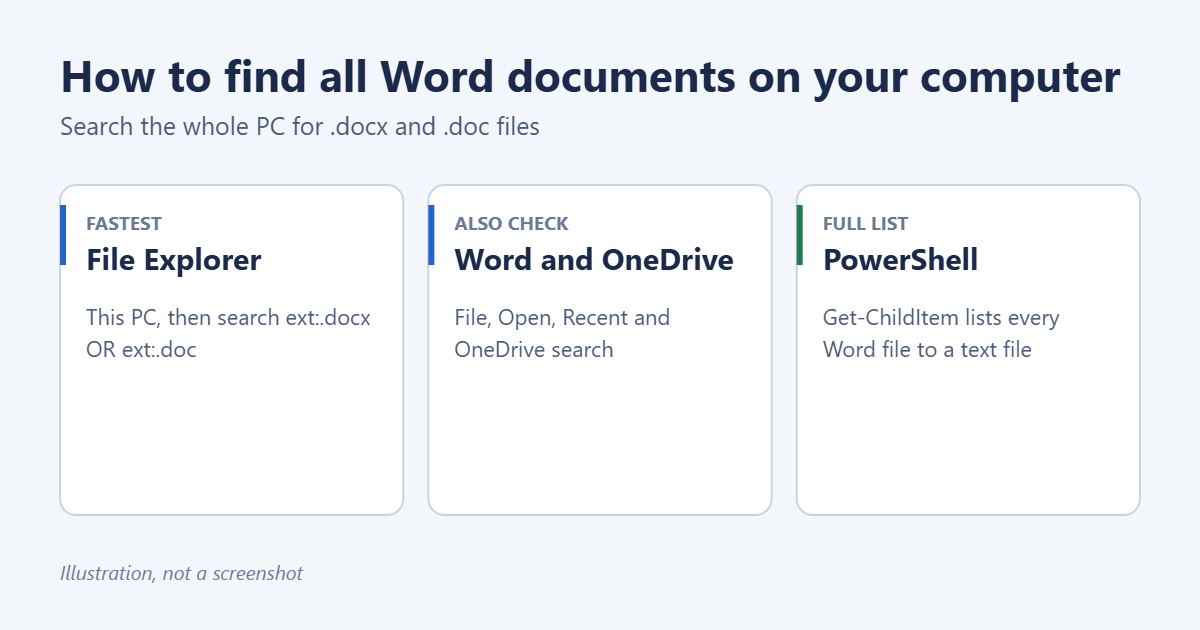
Search the whole PC in File Explorer
- Press Windows logo key + E to open File Explorer.
- Select This PC in the left pane, so the search covers every drive.
- Click in the search box in the top-right corner and type
ext:.docx OR ext:.doc. Type OR in capitals. - Press Enter and wait. Searching an entire PC can take a few minutes the first time.
- Select the View menu and choose Details, then select the Date modified column heading to sort newest first.
Right-click any result and select Open file location to see the folder it’s in.
Other useful searches
kind:=documentfinds Word documents along with PDFs, text files and other documents.ext:.docx datemodified:this weekfinds Word files changed in the last week. Try last month or this year too.ext:.docx budgetfinds Word files with “budget” in the name or, if the location is indexed, in the text.ext:.dotx OR ext:.docmfinds Word templates and macro-enabled documents.ext:.rtf OR ext:.odtfinds documents Word can open that were saved in other formats.
Make Windows search faster and more thorough
By default, Windows indexes only your user folders, such as Documents and Desktop. Searches elsewhere work, but slowly. To index every drive:
- Open Settings > Privacy & security > Searching Windows (in Windows 10, Settings > Search > Searching Windows).
- Under Find my files, choose Enhanced.
- Leave the PC plugged in while indexing finishes. It can take a few hours on a large drive.
Once indexing is done, searches return results almost instantly and can match words inside documents, not just file names.
Find documents from inside Word
- Open Word and select File > Open.
- Select Recent to see documents you’ve opened lately, including ones saved in OneDrive or SharePoint.
- Use the search box at the top of the Open screen to search those locations by name.
Right-click a recent file and select Copy path to clipboard or Open file location to see where it’s stored.
Check OneDrive and the cloud
If you sign in to Office with a Microsoft account, Word may save documents to OneDrive by default. Those files appear in File Explorer’s OneDrive folder, but some may be online-only.
- In File Explorer, select OneDrive in the left pane and search there with
ext:.docx. - Or go to office.com, sign in, and select Word to see every document in your OneDrive, including ones that aren’t synced to this PC.
- Work and school accounts may store documents in SharePoint or Teams. Check the Files tab in the Teams channels you use.
List every Word document with a command
To get a complete list you can save or print, use PowerShell:
- Right-click Start and select Terminal.
- Paste this command and press Enter:
Get-ChildItem -Path C:\ -Include *.docx,*.doc -Recurse -ErrorAction SilentlyContinue | Select-Object FullName, LastWriteTime | Export-Csv "$env:USERPROFILE\Desktop\word-files.csv" -NoTypeInformation - When it finishes, open word-files.csv on your desktop in Excel. It lists every Word file’s full path and when it was last changed.
Change C:\ to D:\ to search another drive. The command skips folders you don’t have permission to open.
Copy all Word documents into one folder
- Run the File Explorer search above.
- Press Ctrl + A to select every result.
- Press Ctrl + C, open the folder you want, and press Ctrl + V.
Files with the same name in different folders will conflict. Windows asks whether to replace, skip or keep both; choose Let me decide for each file if you want to check them. Copying leaves the originals in place, which is safer than moving them.
Find a document you can’t see anywhere
- Unsaved documents: in Word, select File > Info > Manage Document > Recover Unsaved Documents. See how to recover unsaved or deleted Word documents.
- Deleted documents: check the Recycle Bin, and in OneDrive check the online Recycle bin, which keeps files for 30 days.
- Older versions: files in OneDrive keep a version history. See how to see previous versions of a Word document.
- AutoRecover files: search File Explorer for
ext:.asd, the format Word uses for autosaved copies.
Keep your documents easy to find next time
- Pick one home for documents, such as your Documents folder or a OneDrive folder, and set it as Word’s default: select File > Options > Save and change Default local file location.
- Use descriptive file names that include a date or project, such as 2026-10 Budget Report.docx, so searches find them by name.
- Pin important documents in Word’s File > Open > Recent list by selecting the pin icon next to them.
- Add folders to Quick access in File Explorer: right-click a folder and select Pin to Quick access.
- Turn on OneDrive backup for your Documents and Desktop folders so your files are searchable from any device.
Troubleshooting
The search finds nothing
Check that you selected This PC before searching, not a single folder. Make sure there are no typos in ext:.docx, and wait for the progress bar in the address bar to finish.
Search is very slow
The drive isn’t indexed. Turn on Enhanced search as described above, or use the PowerShell command, which doesn’t depend on the index.
Some documents are missing from the results
They may be online-only OneDrive files, on an external drive that isn’t connected, or in a folder excluded from search. Connect external drives and search them separately, and check office.com for cloud files.
Thousands of results appear
Programs install their own Word files, such as templates and help documents. Add a date filter, such as datemodified:this year, or search only your user folder (C:\Users\YourName).
Frequently asked questions
What’s the difference between .doc and .docx?
.docx is the format Word has used since Word 2007. .doc is the older format. Current Word versions open both, and you can save a .doc as .docx with File > Info > Convert.
How do I find all Word documents on a Mac?
Open Finder, press Command + F, select This Mac, set the search criteria to Kind is Document, and type docx in the search field.
Can I search for text inside Word documents?
Yes. Type the words into File Explorer’s search box. It finds matches inside documents in indexed locations, which is why turning on Enhanced search helps.
How do I find other file types?
Use the same method with a different extension, such as ext:.xlsx for Excel. See how to find all Excel files.
Related: How to duplicate a Word document.

Matt Jacobs has been working as an IT consultant for small businesses since receiving his Master’s degree in 2003. While he still does some consulting work, his primary focus now is on creating technology support content for SupportYourTech.com.
His work can be found on many websites and focuses on topics such as Microsoft Office, Apple devices, Android devices, Photoshop, and more.