To format a 6×9 book in Word, set the page size first: go to Layout > Size > More Paper Sizes and enter 6″ wide by 9″ high for the whole document. Then open Layout > Margins > Custom Margins, set Multiple pages to Mirror margins, and give the Inside margin enough room for the spine. After that, style your chapter titles with Heading 1, start each chapter with a section break, set up page numbers that begin at 1 on Chapter 1, and save a PDF with the fonts embedded. Do the page setup before you paste in your manuscript, so the text only reflows once.
Applies to: desktop Word for Microsoft 365 (Windows and Mac), Word 2024, Word 2021, Word 2019 and Word 2016. Menu names below are from Word for Windows; Mac differences are noted where they matter. The steps are written for the desktop app, which has the full page setup and PDF options that print formatting needs.
Book printing terms in plain English
A few printing words come up in every step. Knowing them makes the settings much less mysterious.
- Trim size: the finished size of the printed page after the printer cuts it. 6 x 9 inches is a common trade paperback size, popular for nonfiction, memoir and many novels.
- Inside margin (gutter side): the margin next to the spine. It has to be wider than the outside margin because some of the page curves into the binding.
- Recto and verso: recto is a right-hand page (odd page numbers), verso is a left-hand page (even page numbers). Chapters traditionally start on a recto page.
- Bleed: extra image area beyond the trim line, needed only when a picture or background color runs right to the edge of the page. A text-only book doesn’t need bleed.
- Front matter: the pages before Chapter 1, such as the title page, copyright page, dedication and contents.
Before you start
- Check your printer’s specs. The exact trim sizes, minimum margins and bleed rules come from the print-on-demand service or printer you’ll use, not from Word. Amazon KDP, for example, publishes them on its Set Trim Size, Bleed, and Margins help page. Decide on bleed and an approximate page count before you set margins.
- Work on a copy. Changing an 8.5 x 11 manuscript to 6 x 9 reflows every page and often adds many pages. Save the formatted version as a new file, such as MyNovel-6×9-print.docx.
- Turn on formatting marks. Select Home > Show/Hide ¶. You’ll see section breaks, page breaks and stray empty paragraphs, which cause most layout problems.
- Use Print Layout view. Go to View > Print Layout so you see real pages. View > Multiple Pages helps you check facing pages later.
Still drafting? Writing a book in Word covers outlining, chapter organization and drafting tools. This guide picks up when the text is ready to be laid out for print.
Step 1: Set the page size to 6 x 9 inches
- Open your manuscript copy, or a new blank document if you’ll paste the text in later.
- Go to Layout > Size > More Paper Sizes. The Page Setup dialog opens on the Paper tab.
- Set Width to 6″ and Height to 9″. If Word shows centimeters, enter 15.24 cm and 22.86 cm. The Paper size box changes to Custom size.
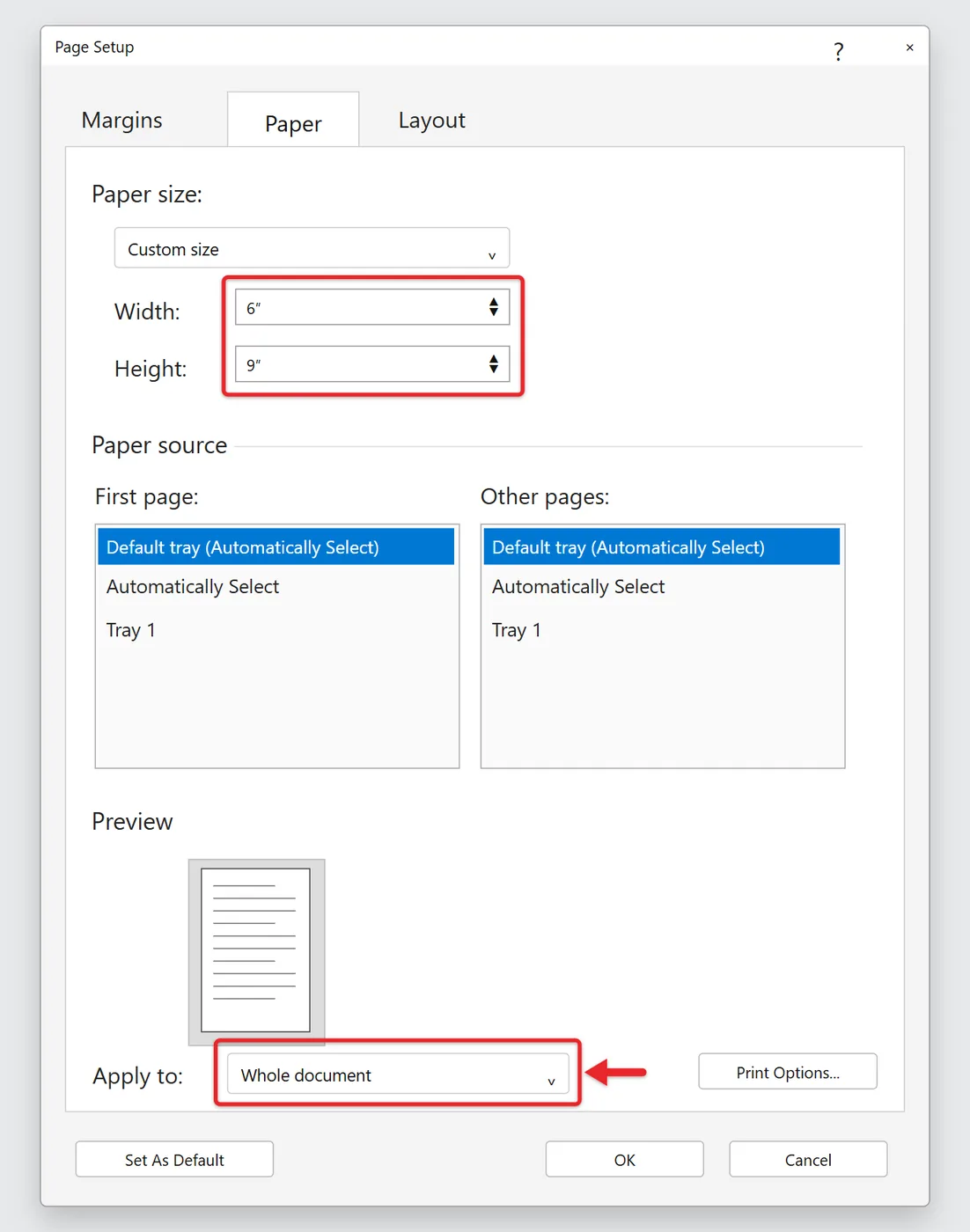
- Set Apply to to Whole document and select OK.
The pages on screen become narrow and tall, and the page count in the status bar goes up. On a Mac, if you don’t see a custom width and height under Layout > Size, use File > Page Setup, open the Paper Size list, choose Manage Custom Sizes, and add a 6 x 9 in size, as described in Apple’s steps for creating a custom paper size on a Mac.
If your book needs bleed
Only books with images or color that run off the edge need bleed. Printers handle it by making the page slightly larger than the trim size. For a 6 x 9 book on KDP, the page size with bleed is 6.125″ x 9.25″, because the bleed is 0.125″ on the top, bottom and outside edges. Other printers may want bleed on all four sides, so confirm with yours. Word doesn’t add bleed for you: you set the larger page size and stretch edge-to-edge images past the trim line yourself.
Step 2: Set mirror margins and the inside margin
Mirror margins make the left and right pages match like a printed book: the wide margin is always on the spine side. Microsoft’s page on setting mirror margins for facing pages shows the same setting.
- Go to Layout > Margins > Custom Margins.
- Under Pages, open Multiple pages and choose Mirror margins. The Left and Right boxes change to Inside and Outside, and the preview shows two facing pages.
- Enter your margins. A comfortable starting point for a 6 x 9 text book of about 150 to 300 pages is Top 0.75″, Bottom 0.75″, Inside 0.75″ and Outside 0.5″.
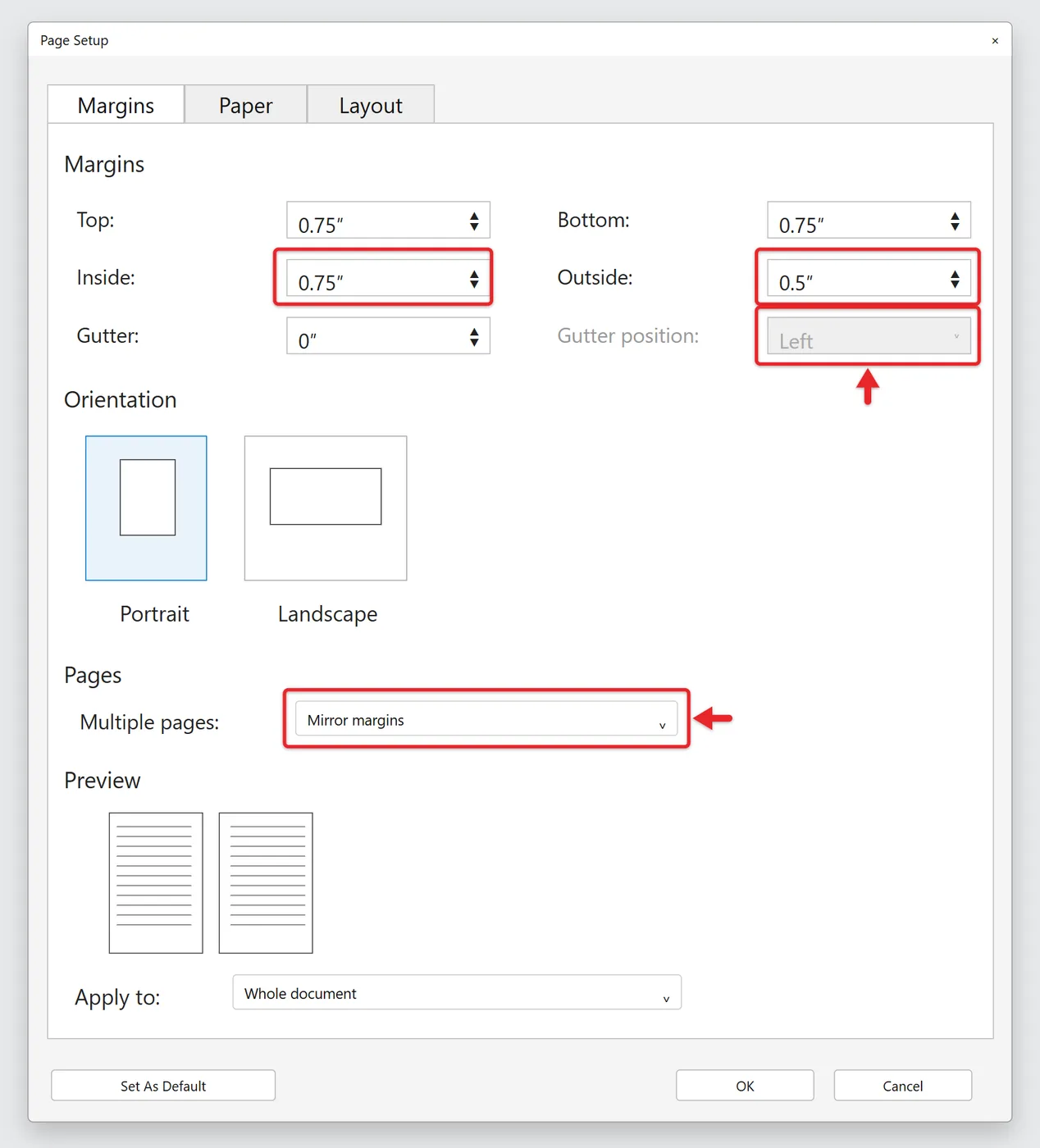
- Leave Gutter at 0″ if your inside margin already includes the binding space (simplest), or put the extra binding space in Gutter instead. Don’t do both by accident.
- Set Apply to to Whole document and select OK.
With mirror margins on, the Gutter position box is grayed out because Word places the gutter on the binding side automatically, as Microsoft explains in its gutter margin article. What counts for the printer is the total space on the spine side: inside margin plus gutter.
How wide should the inside margin be?
Thicker books need more room on the spine side. These are KDP’s published minimums for paperbacks; most designers go wider for comfort.
| Page count | Minimum inside margin | Minimum outside, top and bottom |
|---|---|---|
| 24 to 150 | 0.375″ | 0.25″ (0.375″ with bleed) |
| 151 to 300 | 0.5″ | 0.25″ (0.375″ with bleed) |
| 301 to 500 | 0.625″ | 0.25″ (0.375″ with bleed) |
| 501 to 700 | 0.75″ | 0.25″ (0.375″ with bleed) |
| 701 to 828 | 0.875″ | 0.25″ (0.375″ with bleed) |
If you add a lot of pages later, recheck this table, because crossing a page-count boundary raises the minimum. A minimum-margin book looks cramped, so an extra 0.25″ over the minimum on the inside is a reasonable habit.
Step 3: Style the body text
Change the Normal style rather than formatting paragraphs by hand. Every body paragraph then updates at once.
- On the Home tab, right-click Normal in the Styles gallery and choose Modify.
- Pick a readable serif font, such as Garamond, Georgia, Palatino Linotype, Book Antiqua or Cambria, at 11 or 12 pt.
- Select Format > Paragraph. Set Alignment to Justified, Special to First line by 0.25″ to 0.3″, Before and After to 0 pt, and Line spacing to Multiple at 1.15 to 1.3.
- On the Line and Page Breaks tab, make sure Widow/Orphan control is checked. It’s on by default and stops a single line of a paragraph from being stranded at the top or bottom of a page.
- Select OK twice.
Fiction usually uses first-line indents with no space between paragraphs. Nonfiction often uses block paragraphs with a little space after each and no indent. Pick one approach, not both. For more indent options, see how to indent in Word.
Small touches that make it look like a real book
- No indent on the first paragraph of a chapter or scene. Create a style based on Normal (for example “First Paragraph”) with the first-line indent set to 0, and apply it after each chapter title and scene break.
- Visible scene breaks. Use a centered ornament such as * * * instead of a blank line. A blank line disappears when it lands at the bottom of a page.
- Hyphenation. Justified text in a narrow 6-inch page can get wide gaps between words. Layout > Hyphenation > Automatic tightens the spacing; see turning on automatic hyphenation in Word.
- Clean paste. If you paste chapters in from another file, use Paste Options > Keep Text Only so old fonts and spacing don’t come along. You’ll then need to reapply italics.
Step 4: Format chapter headings and chapter breaks
- Click in a chapter title and select Heading 1 in the Styles gallery. Repeat for every chapter. Using the same style everywhere is what makes the automatic table of contents and the Navigation pane work.
- Right-click Heading 1 > Modify and set the look: for example centered, 18 to 24 pt, black, with about 72 pt of space before so the title sits lower on the page, as most printed books do.
- Delete any manual page breaks or rows of empty paragraphs you used to push chapters to new pages.
- Click just before the first character of each chapter title (from Chapter 2 on) and go to Layout > Breaks > Odd Page. Each chapter now starts on a right-hand page, and Word adds a blank page when needed.
Prefer no blank pages? Use Layout > Breaks > Next Page instead. Chapters then start on whichever page comes next, which is common in nonfiction and saves paper. Either way, these are section breaks, so each chapter can have its own header. Adding a section break in Word explains the four break types if they’re new to you.
The Page break before option on the Line and Page Breaks tab of Heading 1 is another way to push chapters to a new page, documented on Microsoft’s Line and Page Breaks settings page. It doesn’t create sections, though, so use section breaks if you want chapter names in the headers or numbering that restarts.
Step 5: Add the front matter and a table of contents
A typical order for a 6 x 9 paperback is:
- Half-title page (book title only), recto
- Blank page or “Also by” list, verso
- Title page (title, subtitle, author name), recto
- Copyright page, verso
- Dedication or epigraph, recto (optional)
- Table of contents, recto (common in nonfiction, optional in fiction)
- Chapter 1, recto
Separate each front-matter page with Layout > Breaks > Next Page, and use an Odd Page break before Chapter 1. For a copyright page, a short block works: copyright line with year and author name (for example, Copyright © 2026 Alex Morgan), “All rights reserved,” edition, and ISBN if you have one.
To add the contents page, click on the contents page and go to References > Table of Contents, then pick an automatic style. It lists every Heading 1 with its page number. Because page numbers change as you edit, update it last: right-click the table and choose Update Field > Update entire table. The table of contents guide covers custom levels and styles.
Turn on different odd and even pages
- Double-click the top margin of any page to open the header. The Header & Footer tab appears on the ribbon.
- Check Different Odd & Even Pages. Odd (right-hand) and even (left-hand) pages now have separate headers and footers.
- Check Different First Page in each chapter’s section. The opening page of every chapter then has no running header, which is standard in printed books.
- In an even-page header, type the author name; in an odd-page header, type the book title or the chapter name. Microsoft’s article on different headers or footers for odd and even pages shows the same setup.
Want the chapter name in each chapter’s header? Turn off Link to Previous in that chapter’s odd-page header before you type, or the change spreads to every other section. Making different headers in Word walks through unlinking in more detail.
Add page numbers on both sides
- Go to Insert > Page Number > Bottom of Page and choose a centered number, or place numbers on the outside corners: right-aligned on odd pages and left-aligned on even pages.
- Because odd and even pages are now separate, add the number on one odd page and one even page. If numbers appear only on every other page, this is the step that was missed.
- Check that chapter opening pages show a number in the footer if you want one there. With Different First Page on, the first-page footer is separate too.
Start numbering at 1 on Chapter 1
- Click in the footer of the first page of Chapter 1.
- On the Header & Footer tab, turn off Link to Previous for the footer (do it for the odd, even and first-page footers in that section).
- Go to Page Number > Format Page Numbers, choose Start at and enter 1. Select OK.
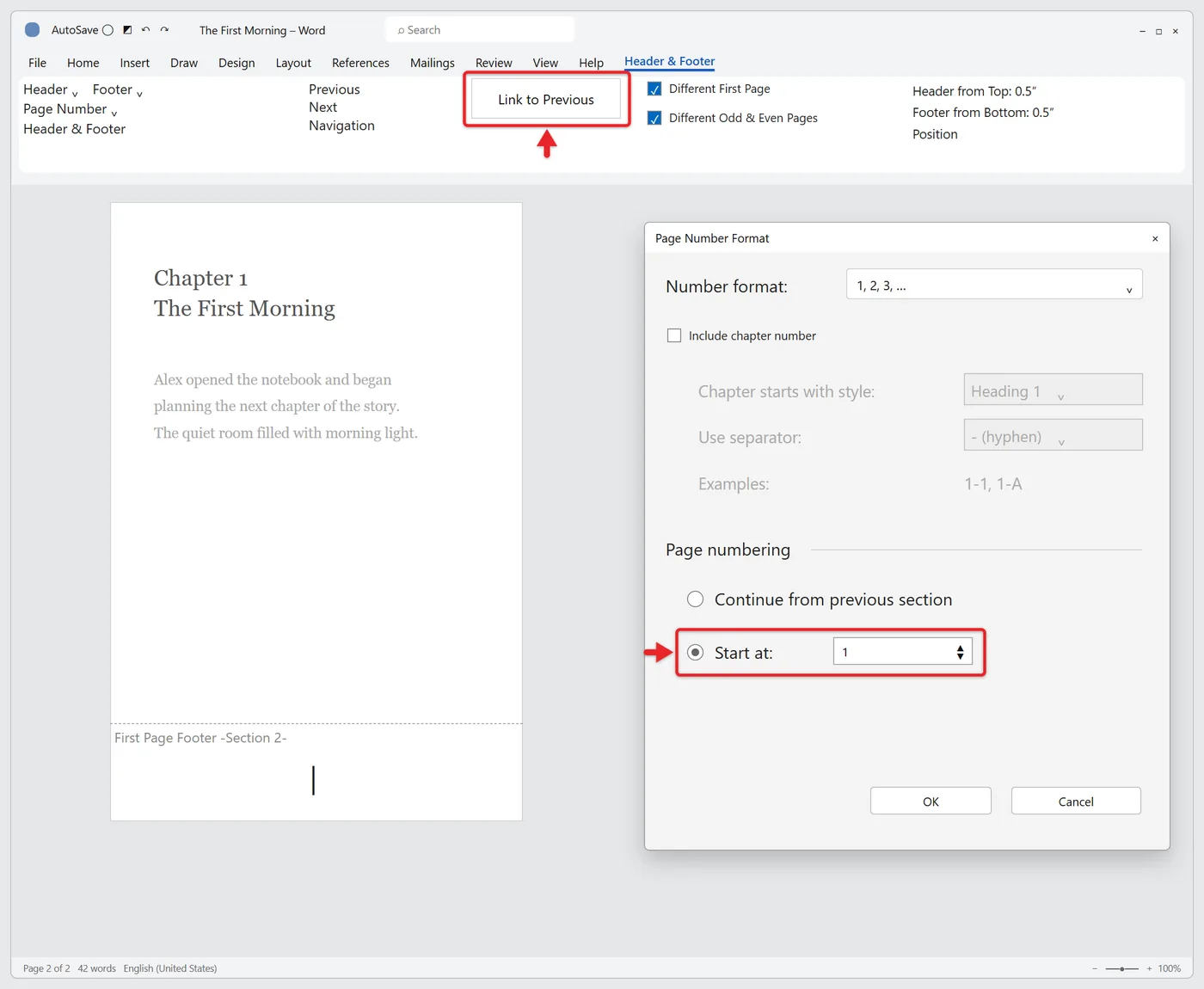
- Go back to the front matter and delete its page numbers, or set its Number format to i, ii, iii if you want roman numerals there.
If later chapters restart at 1 too, select their page numbers, open Format Page Numbers and choose Continue from previous section. Restarting page numbering in Word covers more numbering cases, and you can delete the header in one section to keep the front matter clean.
Step 7: Prepare images (if your book has any)
- Use images that are about 300 DPI at the size they will print. A photo that fills the 4.75″ text width needs to be roughly 1,425 pixels wide.
- Stop Word from shrinking them: File > Options > Advanced > Image Size and Quality, then check Do not compress images in file.
- Set each picture’s Layout Options to In Line with Text or Top and Bottom, so images don’t drift when text above them changes.
- Keep images inside the margins unless you set up bleed. To scale them precisely, see resizing an image in Word.
Step 8: Export a print-ready PDF with embedded fonts
Most print-on-demand services want a PDF, not a .docx file. The PDF locks the layout and should carry its fonts with it.
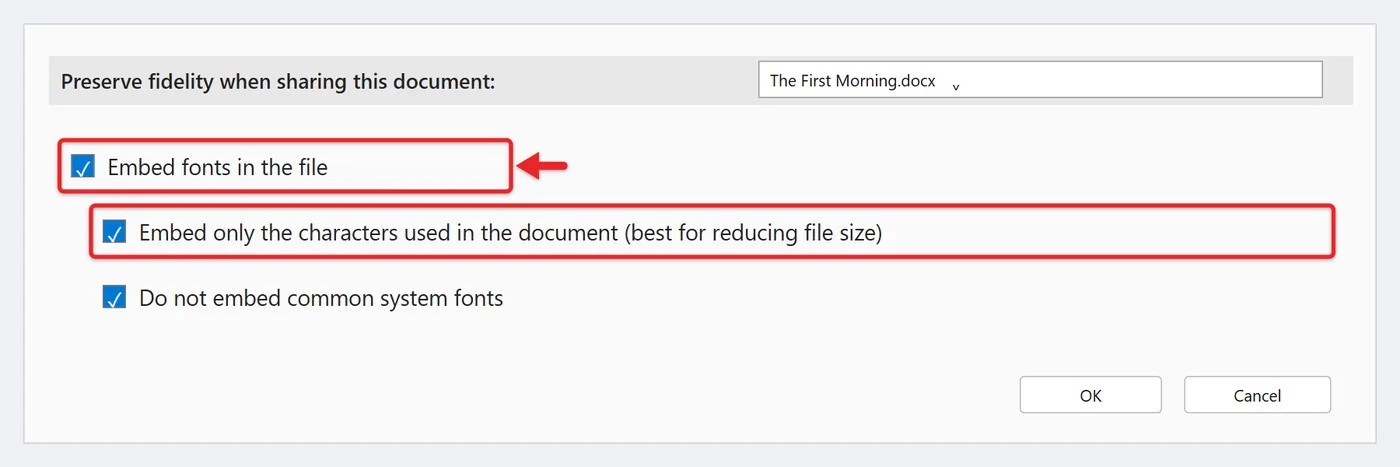
- Go to File > Options > Save. Under Preserve fidelity when sharing this document, check Embed fonts in the file, and leave Embed only the characters used in the document checked to keep the file smaller. Select OK. Microsoft’s page on embedding fonts notes that some fonts don’t allow embedding, so stick with fonts whose license permits it.
- Update the table of contents one last time (right-click it, Update Field).
- Go to File > Save a Copy (or Save As), choose a folder, and set the file type to PDF.
- Choose Standard (publishing online and printing) rather than Minimum size if Word shows that choice.
- Select Options. Confirm Page range is All. Checking ISO 19005-1 compliant (PDF/A) forces fonts to be embedded, but it’s optional; leave it off if your printer asks for a standard PDF. Select OK, then Save.
On a Mac, use File > Save As, choose PDF as the file format, and pick Best for printing if that option appears. Microsoft’s full list of PDF options is on Save or convert to PDF. If a printer requires PDF/X, note that Word’s PDF options don’t include it; ask the printer whether a standard PDF with embedded fonts is accepted.
How to check the finished file
Open the PDF in a PDF reader (not Word) and go through this list:
- The document properties show a page size of 6 x 9 in (or 6.125 x 9.25 in with bleed) on every page.
- The fonts list in the reader’s document properties shows every font as embedded or embedded subset.
- Chapter 1 and every chapter opening sit on odd-numbered PDF pages if you used Odd Page breaks. Use a two-page view with the cover page shown separately to see real spreads.
- Page numbers start at 1 on Chapter 1, and blank pages and chapter openers have no running header.
- Margins look wider on the spine side of every page, and no text or page number crosses the printer’s minimum.
- Italic, special characters and images came through correctly. Opening the PDF on a different computer is a good test for missing fonts.
Most print-on-demand services also show an online previewer after upload that flags margin problems. For a physical proof of your layout at home, you can print the book in Word double-sided and look at real spreads.
To undo the whole layout, go back to the unformatted manuscript copy you saved before Step 1. Individual changes are reversible too: set the paper size back to Letter and Multiple pages back to Normal.
Book fold or a template instead?
Book fold (in Custom Margins > Multiple pages) is for a different job. It prints two half-size pages side by side on landscape Letter or A4 paper so you can fold and staple a booklet at home, as Microsoft’s Create a booklet or book in Word describes. Don’t use it for a 6 x 9 file you’ll upload to a printer; use mirror margins.
A ready-made 6 x 9 Word template saves the page setup and styles, but it still needs the same checks: margins that meet your printer’s minimum for your page count, your fonts embedded, and correct numbering after you paste your text into it. If you use one, paste as text only and apply the template’s styles.
Troubleshooting
Some pages are still Letter size
One section kept its old settings. Press Ctrl + A (Command + A on Mac), open Layout > Size > More Paper Sizes, and apply 6 x 9 to the Whole document again. Do the same for margins.
Page numbers show only on odd or only on even pages
Different Odd & Even Pages is on, so each side needs its own number. Insert the page number on an even page as well. If you don’t want separate headers, uncheck the option instead.
Headers repeat the wrong chapter name
The chapter’s header is still linked to the previous section. Click in it, turn off Link to Previous, then retype the name. Check both the odd and even headers.
Extra blank pages before chapters
That’s how Odd Page breaks work when the previous chapter ends on a right-hand page. If you see two blank pages in a row, look for a manual page break or empty paragraphs before the section break and delete them. Switch to Next Page breaks if you’d rather not have blank pages at all.
The printer says fonts aren’t embedded
Turn on Embed fonts in the file (Step 8) and export again. If a specific font still won’t embed, its license doesn’t allow it; switch that text to another font, or check Bitmap text when fonts may not be embedded in the PDF options as a last resort.
Chapter titles split from their first paragraph
Heading 1 normally has Keep with next turned on. If a title ends up alone at the bottom of a page, modify Heading 1 and check Keep with next on the Line and Page Breaks tab.
FAQ
What margins should I use for a 6×9 book in Word?
For a 200 to 300 page text book, 0.75″ top, bottom and inside with 0.5″ outside is a comfortable layout that clears KDP’s 0.5″ inside minimum for 151 to 300 pages. Books over 300 pages need a wider inside margin; check your printer’s table.
Should I use the Gutter box or a bigger inside margin?
Either works, because the printer only cares about the total space on the spine side. Using the inside margin alone with Gutter at 0 is easier to keep track of. If you do use Gutter, remember it’s added on top of the inside margin.
Does Word have a built-in 6×9 paper size?
Not in the standard list on most installations, so you enter it as a custom size. Some printer drivers add more sizes to the list, but the custom 6″ x 9″ entry works on any computer.
Can I make the 6×9 settings my default?
Yes. In the Page Setup dialog, select Set As Default (Windows) or Default under Format > Document (Mac). This changes the Normal template, so every new blank document will be 6 x 9, which you may not want for everyday letters. Saving a book template (.dotx) is usually a better choice.
Next step
Once your PDF passes the checks above, upload it to your printer’s previewer and fix anything it flags. Keep the .docx as your master file: any later correction goes into the .docx first, then you export a new PDF.

Matt Jacobs writes and maintains the guides on Support Your Tech, which he started in 2017. He spent most of his career keeping small-business PCs running and still takes the occasional consulting job, so the steps here come from fixing the same problems on other people’s computers. Every guide is checked on his own Windows 11, Windows 10, Mac, iPhone and iPad before it goes up.