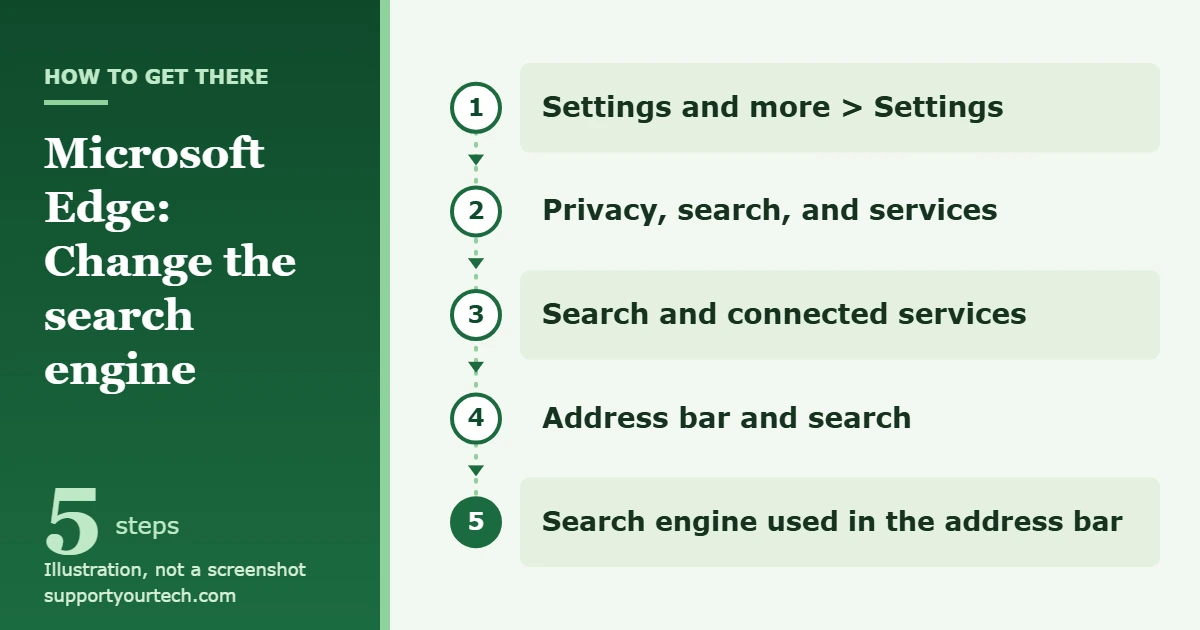
To get rid of Bing on Windows 10, change the search engine in your web browser. In Microsoft Edge, select Settings and more > Settings > Privacy, search, and services > Search and connected services > Address bar and search, then pick another engine under Search engine used in the address bar. Chrome and Firefox have their own search engine settings. The search box on the Windows 10 taskbar always gets its web results from Bing, so the documented choices there are to hide the box or, on Enterprise and Education PCs, to turn web results off with Group Policy.
Applies to: Windows 10 with Microsoft Edge, Google Chrome or Mozilla Firefox. Checked against Microsoft Support, Microsoft Learn, Google Chrome Help and Firefox Help on October 7, 2026.
Where Bing shows up in Windows 10
Bing is a web search service, not a single program, so “getting rid of it” means changing each place that sends your searches to it. Knowing where it appears tells you which steps you need.
| Where you see Bing | What you can do | Section |
|---|---|---|
| Searches typed in the Microsoft Edge address bar | Choose a different search engine | Microsoft Edge |
| Searches in Chrome or Firefox | Choose a different default engine and remove Bing from the list | Chrome, Firefox |
| A browser home page or startup page that opens Bing | Set a different home page or startup page | Each browser section |
| Web results in the taskbar search box | Hide the search box, turn off search highlights, or use Group Policy on Enterprise and Education | Windows Search |
| A Bing toolbar, extension or app you did not choose | Remove the extension or uninstall the program | Toolbars and extensions |
None of the methods below need Registry Editor. Older guides tell you to create registry values to switch off Bing in Start and taskbar search. Microsoft does not document those values for Windows 10 Home or Pro, so this guide sticks to settings and policies that Microsoft and the browser makers publish.
Change the search engine in Microsoft Edge
This changes what happens when you type a search into the Edge address bar. It is the change most people mean when they want Bing gone.
- Open Microsoft Edge and search once from the address bar using the engine you want, for example by going to that engine’s website and running a search there. This makes Edge add it to its list of choices.
- Select Settings and more, then Settings.
- Select Privacy, search, and services.
- Select Search and connected services, then Address bar and search.
- Open the Search engine used in the address bar menu and choose your engine. Your next address bar search uses the new engine.
If the engine you want is not in the menu, go back to step 1. Microsoft says any site that uses OpenSearch technology can be set as the default once you have searched with it. See Microsoft’s page on how to change your default search engine in Microsoft Edge for the official steps. Our guide to changing the default search engine in Windows 10 covers the Edge setting in more detail.
Stop Edge from opening Bing as its home page
If Bing appears when you select the Home button, change the home page:
- In Edge, select Settings and more > Settings.
- Select Start, home, and new tab page.
- Turn on Show home button on the toolbar if you use the Home button.
- Choose New tab page, or select Enter URL and type the address of the page you want. Selecting Home now opens that page.
Microsoft’s article on how to change your browser home page lists the same steps.
Change the search engine in Google Chrome
Chrome uses its own setting, separate from Edge and Windows. Changing it in one browser does not change the others.
- Open Chrome, select More at the top right, then Settings.
- Select Search engine.
- Under Search engine, select Change.
- Choose a new default search engine. Searches from the address bar now use it.
To take Bing off the list entirely, open Settings > Search engine > Manage search engines and site search. Make sure another engine is your default, then select More next to Bing and choose Delete. If you only want it out of the way for now, choose Deactivate instead; it moves to Inactive shortcuts, where Activate brings it back. Google’s help page on how to set your default search engine in Chrome explains each option.
Change Chrome’s home page and startup pages
Bing can also open in Chrome because it was set as the home page or a startup page.
- Open More > Settings.
- Under Appearance, check Show Home button. If it is on and points to Bing, choose the New Tab page or enter a custom page.
- On the left, select On startup. Choose Open the New Tab page or Continue where you left off, or, under Open a specific page or set of pages, remove the Bing address and add the page you want with Add a new page.
Google’s guide to setting your homepage and startup page has the full details.
Change the search engine in Mozilla Firefox
- Click the menu button in Firefox and select Settings.
- Select Search in the left pane.
- Use the drop-down menu under Default Search Engine to choose your engine.
To remove Bing from Firefox’s list, go to the Search Shortcuts section on the same page, click Bing to highlight it, and click Remove. If a search engine was added by an extension, Mozilla says you must remove it with the Add-ons Manager instead. For the home page, open Settings, go to the Home panel, and pick Firefox Home (Default), Custom URLs… or Blank page under Homepage and new windows. Mozilla’s page on how to manage Firefox search settings covers the search options.
Bing in the Windows 10 taskbar search box
Microsoft states that when you use Windows Search to search the web or get search suggestions, the results are powered by Bing. The Windows 10 Settings app does not include a documented switch to turn those web results off for home users. Start > Settings > Search > Permissions & History lets you set SafeSearch and clear your history, but it does not remove Bing. Your browser’s search engine setting also has no effect on the taskbar box. Here is what you can do instead.
Hide the search box
If you never use taskbar search for the web, hiding the box keeps Bing out of sight. Right-click (or press and hold) an empty part of the taskbar, select Search, and then select Hidden. To bring it back, repeat the steps and select Show search box.
Turn off search highlights
Search highlights show notable moments of the day, such as holidays and anniversaries, in the search box. To turn them off, right-click the taskbar, select Search, and clear Show search highlights. Microsoft notes that the search box must be shown for highlights to appear, and that an administrator may turn them off for an organization.
Turn off web results with Group Policy (Enterprise and Education)
Microsoft documents a policy that stops web queries and web results in Windows Search. According to Microsoft Learn, it applies to Windows 10 version 1803 and later on the Enterprise and Education editions; Microsoft does not list Home or Pro. On a work or school PC, this is normally set by your IT department, so ask them before changing it.
- In the Group Policy editor, go to Computer Configuration > Administrative Templates > Windows Components > Search.
- Open Don’t search the web or display web results in Search.
- Select Enabled and apply the change. With the policy enabled, Microsoft says queries are not performed on the web and web results are not displayed in Search.
Microsoft describes this policy in its Search policy reference, and lists it under Cortana and Search in its guide to managing connections to Microsoft services. Setting it back to Not Configured lets users choose again.
Remove Bing toolbars, extensions and programs
If Bing keeps returning after you change your settings, an extension or program you did not choose may be setting it. Remove anything you do not recognize.
- Edge extension: right-click the extension’s icon to the right of the address bar and choose Remove from Microsoft Edge, then Remove. You can also open Extensions, select More actions next to the extension, and choose the same option.
- Chrome extension: right-click its icon and select Remove from Chrome, or go to More > Extensions > Manage extensions and select Remove. Google’s page on how to install and manage extensions has more.
- Desktop program: in the taskbar search box, type Control Panel and open it. Select Programs > Programs and Features, right-click a toolbar or program you did not install on purpose, and choose Uninstall or Uninstall/Change. Microsoft’s guide to uninstalling apps and programs shows the other ways to remove apps.
Google lists a search engine or home page that keeps changing without your permission as a sign of unwanted software. If that happens in Chrome, remove the program and then use Reset settings > Restore settings to their original defaults > Reset settings to put Chrome back to its defaults.
Check that it worked or undo it
- Browser search: type a few words into the address bar and press Enter. The results page should come from the engine you chose. To undo, pick Bing again in the same menu.
- Home page: select the Home button or restart the browser and check which page opens.
- Taskbar: after you select Hidden, the search box disappears. Choose Show search box to restore it.
- Group Policy: type a web-style query into Windows Search. Web results should no longer appear. Set the policy to Not Configured to reverse it.
Troubleshooting
The engine I want isn’t in the list
In Edge, search once with that engine, then reopen Address bar and search. In Chrome, open Manage search engines and site search and use Add next to Site search, entering the engine’s results address with %s where the search words go.
The setting is greyed out or changes back
Google notes that on a Chrome browser managed by an organization, the administrator may set the search engines. The same applies to many work and school PCs, so check with your IT team. On a personal PC, a setting that keeps changing points to unwanted software; remove unknown extensions and programs as described above.
Bing still appears in taskbar search
That is expected on Windows 10 Home and Pro. Changing browser settings does not affect Windows Search, and Microsoft documents no Settings switch for web results there. Hide the search box if you want it out of sight.
Frequently asked questions
Can I uninstall Bing from Windows 10?
Not as a whole, because Bing is a web service rather than a program. You can change the search engine in each browser, hide the taskbar search box, and uninstall any Bing-branded toolbar or app that appears in Programs and Features.
Does changing Edge’s search engine change Windows search?
No. The Edge setting only covers searches typed in the Edge address bar. Windows Search gets its web results from Bing either way.
Should I use the registry tweak from other guides?
This guide does not recommend it. Microsoft does not document those registry values for Windows 10 Home and Pro, and Registry Editor mistakes can cause problems. Use the browser settings and the taskbar options instead, or the documented Group Policy on Enterprise and Education.
Does SafeSearch Off remove Bing?
No. SafeSearch filters what appears in search results; it does not switch Bing off. Microsoft says a Strict setting is shared with Bing in your browser, while Moderate or Off leaves your Bing.com setting in charge.
How do I clear what I searched for?
Go to Start > Settings > Search > Permissions & History and, under History, select Clear device search history. Microsoft’s Windows Search and privacy page explains what Windows stores.
Is this different on Windows 11?
The browser steps are the same, but the taskbar and Settings options differ. See our guide on how to remove Bing from Windows 11.
Once your search engine is changed, you may also want to set your default apps in Windows 10 so links open in the browser you prefer.

Matt Jacobs has been working as an IT consultant for small businesses since receiving his Master’s degree in 2003. While he still does some consulting work, his primary focus now is on creating technology support content for SupportYourTech.com.
His work can be found on many websites and focuses on topics such as Microsoft Office, Apple devices, Android devices, Photoshop, and more.