You cannot fully remove Bing from Windows 11 in the United States, because it is not a separate app: Microsoft builds it into Windows Search and Microsoft Edge. What you can do is stop using it. In Edge, select Settings and more > Settings > Privacy, search, and services > Search and connected services > Address bar and search, then pick another option under Search engine used in the address bar. To get the Bing-powered search box off your taskbar, right-click the taskbar, select Taskbar settings, and set the search option under Taskbar items to Hide.
Applies to: Windows 11 (Home, Pro, Enterprise, and Education) with Microsoft Edge, Google Chrome, or Mozilla Firefox. Checked against Microsoft Support, Microsoft Learn, Google Chrome Help, and Mozilla Support on October 7, 2026.
What you can and cannot remove
“Bing” shows up in several unrelated places in Windows 11, and each one has its own switch. Work out which one is bothering you before you change anything.
| Where you see Bing | What Microsoft documents | Can it be removed? |
|---|---|---|
| Searches from the Edge address bar | A setting to choose a different search engine | Yes, you can switch engines |
| Searches in Chrome or Firefox | Each browser has its own default search engine setting | Yes, you can switch engines |
| The search box on the taskbar | A setting to hide it | Hidden, not removed |
| Web results when you search from Start | A policy for Enterprise and Education editions; no switch in Settings | Not on Home or Pro through a documented setting |
| A pinned Bing icon or installed Bing app | Unpin or uninstall, like any other app | Yes |
| The “Web Search from Microsoft Bing” component | Can be uninstalled only on PCs set up in the European Economic Area | Only in the EEA |
Microsoft’s own taskbar help page says the Search tool integrates Microsoft Bing for web results, and its Windows Search privacy page says web searches and search suggestions in Windows Search are powered by Bing. Neither page lists a switch that turns those web results off on a home PC. The sections below cover everything that is documented, and say plainly where the documentation stops.
Change the search engine in Microsoft Edge
This is the change most people are looking for. It stops address bar searches in Edge from going to Bing.
- Open Microsoft Edge and run one search with the engine you want to use. For example, go to that search engine’s website and search for anything. Microsoft lists this as the first step because Edge adds a search engine to its list after you have used it.
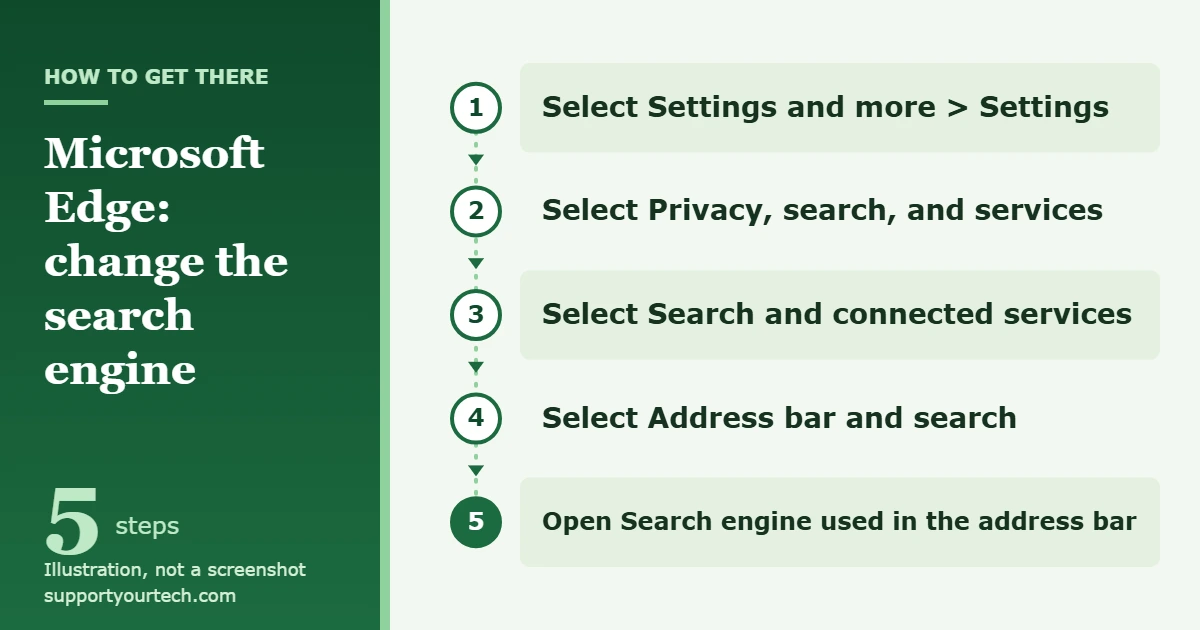
- Select Settings and more > Settings.
- Select Privacy, search, and services.
- Select Search and connected services, then select Address bar and search.
- Open the Search engine used in the address bar menu and choose your preferred search engine.
If the engine you want is missing from the menu, repeat step 1. Microsoft’s instructions say the engine or website you searched with will then appear in the list. Edge accepts search engines and sites that support the OpenSearch standard.
Microsoft notes that keeping Bing as the default gives you extras such as direct links to Windows apps and, for work accounts, suggestions from your organization. You lose those when you switch, and nothing else in Edge stops working. For a walkthrough aimed at one specific engine, see our guide on how to make Google the default search engine in Windows 11.
Change the search engine in Chrome or Firefox
Each browser keeps its own search setting. Changing Edge does nothing to Chrome or Firefox, and the reverse is also true. If Bing appears in one of these browsers, change it there.
Google Chrome
- Open Chrome. At the top right, select More, then Settings.
- Select Search engine.
- Under “Search engine,” select Change.
- Select a new default search engine. Your next address bar search uses it.
Mozilla Firefox
- Open Firefox, click the menu button, and select Settings.
- Select Search in the left pane.
- Use the drop-down menu under Default Search Engine to choose the engine you want.
Firefox also lets you take Bing off its list entirely. In the same Search settings, click Bing in the list of search engines to highlight it, then click Remove. If you change your mind later, Restore Default Search Engines at the bottom of the page brings it back.
Hide the search box on the taskbar
The taskbar search box is the most visible Bing entry point in Windows 11. You can hide it without affecting search itself.
- Right-click the taskbar and select Taskbar settings.
- Under Taskbar items, open the drop-down menu for the search area.
- Choose Hide. This removes the search feature from the taskbar.
The other choices in that menu are Search box, Search icon and label, and Search icon only. If you still want a quick way to find files and apps but want it to take less room, Search icon only is the middle ground.
Hiding the box does not turn off Windows Search. You can still open Start and type to find apps, files, and settings, and that search can still show web results from Bing.
Review the Windows Search settings
Windows 11 has a settings page for search. It does not contain a “turn off Bing” switch, but it controls what Windows Search is allowed to use and remember.
- Select Start > Settings > Privacy & security > Search permissions.
- Under SafeSearch, choose a filtering level. Microsoft documents three: Strict, Moderate, and Off.
- Under Cloud content search, decide whether Windows Search may include results from your Microsoft account or your work or school account, such as OneDrive and Outlook content.
- Under History, select Clear device search history to erase the searches saved on this PC.
These settings reduce how much personal and online content is mixed into your search results. They do not stop Windows Search from sending what you type to Bing for web suggestions. Microsoft’s documentation for this page does not describe a setting that does.
The documented policy that blocks web results in search
Microsoft does document one setting that stops Windows Search from querying the web: a policy named Don’t search the web or display web results in Search. Here is what Microsoft Learn says about it.
- What it does: when the policy is enabled, queries are not performed on the web and web results are not displayed when someone searches. When it is not configured, the user decides.
- Where it lives: under Computer Configuration, in Windows Components > Search. It applies to the whole device, not to a single user.
- Which editions: Microsoft’s policy reference lists it for Windows Enterprise, Education, and IoT Enterprise. Windows Pro is marked as not supported, and Windows Home is not listed.
- Registry location: the policy is stored in SOFTWARE\Policies\Microsoft\Windows\Windows Search as a value named ConnectedSearchUseWeb, where 0 means web results are not allowed and 1 means they are allowed.
In practice this is a tool for organizations. If your PC runs Enterprise or Education, it is usually managed by an IT department, and they are the people to ask. On Home and Pro, Microsoft does not say this policy will work, so we do not recommend creating the registry value by hand and expecting web results to vanish.
The same policy reference lists a few related settings that are supported on Pro as well:
- Allow search highlights: disabling it turns off search highlights in the Start menu search box and in search home.
- Configures search on the taskbar: lets an administrator lock the taskbar search to hidden, icon only, icon and label, or search box. Requires Windows 11, version 24H2 or later.
- Fully disable Search UI: switches off the search interface and every way of opening it, including keyboard shortcuts and typing in the Start menu. Requires Windows 11, version 22H2 or later. This removes local search too, so it is far more drastic than most people want.
Registry tweaks you will see elsewhere
Many guides tell you to add a value named DisableSearchBoxSuggestions or BingSearchEnabled to the registry. Before you try either, know what Microsoft’s documentation actually says.
- DisableSearchBoxSuggestions is a real policy, but Microsoft documents it as Turn off display of recent search entries in the File Explorer search box. Its description covers suggestion pop-ups in File Explorer and whether your search entries are stored. It does not mention Bing, web results, or the Start menu.
- BingSearchEnabled does not appear in Microsoft’s Search policy reference at all.
Because neither is documented as a way to remove Bing from Windows 11 search, we have left the steps out. Undocumented values can stop working or change behavior after a Windows update, and there is no official description of what else they affect.
Remove Bing shortcuts and apps
Sometimes “Bing” is just an icon or an app that was installed along the way. Those can be removed like anything else.
- A pinned taskbar icon: right-click the pinned icon and select Unpin from taskbar.
- An installed app with Bing in its name: select Start > Settings > Apps > Installed apps, find the app, and select More > Uninstall. You can also select Start > All apps, right-click the app, and select Uninstall.
- Bing installed as a web app through Edge: type edge://apps in the Edge address bar, select Details on the app’s card, and select Uninstall.
Microsoft warns that some apps cannot be uninstalled from the Settings app. If an entry has no Uninstall option, treat it as part of Windows and leave it in place.
If your PC was set up in the European Economic Area
Microsoft changed Windows to comply with the European Union’s Digital Markets Act. In its announcement, Microsoft listed “Web Search from Microsoft Bing” and Microsoft Edge among the items that can be uninstalled in the European Economic Area (EEA), with the change reaching EEA customers from March 2024.
Windows uses the region chosen during device setup to decide whether a PC is in the EEA. According to Microsoft, that region can only be changed afterward by resetting the PC. Changing the country in Settings later does not unlock the option, so this is not a route for a PC that was set up with the United States as its region.
How to confirm the change and undo it
- Browser search engine: type a word (not a web address) into the address bar and press Enter. The results page should come from the engine you chose. To undo it, go back to the same menu and select Bing.
- Taskbar search: the search box should be gone from the taskbar. To bring it back, return to Taskbar settings and choose Search box under Taskbar items.
- Uninstalled apps: Microsoft says apps can be installed again from the Microsoft Store or the internet.
Troubleshooting
Bing comes back as the search engine
If the search engine switches back without you touching it, look at your extensions first. In Edge, select Extensions to the right of the address bar, then Manage extensions, and turn off the toggle next to anything you do not recognize. To delete one, select More actions next to it, then Remove from Microsoft Edge > Remove. In Firefox, search engines that were added by an extension must be removed through the Add-ons manager.
Google’s Chrome help states that unexpected changes to your search engine can be a sign of malware. Bing itself is a legitimate Microsoft service, but a program that keeps changing your settings without permission is not behaving legitimately. Uninstall any software you did not mean to install and run a malware scan with Windows Security.
The search engine setting is locked or greyed out
On a work or school PC, an administrator can set the search engine by policy. Microsoft’s Edge policy named Enable the default search provider is one example: when it is configured, users cannot change or override it. There is no supported way around a managed setting. Ask your IT department if you need a different engine.
Bing opens when I click the home button in Edge
That is a home page setting, not the search engine. In Edge, select Settings and more > Settings > Start, home, and new tab page. With Show home button on the toolbar turned on, choose New tab page or select Enter URL and type the address you want.
Links still open in Edge
Which browser opens links is a separate setting from which search engine a browser uses. Open the Settings app and select Apps > Default apps, then choose the browser you prefer and set it as the default. Our guide on how to remove Microsoft Edge as the default browser in Windows 11 covers that in detail.
I changed my browser, but searching from Start still shows Bing results
That is expected. Web results in Windows Search come from Bing no matter which browser or search engine you use elsewhere. On Home and Pro, the documented options are to hide the taskbar search box and adjust Search permissions, as described above.
Frequently asked questions
Can I uninstall Bing from Windows 11?
Not on a PC set up outside the European Economic Area. Bing is part of Windows Search and Edge, so there is nothing to uninstall. You can remove Bing apps and shortcuts, switch search engines in your browsers, and hide the taskbar search box.
Is Bing a virus?
No. Bing is Microsoft’s search engine and ships with Windows. If your search engine keeps changing to Bing or anything else after you set it, the cause is usually an extension, another program, or a policy on a managed PC.
Do I need to remove Microsoft Edge to stop using Bing?
No. Changing Search engine used in the address bar in Edge is enough to stop Edge searches from going to Bing, and you can use a different browser without removing Edge.
Will the web-results policy work on Windows 11 Home or Pro?
Microsoft’s policy reference lists Don’t search the web or display web results in Search for Enterprise, Education, and IoT Enterprise only. Pro is marked as not supported and Home is not listed, so do not count on it.
Does hiding the taskbar search box break search?
No. It only removes the box from the taskbar. You can still open Start and type to search your PC.
Is the process the same on Windows 10?
The browser steps are the same, but the Windows settings are in different places. See our separate guide on how to get rid of Bing on Windows 10.
Microsoft and browser documentation
- Change your default search engine in Microsoft Edge (Microsoft Support)
- Windows Search and privacy (Microsoft Support)
- Customize the taskbar in Windows (Microsoft Support)
- Search policy reference (Microsoft Learn)
- Set your default search engine in Chrome (Google Chrome Help)
- Change your default search settings in Firefox (Mozilla Support)
Start with the Edge search engine setting, then hide the taskbar search box if you want Bing out of sight in Windows itself. Both changes can be reversed from the same menus.

Matt Jacobs has been working as an IT consultant for small businesses since receiving his Master’s degree in 2003. While he still does some consulting work, his primary focus now is on creating technology support content for SupportYourTech.com.
His work can be found on many websites and focuses on topics such as Microsoft Office, Apple devices, Android devices, Photoshop, and more.