If you forgot the password for a Windows 10 administrator account, use the recovery route that matches the sign-in method shown on the PC. A Microsoft account, a local-account password, and a Windows PIN are different credentials. Use Microsoft’s recovery options for your own account; do not use tools or instructions intended to bypass a password. If you still know the password and only want to stop typing it, see how to remove the lock screen password in Windows 10.
Windows 10 reached the end of ordinary support on October 14, 2025. These steps can still help on a Windows 10 PC, but consider moving a compatible device to a supported version of Windows after you regain access.
1. Check which sign-in option you are using
- Start the PC until you reach the Windows sign-in screen.
- Select your account if Windows shows more than one account.
- Select Sign-in options if it appears below the entry box.
- Choose the password icon when you need to use an account password instead of a PIN.
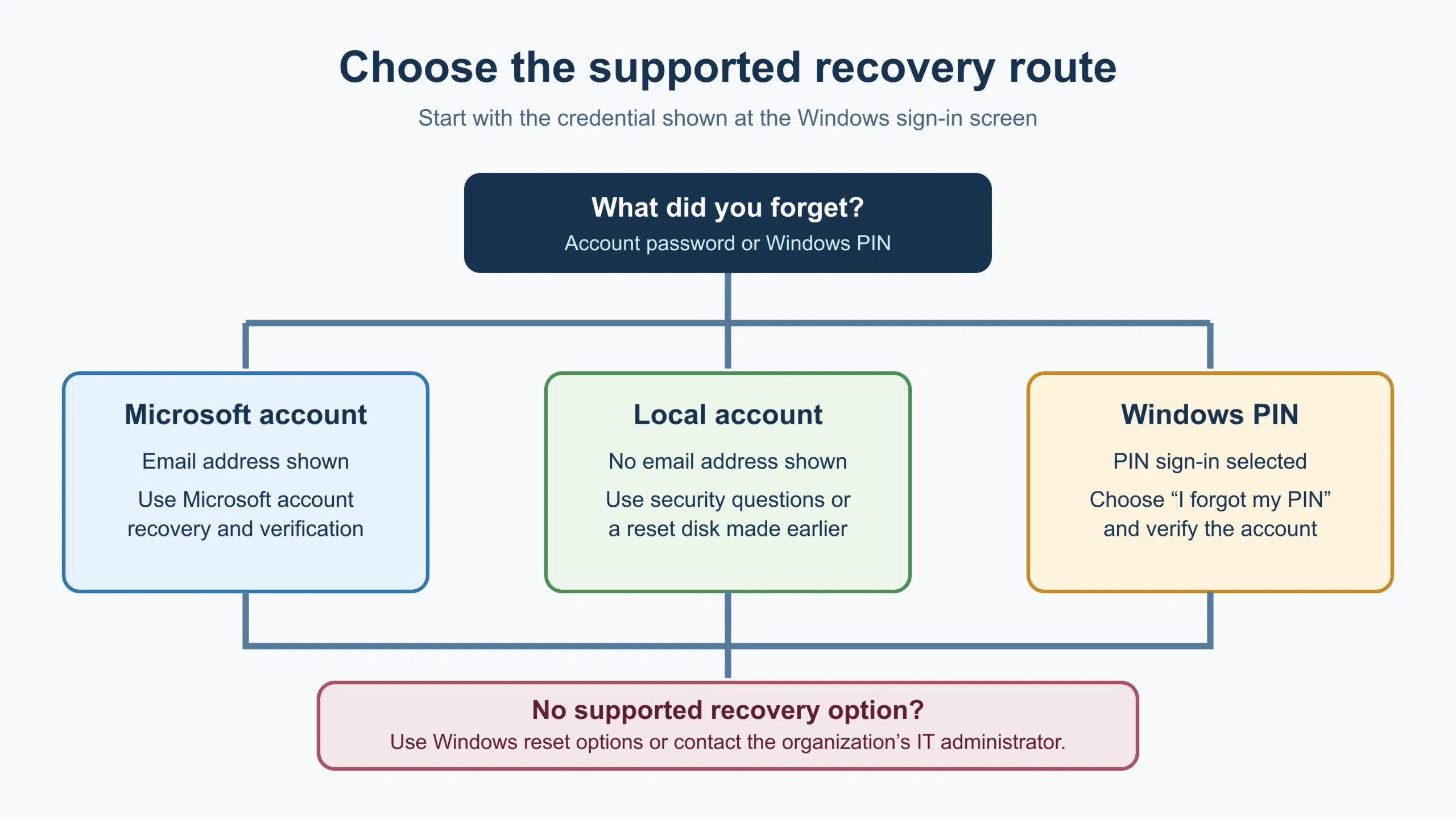
An email address on the sign-in screen usually means that the PC uses a Microsoft account. A name without an email address can be a local account. A PIN is a device sign-in method, so resetting a PIN is different from resetting the password for the account behind it. On a Windows 11 PC, follow the Windows 11 password reset steps instead.
2. Reset a Microsoft account password
If the account uses a Microsoft email address, choose I forgot my password on the sign-in screen when available. You can also start from another device at Microsoft’s account recovery guidance.
- Enter the Microsoft account email address or other requested account information.
- Complete Microsoft’s identity-verification steps using a recovery method available to you.
- Create a new password when Microsoft confirms that you can reset it.
- Reconnect the Windows PC to the internet if needed, then use the new password at the sign-in screen.
Use only recovery details that belong to the account owner. Microsoft support agents cannot retrieve or circumvent a forgotten password. If you cannot complete the normal reset, use the account-recovery form and provide accurate information rather than repeatedly guessing passwords.
3. Reset a local-account password from the sign-in screen
A local account does not use the same online reset process. On Windows 10, a local account may offer security questions that were set up when the local account was created.
- Select the password entry option on the sign-in screen.
- Enter a password attempt, then select OK if Windows reports that it is incorrect.
- Select Reset password when that option appears.
- Answer the security questions exactly as they were set up.
- Choose and confirm a new password, then sign in.
Microsoft documents this local-account process in its password reset guide. If the Reset password option does not appear, do not assume that a security question exists for that account.
4. Use a password reset disk only if you made one earlier
A password reset disk is a recovery USB drive created before the password was forgotten. It works for the local account for which it was created. It is not an online download, a general-purpose installer, or a USB drive borrowed from another PC.
- Connect the password reset disk to the locked PC.
- At the local-account sign-in screen, select Reset password.
- Choose Use a password reset disk instead if Windows offers that choice.
- Follow the Password Reset Wizard to set a new local-account password.
Microsoft’s password reset disk instructions explain that the disk is created while you can still sign in. Create one only for a local account you can already access, and keep it in a secure location.
5. Reset a PIN separately from the password
If Windows normally accepts a PIN and you still know the account password, select I forgot my PIN on the sign-in screen and follow the prompts. For a Microsoft account, the PIN reset requires account verification. If you forgot both the PIN and the account password, reset the password first. Our guide to resetting a PIN in Windows 10 walks through each step.
Microsoft’s PIN reset guidance explains the difference. A PIN reset does not reveal an old password or solve a local-account password problem by itself.
6. Use an existing administrator account when one is already available
If another administrator account was already set up on the same PC and its owner can sign in, that administrator can reset the password for a local account. This is an account-management action, not a way to create a new administrator account from a locked computer.
- Sign in with the pre-existing administrator account.
- Open Computer Management.
- Open Local Users and Groups → Users.
- Right-click the local account that needs a new password and choose Set Password.
- Enter and confirm the new password, then sign out and test it on the affected account. To change it again later, follow our steps to set a password in Windows 10.
This route applies to local accounts. Microsoft notes that if no administrator account is available to change the password, resetting the Windows device is the supported next option.
When no supported recovery option is available
For a local account with no security questions, no reset disk, and no pre-existing administrator account, Microsoft directs the owner to reset the device. Before choosing that route, check whether you have current backups and understand the reset choices shown by Windows. A reset can remove installed apps and can affect personal files depending on the option selected; do not rely on it as a way to preserve every file.
For a work or school PC, contact the organization’s IT administrator. For a personal PC, use Microsoft’s support resources after trying the matching recovery path above. Do not follow advice that changes accessibility files, boots external tools to alter account access, or claims to reveal a password.
After you regain access
- Update the account’s recovery email address and phone number if they have changed.
- For a local account, create a password reset disk while you can sign in.
- Use a password manager or another secure system to store credentials.
- Review whether a Microsoft account or a separate, documented administrator account is appropriate for the PC.
Use one supported recovery path at a time and test the new credential at the sign-in screen. That keeps the account secure and gives you a clearer record of what solved the problem.
Related: how to find the administrator password on Windows 10.
Related: check admin rights on Windows 10.

Matt Jacobs has been working as an IT consultant for small businesses since receiving his Master’s degree in 2003. While he still does some consulting work, his primary focus now is on creating technology support content for SupportYourTech.com.
His work can be found on many websites and focuses on topics such as Microsoft Office, Apple devices, Android devices, Photoshop, and more.