Last updated on November 17th, 2026 at 03:17 pm
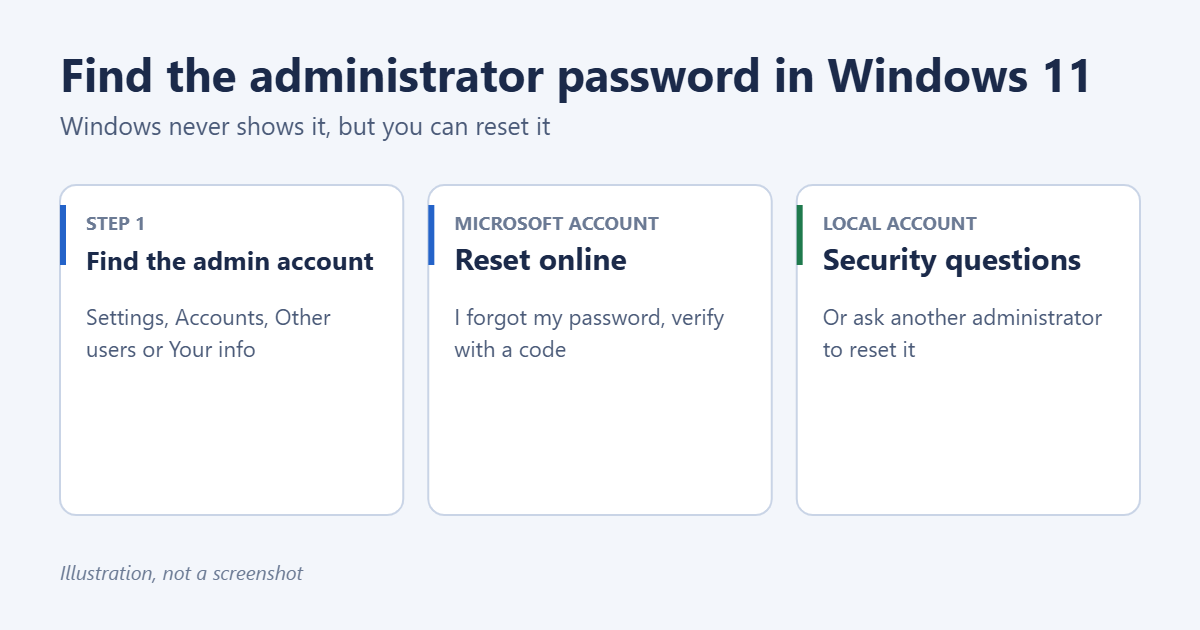
Windows 11 doesn’t store the administrator password anywhere you can view it, so the fix is to reset it. If the admin account is a Microsoft account (it shows an email address), reset the password online or select I forgot my password on the sign-in screen. For a local account, answer its security questions or have another administrator set a new password. That covers Home and Pro PCs you own; on a work or school PC, ask your IT department.
Why you can’t look up the password
Windows doesn’t keep a readable copy of account passwords. It stores a one-way scrambled version that can check whether a password is right but can’t be turned back into the password. That’s why every legitimate route is a reset, not a lookup. If a website or app promises to “show” your admin password, treat it with suspicion. Passwords you saved for websites, apps and Wi-Fi are different, and you can view your own in the places listed in how to find stored passwords on Windows 11.
Find out which account is the administrator
Often the “administrator password” Windows is asking for is just the password of the main account on the PC, the one created when it was set up. In many cases you don’t need the password at all, because the owner can approve the action on the permission prompt themselves.
- Sign in with any account and open Settings > Accounts.
- Select Your info. If it says Administrator under your name, you’re already an admin and the password Windows wants is your own sign-in password or PIN.
- Select Other users (or Family) to see other accounts. Select an account to see whether its type is Administrator or Standard User.
To list every admin account at once, open Terminal and run net localgroup administrators. Other ways to check are in checking admin rights.
What if I bought the PC second-hand?
Ask the seller to remove their account or reset the PC. If they can’t, reset the PC yourself using the steps above.
Related: giving a user admin rights in Windows 11 and fixing administrator permission errors in Windows 11. On an older PC, read finding the administrator password on Windows 10.
Reset the administrator password
If it’s a Microsoft account
- On the sign-in screen, select the admin account and then I forgot my password. Or go to Microsoft’s password reset page on any device.
- Enter the email address, choose where to receive a security code, and enter the code.
- Create a new password.
- Make sure the PC is connected to the internet, then sign in with the new password.
If it’s a local account with security questions
- On the sign-in screen, select the admin account, type any password and press Enter.
- Select OK, then Reset password.
- Answer the three security questions and choose a new password.
If another administrator account exists
- Have the other administrator sign in.
- Open Control Panel > User Accounts > User Accounts > Manage another account.
- Select the account and choose Change the password, then enter a new one.
This works for local accounts. Microsoft account passwords can only be reset online.
If you made a password reset disk
Plug in the USB drive, enter a wrong password on the sign-in screen, select Reset password, and follow the Password Reset Wizard.
Each route is covered in more detail in resetting a Windows 11 password.
If Windows asks for an admin password while you’re signed in
When you install an app or change a system setting from a standard account, a User Account Control box asks for an administrator’s password. You have three options:
- Ask the administrator (often a parent or the person who set up the PC) to type their password or PIN in the box.
- Have the administrator change your account to an administrator in Settings > Accounts > Other users > Change account type. Changing the administrator on Windows 11 goes through it.
- Install the app without admin rights if it offers a “just for me” option. Many apps from the Microsoft Store install without an admin password.
The built-in Administrator account
Windows 11 includes a hidden account named Administrator that’s turned off by default and has no password set. It’s meant for troubleshooting, not everyday use, and you need admin rights to turn it on. If you don’t have admin access, it can’t help you, and leaving it turned on is a security risk. If you need it for a specific task, follow enabling the Administrator account in Windows 11.
Last resort: reset the PC
If no administrator can sign in and you can’t reset the password, reinstalling Windows creates a new administrator account. This deletes all apps, settings and personal files.
- On the sign-in screen, select Power, hold Shift, and select Restart.
- Select Troubleshoot > Reset this PC > Remove everything.
- Follow the prompts. If asked for a BitLocker recovery key, find it at account.microsoft.com/devices/recoverykey.
- When setup finishes, create a new account, which will be an administrator.
Avoid losing admin access again
- Use a Microsoft account for the main administrator so you can always reset the password online.
- Set up a second administrator account for a trusted family member, or keep a separate admin account for yourself.
- Add a PIN or Windows Hello in Settings > Accounts > Sign-in options.
- Store the password in a password manager you can reach from your phone.
No reset link or option for the account
“I forgot my password” doesn’t appear
The account is a local account, or the PC is offline. Connect to Wi-Fi from the network icon on the sign-in screen. If there’s still no link and no email address under the name, use the local account options.
Reset password doesn’t appear for a local account
The account has no security questions. Use another administrator account or a password reset disk, or reset the PC.
The PC belongs to a company or school
It’s managed by the organization, and changing admin access yourself can break its management or breach its policies. Contact the IT help desk.
The new password isn’t accepted
For a Microsoft account, connect the PC to the internet and restart so it syncs the new password. Check that Caps Lock is off and the keyboard layout is correct.
Related guides

Matt Jacobs writes and maintains the guides on Support Your Tech, which he started in 2017. He spent most of his career keeping small-business PCs running and still takes the occasional consulting job, so the steps here come from fixing the same problems on other people’s computers. Each guide follows Microsoft, Apple and Google’s own documentation and is updated when the steps change. Screenshots marked “Recreated” are illustrations of the real screens.