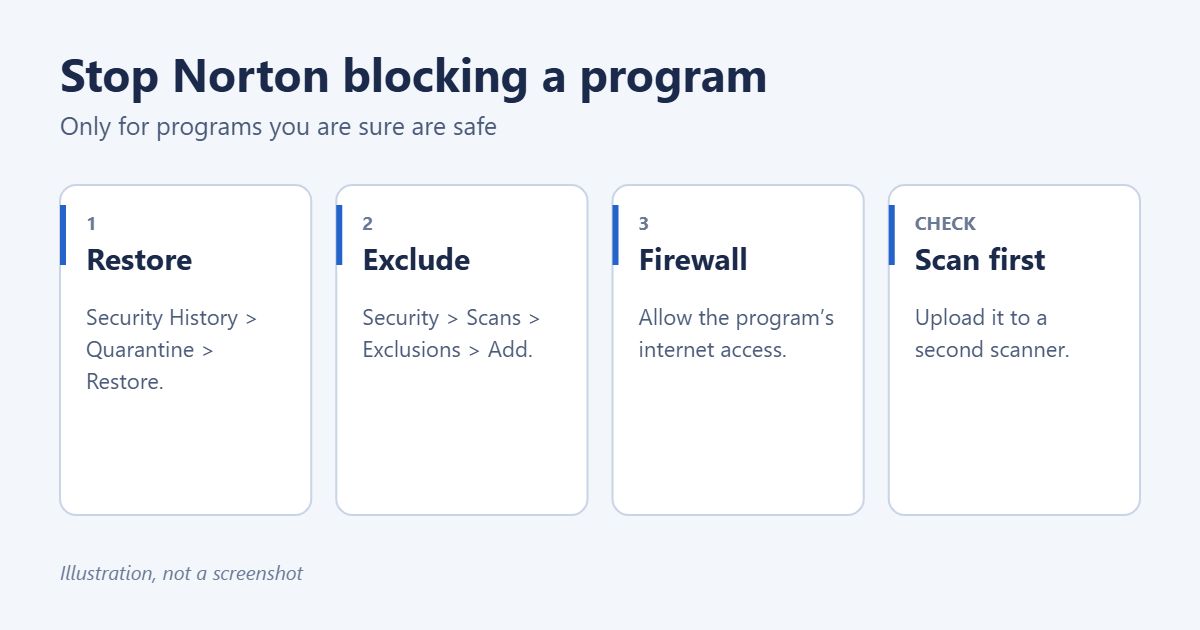
To stop Norton from blocking a program you trust, restore it from quarantine and add it to Norton’s exclusions. Open Norton, go to Security > Scans > Exclusions, select Add, browse to the program’s file or folder and select Add. If Norton is blocking the program’s internet connection rather than the file, allow it in Norton’s firewall settings instead. Only do this for software from a source you’re sure of, because Norton blocks real threats far more often than it makes mistakes.
Applies to: Norton 360 and Norton AntiVirus Plus on Windows 11 and 10. Norton changes its layout from time to time, so names may differ slightly in your version. Last reviewed October 7, 2026.
Before you unblock anything
- Check where the program came from. Software from the developer’s official website or the Microsoft Store is usually safe. Cracked software, “free” versions of paid apps and files from email attachments often aren’t.
- Get a second opinion. Right-click the file in File Explorer and scan it with Microsoft Defender if it’s available, or ask the developer whether their program triggers false alarms.
- Read what Norton found. A name like WS.Reputation.1 means the file is new or rare, not that it’s known to be harmful. A named threat, such as a Trojan, is a reason to stop.
Step 1: Restore the program from quarantine
If Norton removed the file, bring it back first.
- Open Norton and select Security, then History (called Security History in some versions).
- Set the view to Quarantine.
- Select the program’s file, then Options or the three dots.
- Choose Restore & exclude this file if offered, or Restore.
- Confirm when Norton warns you.
Step 2: Add the program to Norton’s exclusions
- Open Norton and select Security in the left pane.
- Open the Scans tile, then the Exclusions tab.
- Select Add (or Add Exclusion).
- Browse to the program’s .exe file, or the folder it’s installed in, and select OK.
- Select Add.
Excluding the program’s folder covers all of its files, which helps when a program updates itself. Keep exclusions as narrow as possible.
If Norton blocks a file while you download it, add your Downloads folder (or a dedicated folder) to the exclusions, download the file there, then remove the exclusion once the program is installed.
Step 3: Let the program through Norton’s firewall
If the program runs but can’t connect to the internet, Norton’s firewall is blocking it.
- Open Norton and go to the firewall settings. In older versions, select Settings > Firewall > Program Control.
- Find the program in the list. If it isn’t there, select Add and browse to its .exe file.
- Set its access to Allow.
- Select Apply.
If a game or server also needs specific ports, see how to open ports on Windows 11; Norton’s firewall replaces Windows’ own while it’s active.
Step 4: Report a false positive
If you’re confident the program is safe, report it to Norton through its false positive submission form on Norton’s website. If Norton agrees, it updates its detection so other users aren’t affected, and you can remove your exclusion later.
Temporary option: pause protection
To install something once, you can turn off Auto-Protect for a short time, such as 15 minutes, from Norton’s security settings or by right-clicking the Norton icon in the taskbar. Turn it back on straight after. An exclusion is safer than leaving protection off.
Troubleshooting
Norton keeps quarantining the program after I excluded it
Check that you excluded the exact file or folder the program runs from, not a shortcut. Some programs also run helper files from another folder, often under C:\ProgramData or your AppData folder.
The program still won’t run
Microsoft Defender SmartScreen may be blocking it too. Select More info > Run anyway on the blue warning if you trust the program. If you uninstall Norton later, Windows Security takes over; see how to turn on Windows Defender in Windows 11.
Frequently asked questions
Is it safe to exclude a program from Norton?
Only if you trust it completely. Norton won’t scan excluded items, so anything harmful inside them can run unchecked.
How do I undo an exclusion?
Go back to Security > Scans > Exclusions and select the delete (X) icon next to the item.

Matt Jacobs has been working as an IT consultant for small businesses since receiving his Master’s degree in 2003. While he still does some consulting work, his primary focus now is on creating technology support content for SupportYourTech.com.
His work can be found on many websites and focuses on topics such as Microsoft Office, Apple devices, Android devices, Photoshop, and more.