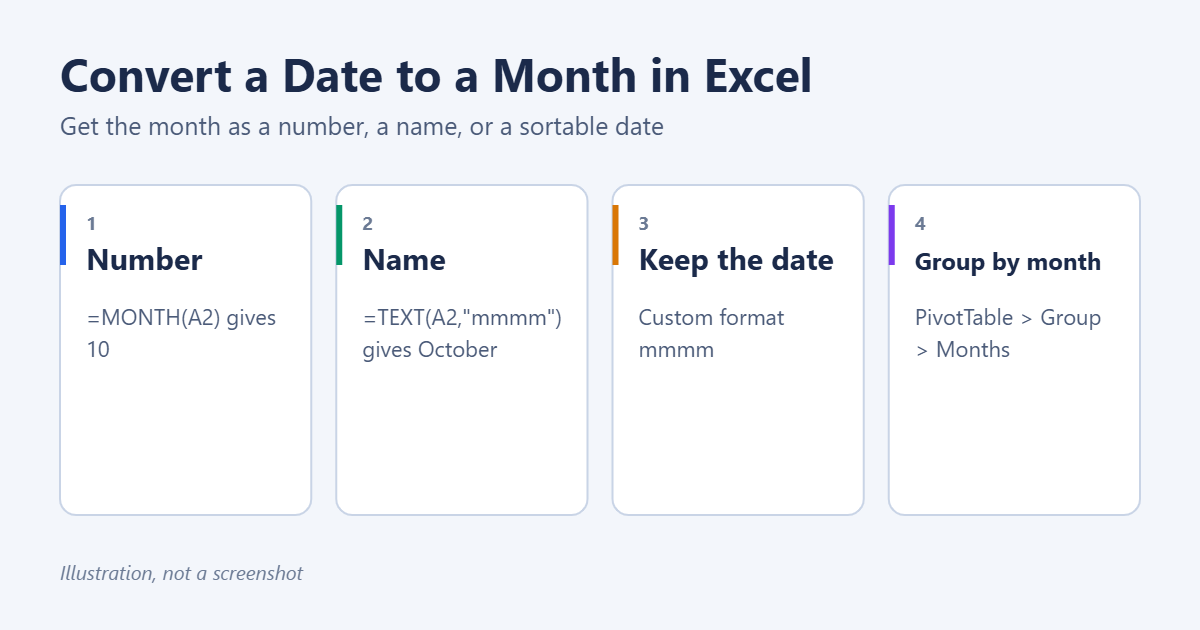
To convert a date to a month in Excel, use =MONTH(A2) to get the month number (10 for October), or =TEXT(A2,"mmmm") to get the month name (October). Use "mmm" for the short name (Oct). If you only want the cell to show the month while keeping the full date underneath, for sorting and calculations, apply the custom number format mmmm instead. Here’s when to use each, plus how to total data by month.
Quick reference
| You want | Formula or format | Result for 10/8/2026 |
|---|---|---|
| Month number | =MONTH(A2) |
10 |
| Full month name | =TEXT(A2,"mmmm") |
October |
| Short month name | =TEXT(A2,"mmm") |
Oct |
| Month and year | =TEXT(A2,"mmmm yyyy") |
October 2026 |
| First day of the month | =DATE(YEAR(A2),MONTH(A2),1) |
10/1/2026 |
| Show the month, keep the date | Custom format mmmm | October (still a date) |
Method 1: Month number with MONTH
- In B2, type
=MONTH(A2)and press Enter. - Double-click the fill handle to copy it down.
The result is a number from 1 to 12, which is useful for formulas such as =COUNTIF(B:B,10) to count October entries.
Method 2: Month name with TEXT
=TEXT(A2,"mmmm") returns the full name, and "mmm" returns the three-letter abbreviation. The result is text, so it can’t be sorted in calendar order. Excel sorts it alphabetically (April, August, December…). Use Method 3 or 4 when order matters.
Turn a month number into a name
If B2 holds a number from 1 to 12: =TEXT(DATE(2026,B2,1),"mmmm"). Any year works, since only the month matters.
Method 3: Show the month with a custom format
- Select the dates.
- Press Ctrl + 1 and choose Custom.
- Type mmmm (or mmm yyyy) in the Type box and click OK.
The cells display only the month, but each one is still the original date. Sorting, filtering and date maths keep working. For more custom codes, see how to change the number format in Excel.
Method 4: Total or count by month
PivotTable grouping
- Click in your data and go to Insert > PivotTable > OK.
- Drag the date field into Rows. Recent versions of Excel group it into Years and Months automatically.
- If they don’t, right-click a date in the PivotTable, choose Group, and select Months (and Years).
- Drag the amount field into Values.
See how to make a pivot table in Excel.
Formulas
To total sales in column C for October 2026: =SUMIFS(C:C,A:A,">="&DATE(2026,10,1),A:A,"<"&DATE(2026,11,1)). Using date ranges like this is more reliable than matching month names, and it keeps different years separate.
Related conversions: quarter, year and fiscal month
- Quarter:
="Q"&ROUNDUP(MONTH(A2)/3,0)gives Q4 for October. - Year:
=YEAR(A2)gives 2026. - Year and month as one sortable value:
=TEXT(A2,"yyyy-mm")gives 2026-10. Because the year comes first, it sorts correctly as text. - Fiscal month, for a year starting in July:
=MONTH(EDATE(A2,-6))returns 1 for July and 4 for October. Change -6 to match your fiscal year’s start. - Last day of the month:
=EOMONTH(A2,0)gives 10/31/2026.
These are handy as helper columns before building a PivotTable or chart, so you can group by quarter or fiscal period as well as by month.
Month names in other languages
TEXT uses your system’s language for month names. To force a language, add a locale code, for example =TEXT(A2,"[$-fr-FR]mmmm") for octobre.
Troubleshooting
Every row shows January
The cells probably contain text or numbers, not real dates. Excel treats an empty or zero cell as January 1900. Check that the dates are right-aligned, and convert text dates with Data > Text to Columns > Finish.
#VALUE! error
The source cell is text that Excel can’t read as a date. Retype it, or use =MONTH(DATEVALUE(A2)).
The month names sort alphabetically
Sort by the original date column, or by a MONTH number column, instead of the name column.
Related guides
Summary
=MONTH(A2)for the number.=TEXT(A2,"mmmm")or"mmm"for the name.- A custom mmmm format to show the month and keep the date.
- A PivotTable or SUMIFS to total by month.

Matt Jacobs has been working as an IT consultant for small businesses since receiving his Master’s degree in 2003. While he still does some consulting work, his primary focus now is on creating technology support content for SupportYourTech.com.
His work can be found on many websites and focuses on topics such as Microsoft Office, Apple devices, Android devices, Photoshop, and more.