To turn off flash notifications on an iPhone, open Settings, tap Accessibility, tap Audio/Visual, and switch off LED Flash for Alerts. The light next to the rear camera stops blinking when a notification arrives.
Applies to: iPhone, and the iPad models that support LED Flash for Alerts. Checked against Apple Support on October 6, 2026.
What the flash notification setting does
LED Flash for Alerts is an accessibility feature. Apple describes it as a way for the LED flash next to the camera lens on the back of the device to blink when the device is locked and a notification comes in, which helps anyone who might miss an audible alert. It is one switch for the whole phone, so turning it off stops the blinking for every app at once.
Two details explain most of the confusion around it:
- It only works on a locked device. Apple states that LED Flash for Alerts works only when your device is locked, so you will not see the blink while you are using the phone.
- It has a companion switch for silent mode. A second setting named Flash on Silent decides whether the LED also blinks while the iPhone is in silent mode.
Turn off LED Flash for Alerts
- Open the Settings app on your iPhone.
- Tap Accessibility. A list of accessibility categories opens.
- Tap Audio/Visual. This screen holds the hearing-related alert options.
- Find LED Flash for Alerts and turn it off. From this point the rear LED no longer blinks for incoming notifications.
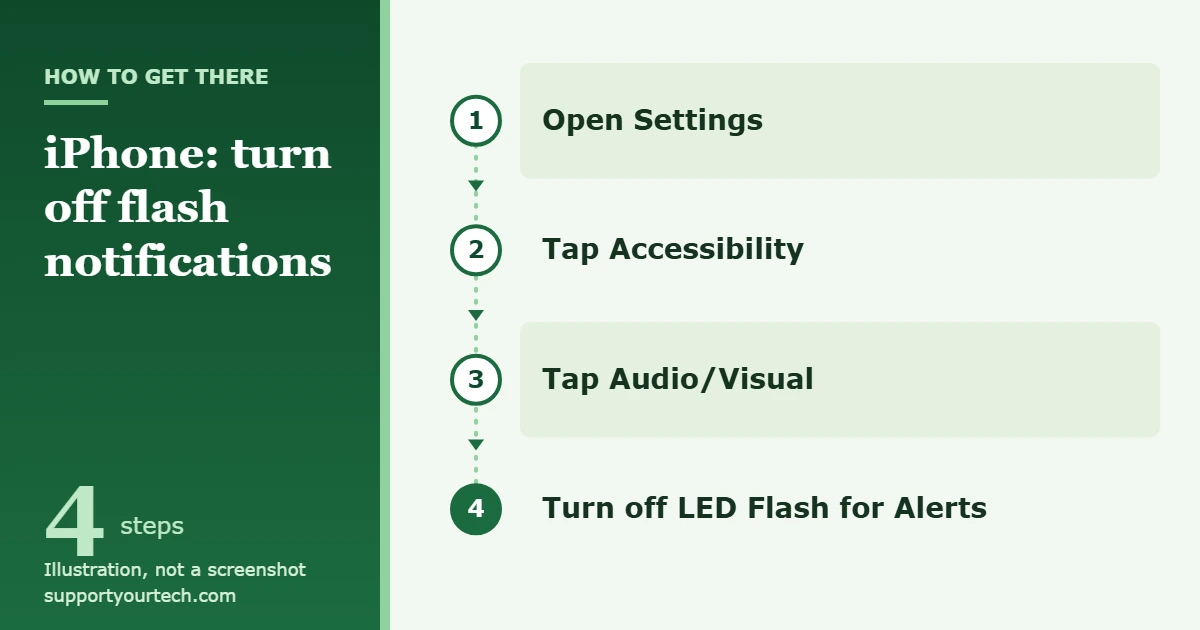
Apple documents the same path in its support article Get LED flash alerts on your iPhone or iPad. That article shows how to turn the feature on, and turning it off is the reverse of its second step.
Keep the flash but stop it in silent mode
If you still want the visual alert most of the time, you do not have to switch the whole feature off. Use this route when the blinking only bothers you in quiet places such as a meeting or a movie theater.
- Open Settings and tap Accessibility.
- Tap Audio/Visual.
- Leave LED Flash for Alerts on and turn off Flash on Silent. The LED then stays dark whenever the iPhone is in silent mode and blinks as before when the ringer is on.
If you are not sure which mode your phone is in, our guide to turning silent mode on or off on an iPhone 14 shows how to check and change it.
If the screen flashes instead of the camera light
Apple’s release notes for iOS 26.2 say that the flash for alerts setting in Accessibility gained an additional option to have the device screen flash when you receive a notification. If your display lights up in a flash for each alert, go back to the same Accessibility area and turn the flash for alerts setting off there. The wording on your screen can differ from the labels above on these newer versions, so read each option on that screen before you leave it.
Apple lists the change under iOS 26.2 in About iOS 26 Updates, and its iPhone User Guide covers the feature under the topic Flash the iPhone screen or indicator light for notifications.
Confirm the change or undo it
- Lock your iPhone and set it face down so the rear camera is visible.
- Ask someone to send you a text message, or wait for any notification.
- Watch the LED beside the camera lens. It should stay dark.
The phone has to be locked for this check to mean anything, because the feature never blinks on an unlocked device. To bring the alerts back, return to Settings, then Accessibility, then Audio/Visual, and turn LED Flash for Alerts on again. Nothing else is changed or lost by switching it off and on.
Troubleshooting
The labels on my iPhone do not match
Apple adjusts Settings wording between iOS releases. Stay inside Accessibility and look for the entry that mentions audio and visual options, then for the switch that mentions flash and alerts. Your installed version is shown in Settings under General and then Software Update.
The light still blinks after I turned the setting off
Open the Audio/Visual screen again and make sure the switch stayed off. If it did, restart the iPhone and install any pending update: Apple’s instructions are to open Settings, tap General, tap Software Update, and choose Download and Install when an update is offered. Back up first, as Apple recommends in Update your iPhone or iPad.
The light blinks only some of the time
That is normal behavior, not a fault. The LED blinks only while the phone is locked, and it skips silent mode when Flash on Silent is off.
The setting keeps changing back on a work or school iPhone
Apple lets organizations configure accessibility settings on devices they manage. If your iPhone was issued by an employer or school and the switch will not stay where you put it, ask your IT administrator.
Frequently asked questions
Why does my iPhone flash when I get a notification?
LED Flash for Alerts is turned on. It is not a fault with the camera or the phone. Someone may have enabled it on purpose, or it may have been switched on by accident while exploring the Accessibility settings.
Does turning off the flash stop notification sounds or vibrations?
No. LED Flash for Alerts is a separate accessibility switch that controls only the blinking light. Your ringtone, alert sounds and vibrations follow their own settings.
Can I turn off the flash for one app only?
Apple’s instructions describe a single switch for all alerts, plus the Flash on Silent option. They do not describe a per-app choice, so the practical options are on, off, or off in silent mode.
Will the flash blink while I am using my iPhone?
Not according to Apple, which says LED Flash for Alerts works only when the device is locked.
Does this work on an iPad?
Only on some models. Apple lists iPad Pro (9.7-inch), iPad Pro (10.5-inch), iPad Pro 12.9-inch (2nd generation) and later, iPad Pro 11-inch (all models), and iPad mini (6th generation). The steps are the same as on iPhone.
Once the flash is off, lock the phone and run the quick test above so you know the change took effect before your next meeting or night’s sleep.

Matt Jacobs has been working as an IT consultant for small businesses since receiving his Master’s degree in 2003. While he still does some consulting work, his primary focus now is on creating technology support content for SupportYourTech.com.
His work can be found on many websites and focuses on topics such as Microsoft Office, Apple devices, Android devices, Photoshop, and more.