To add a Korean keyboard in Windows 11, select Start > Settings > Time & language > Language & region, select Add a language next to Preferred languages, search for Korean, select Next, and then select Install. When it’s installed, press Windows logo key + Spacebar to switch to Korean, and then press the right Alt key to change from English letters (A) to Hangul (가).
Applies to: Windows 11. Checked against Microsoft on September 30, 2026.
You don’t need a keyboard with Korean letters printed on it, and adding Korean doesn’t change the language Windows uses for menus and Settings. It only adds a way to type Korean.
Add the Korean keyboard
- Select Start > Settings > Time & language > Language & region.
- Next to Preferred languages, select Add a language.
- Type Korean in the search box, select 한국어 Korean, and then select Next.
- Under Optional language features, you can clear Language pack, Text-to-speech and Handwriting if you only want to type Korean. Microsoft notes that none of the optional features are needed to type Korean while keeping your current display language.
- Leave Set as my Windows display language turned off, unless you want Windows itself to appear in Korean.
- Select Install. Windows downloads the Korean features, which can take a few minutes.
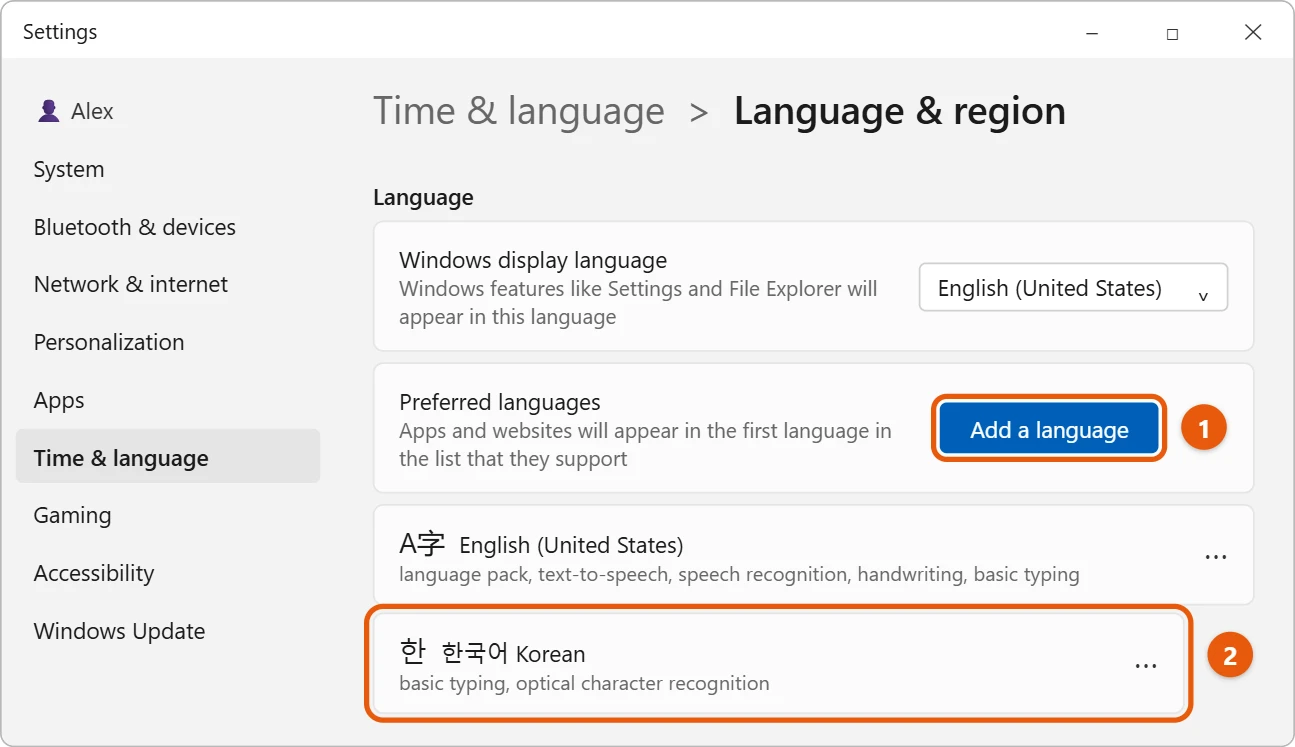
When it’s done, Korean appears under Preferred languages below English. Korean is added with the Microsoft IME keyboard, which types Hangul and can convert words to Hanja.
Note: On a work or school PC, your organization may block installing languages. If Install isn’t available or Windows asks for an administrator, ask your IT administrator to add Korean for you.
Switch between English and Korean
After you add Korean, a language indicator appears on the right side of the taskbar, showing ENG for English.
- Press Windows logo key + Spacebar until Korean Microsoft IME is highlighted, or select ENG on the taskbar and choose Korean. The indicator changes to 한.
- A second indicator, A, appears next to it. A means you’re still typing English letters.
- Press the right Alt key, or select A, to change it to 가. Now you can type Hangul.
- Press the right Alt key again to go back to English letters without leaving the Korean keyboard.
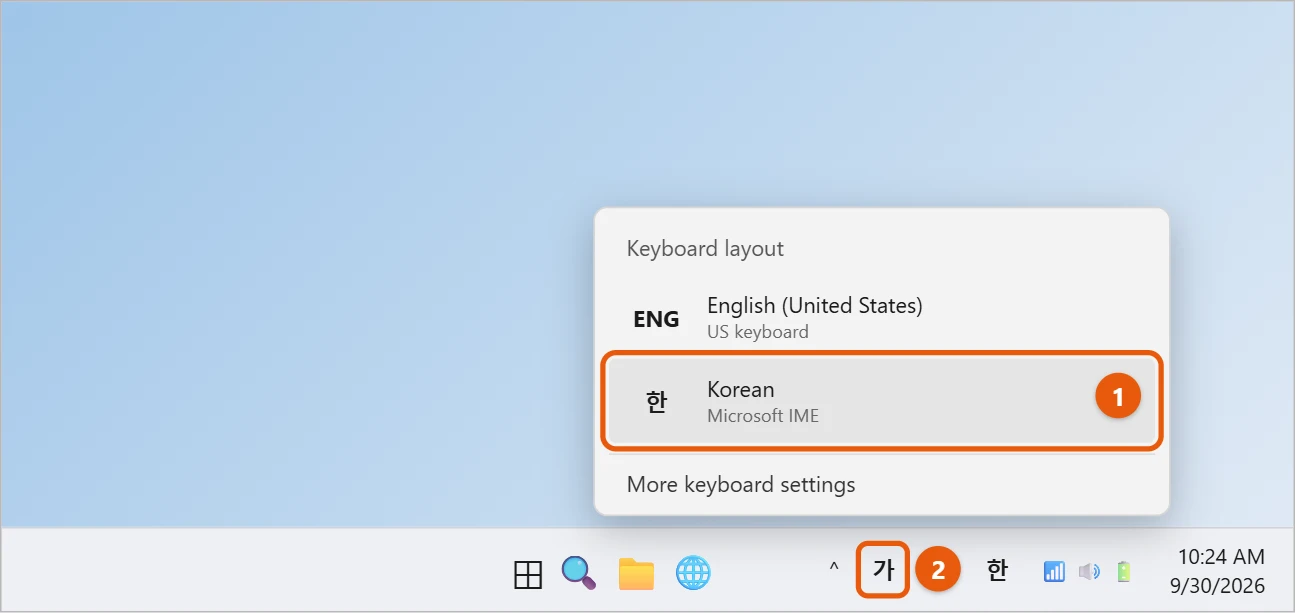
Only the right Alt key switches modes. The left Alt key keeps its normal use. On keyboards made for Korea, the key in that spot is labeled 한/영.
Type Korean on an English keyboard
Windows uses the standard Korean layout, often called 2-set or Dubeolsik. Consonants are on the left side of the keyboard and vowels on the right. You type letters one at a time, and Windows joins them into syllable blocks for you.
- ㅂ ㅈ ㄷ ㄱ ㅅ are on Q W E R T, and ㅁ ㄴ ㅇ ㄹ ㅎ are on A S D F G.
- ㅛ ㅕ ㅑ ㅐ ㅔ are on Y U I O P, and ㅗ ㅓ ㅏ ㅣ are on H J K L.
- Hold Shift for the double consonants ㅃ ㅉ ㄸ ㄲ ㅆ (Shift + Q, W, E, R, T) and the vowels ㅒ ㅖ (Shift + O, P).
For example, to type 안녕 (hello), make sure the indicator shows 가, and then type D K S S U D. Windows builds the first block from ㅇ, ㅏ and ㄴ, and the second from ㄴ, ㅕ and ㅇ.
While you learn the layout, turn on the On-Screen Keyboard with Windows logo key + Ctrl + O. When Korean mode is on, it shows which Hangul letter is on each key, and you can click the keys to type.
Convert Hangul to Hanja
Hanja are Chinese characters used in Korean. To convert a word:
- Type the word in Hangul.
- Press the right Ctrl key, or right-click the 가 indicator and select Hanja Convert.
- If there are several matches, choose the one you want from the list.
Right-clicking 가 or A also lets you switch between half-width and full-width characters, open the IME Pad for handwriting, and open the Microsoft IME settings.
Add the Old Hangul keyboard (optional)
If you study historical Korean, you can add the Microsoft Old Hangul keyboard. It types jamo that are no longer used in modern Hangul.
- In Settings > Time & language > Language & region, select More options (…) next to Korean, and then Language options.
- Select Add a keyboard, and then choose Microsoft Old Hangul.
When it’s selected, the taskbar indicator shows 옛 instead of 한.
If the Korean keyboard isn’t working
- Letters stay in English. The indicator probably shows A. Press the right Alt key or select A so it shows 가.
- Your keyboard has no right Alt key. Select the A or 가 indicator on the taskbar to switch modes instead.
- Letters don’t join into syllables. Check that you’re using Korean Microsoft IME and not another keyboard. Type the letters in order: consonant, vowel, then any final consonant.
- The wrong keyboard is active when you start typing. Go to Settings > Time & language > Typing > Advanced keyboard settings and choose a keyboard under Override for default input method.
- Korean isn’t in the list. Check that the installation finished under Language & region. If it’s still downloading, wait and try again.
For more on switching and managing layouts, see how to change the keyboard layout in Windows 11.
Remove the Korean keyboard
Select Start > Settings > Time & language > Language & region, select More options (…) next to Korean, and then select Remove. The 한 indicator disappears from the taskbar.
Frequently asked questions
Do I need a Korean keyboard to type Korean?
No. Any keyboard works. Stickers or a keyboard cover with Hangul letters can help while you learn, or you can use the On-Screen Keyboard.
Will adding Korean change my Windows language?
No, not unless you set it as your Windows display language. Korean is added below English, so Windows and most apps stay in English.
Is the Korean keyboard free?
Yes. It’s built into Windows 11.
How do I switch between Korean and English quickly?
Use the right Alt key to switch between A and 가 within the Korean keyboard, or Windows logo key + Spacebar to switch between keyboards.
Next steps
On a Windows 10 PC, see how to change the keyboard language in Windows 10. Microsoft covers every Korean input option in Korean IME.
Related: how to change the system locale in Windows 11.

Matt Jacobs has been working as an IT consultant for small businesses since receiving his Master’s degree in 2003. While he still does some consulting work, his primary focus now is on creating technology support content for SupportYourTech.com.
His work can be found on many websites and focuses on topics such as Microsoft Office, Apple devices, Android devices, Photoshop, and more.