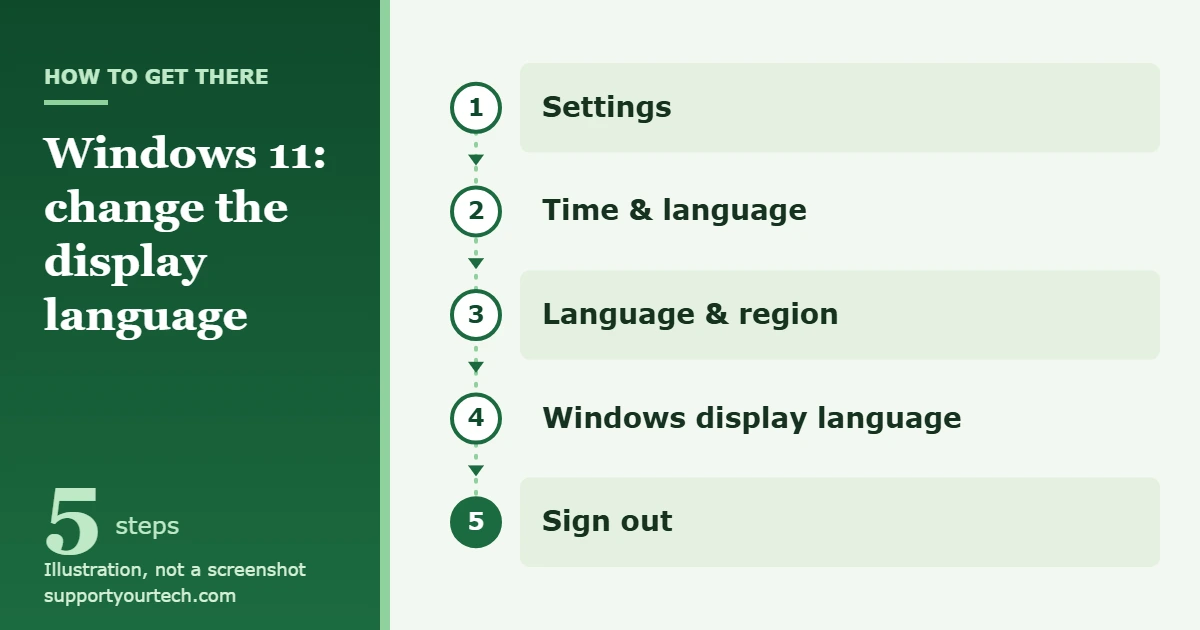
To change the language in Windows 11, open Settings > Time & language > Language & region, pick a language in the Windows display language menu, and select Sign out when Windows asks. If the language is not in that menu yet, select Add a language on the same page to install it first.
Applies to: Windows 11 (editions that support more than one display language). Checked against Microsoft Support on October 7, 2026.
What the display language changes
Windows 11 keeps several language settings on one page, and they do different jobs. Knowing which one you need saves time.
- Windows display language is the language Windows itself uses. Microsoft says it sets the language of Windows features such as the Settings app and File Explorer. This is the setting most people mean when they say they want to change the language.
- Preferred languages is the list of languages installed on your account. Its order decides which language Microsoft Store apps and websites try to use first.
- Keyboards belong to each language in that list. A keyboard layout decides which characters your keys type. It does not translate menus.
A language you add can include more than translated menus. Microsoft groups the extras as language features: basics such as spell checking, fonts, optical character recognition, handwriting, text-to-speech and speech recognition. Not every language offers every feature.
Before you start
- Connect the PC to the internet. Windows downloads the language pack when you add a language.
- Save your work and close your apps. Windows signs you out to apply a new display language.
- Make sure you know your password or PIN. The keyboard layout can change along with the display language, which matters on the sign-in screen (see the troubleshooting section below).
- Check your edition if you are not sure about it. Windows 11 Home Single Language and Home Country Specific editions cannot add another display language.
Add a language to Windows 11
Use these steps when the language you want is not installed yet. If it already appears under Preferred languages, skip to the next section.
- Select Start > Settings. You can also press the Windows logo key + I to open Settings.
- Select Time & language, then Language & region. The languages you already have are listed in the Language section of this page.
- Next to Preferred languages, select Add a language. A window named Choose a language to install opens.
- Type the name of the language or scroll through the list, select the language, and then select Next. Many languages have regional versions, such as English (United States), so pick the one that matches where you live.
- In the Install language features window, make sure Language pack is selected. Select any other features you want, such as speech recognition.
- Select Set as my Windows display language if you want Windows to switch to this language as soon as it is installed. Leave it clear if you only want the language available for later, or only want to type in it.
- Select Install and wait for the download to finish. The language then appears in the Preferred languages list.
- If you chose to make it the display language, sign out when Windows prompts you, then sign back in. Windows now appears in the new language.
Switch to a language that is already installed
Once a language pack is installed, changing between languages takes a few seconds.
- Save your work and close your apps.
- Select Start > Settings > Time & language > Language & region.
- Open the Windows display language menu and select the language you want. Only languages with an installed language pack appear here.
- Windows shows the message “Windows needs to sign you out in order to apply your new display language.” Select Sign out.
- Sign back in. Settings, File Explorer and other Windows features now use the language you selected.
To undo the change, repeat the same steps and choose your previous language. Nothing is removed when you switch, so you can move back and forth as often as you like. Your files, apps and settings stay where they are. Only the language of the interface changes.
Change the language for Microsoft Store apps and websites
Apps from the Microsoft Store and many websites follow the order of your language list instead of the display language. If they still appear in the old language after you switch, change the order.
- Select Start > Settings > Time & language > Language & region.
- Under Preferred languages, drag the language you want to the top of the list.
- Drag the other languages into the order you prefer.
Programs that did not come from Microsoft often have their own language setting inside the program, and some are only published in one language. Changing the Windows display language cannot translate those. Microsoft 365 apps such as Word and Excel may also need a Microsoft 365 language pack, which Microsoft links to from its Windows language pack page.
Add speech features for the new language
Speech features are separate downloads, and Microsoft’s steps start from the language that is currently set as the display language.
- Set the language as your Windows display language, using the steps above.
- Select Start > Settings > Time & language > Language & region.
- Select the ellipsis (three dots) next to the language, then select Language options.
- Under Language Features, select Download next to the features you want. Microsoft lists Text-to-speech, Basic Speech recognition and Enhanced speech recognition.
If a feature has no download button, it is not offered for that language. Microsoft notes that not all languages have speech features.
If Windows is already in the right language and you only need to type in another one, you do not need to change the display language at all. Add a keyboard layout instead.
- Select Start > Settings > Time & language > Language & region.
- Select the ellipsis next to the language, then select Language options.
- Under Keyboards, select Add a keyboard and choose the layout you want.
- To switch while you type, select the input language icon in the system tray and pick a layout, or hold the Windows logo key and press the Spacebar to cycle through the installed layouts.
If the layout you want is not offered for that language, Microsoft’s advice is to add the language that the layout belongs to. Our guide to changing the keyboard layout in Windows 11 covers adding, switching and removing layouts in more detail.
Remove a language you no longer need
- Select Start > Settings > Time & language > Language & region.
- Select the ellipsis next to the language you want to remove, then select Remove.
- Select Yes to confirm.
Windows will not remove the language that is currently your display language. Switch to another language first, sign out and back in, and then remove the old one. You can install a removed language again at any time with Add a language.
Troubleshooting
“Only one language pack allowed” or “Your Windows license supports only one display language”
Microsoft says either message can mean a single language edition of Windows is installed. To check, right-click Start, select Settings > System > About, and look under Windows specifications for the edition. According to Microsoft’s documentation, you can add languages to Windows 11 except on the Home Single Language and Home Country Specific editions. On those editions the display language is tied to the license, so no setting on the Language & region page will change it. You can still add keyboard layouts to type in other languages.
The language is missing from the Windows display language menu
The menu only lists languages whose language pack is installed. Go through the Add a language steps again and confirm that Language pack is selected in the Install language features window. If the language is listed under Preferred languages but still not in the menu, the language pack did not finish installing, so check your internet connection and add the language again.
The language pack will not download
Check that the PC is online, close open apps, and try again. Microsoft lists an internet connection and closed apps as the first step before installing a language pack. On a work or school PC, your organization may control which languages can be installed, so ask your IT administrator if the option is unavailable.
Your password is rejected after the change
Microsoft warns that changing the display language might also change the keyboard layout to match the new language. If the keys now produce different characters, a correct password will look wrong to Windows. On the sign-in screen, use the reveal password icon in the password box to see what you are actually typing, and switch the keyboard layout back if the characters are not the ones you expect.
Some parts of Windows or some apps are still in the old language
First make sure you signed out and back in, because the display language is not applied until you do. Then move your language to the top of the Preferred languages list so that Microsoft Store apps and websites follow it. Apps that are still in the old language after that usually have their own language setting or do not support your language.
You cannot read the current language
If Windows is in a language you do not understand, rely on things that do not depend on reading. The Windows logo key + I opens Settings in any language. From there, the path is the same as in the steps above, and the illustration in this article shows the order of the screens. A translation app on your phone, pointed at the screen, can help you confirm the right entries before you select them.
Frequently asked questions
Do I need to restart my PC to change the language?
No. Windows asks you to sign out, not restart. The new display language is applied when you sign back in.
Will changing the language delete my files or apps?
No. The display language controls the text Windows shows in places such as Settings and File Explorer. It does not remove files, apps or accounts, and you can switch back whenever you want.
Can I have more than one language installed?
Yes, on editions that support it. Every language you add stays in the Preferred languages list, and you can choose any installed language pack from the Windows display language menu. The exceptions are the Home Single Language and Home Country Specific editions.
Do I need an administrator account?
Not on your own PC in most cases. Microsoft’s documentation says that starting with Windows 11, accounts that are not administrators can add a display language and its language features. A PC managed by an employer or school may be set up differently.
Does changing the display language change my keyboard?
It can. Microsoft notes the keyboard layout might change to match the new display language. You can switch layouts from the input language icon in the system tray or with the Windows logo key + Spacebar.
Why do I not see speech options for my language?
Speech features are optional downloads and are not available for every language. Check Language options for the language. If there is nothing to download under Language Features, Windows does not offer speech for it.
Microsoft’s own instructions for these settings are in Manage the language and keyboard/input layout settings in Windows, and the list of available languages is on its Language packs for Windows page. Once Windows is in the language you want, check the keyboard layout next so that what you type matches what you see.
Related: how to change the system locale in Windows 11.

Matt Jacobs has been working as an IT consultant for small businesses since receiving his Master’s degree in 2003. While he still does some consulting work, his primary focus now is on creating technology support content for SupportYourTech.com.
His work can be found on many websites and focuses on topics such as Microsoft Office, Apple devices, Android devices, Photoshop, and more.