Last updated on November 17th, 2026 at 03:04 pm
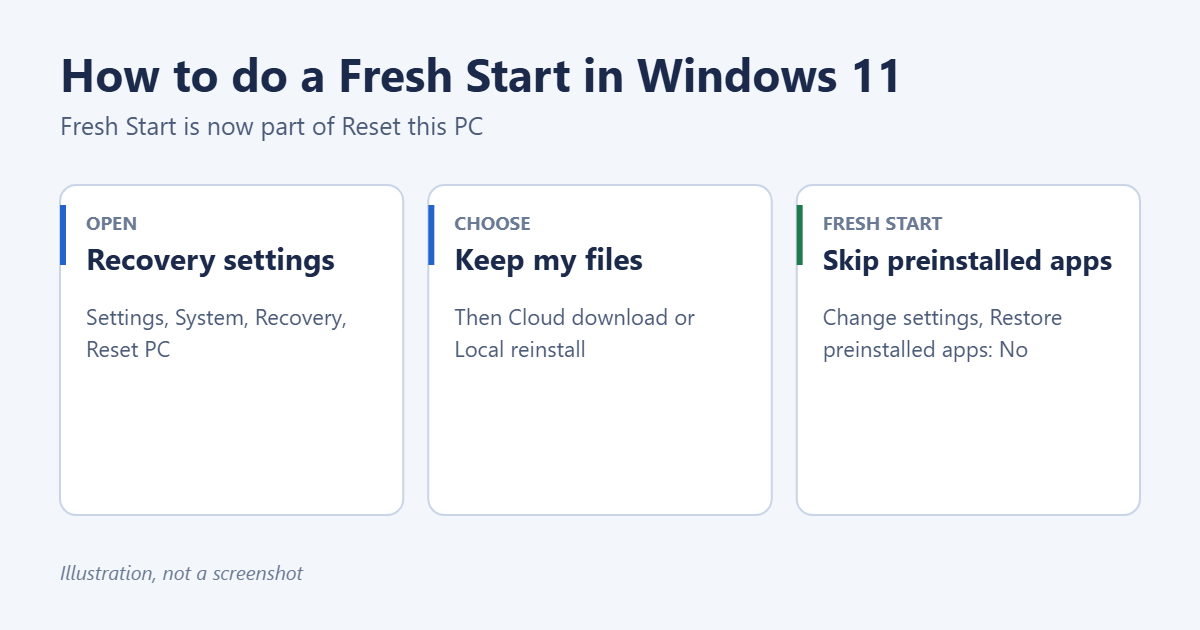
Windows 11 no longer has a separate Fresh Start tool; the same result is built into Reset this PC in Home and Pro, version 23H2 and later. Go to Settings > System > Recovery, select Reset PC, choose Keep my files, and pick Cloud download. On the Additional settings screen, select Change settings and set Restore preinstalled apps? to No. Windows reinstalls itself, keeping your files but not your PC maker’s extra apps.
What a Fresh Start does
A Fresh Start reinstalls Windows to get rid of slowdowns, errors and unwanted software, while keeping your documents, photos and other personal files. Compared with other reset options:
- Keeps: your personal files in your user folders, such as Documents, Desktop, Pictures and Downloads.
- Removes: every app you installed, including Microsoft Office if it was installed separately, your app settings, and the extra apps and trial software your PC maker added.
- Restores: Windows settings to their defaults.
The older Fresh Start tool lived in Windows Security. Microsoft moved it into Reset this PC starting with Windows 10 version 2004, and Windows 11 works the same way. Windows Security may still mention Fresh Start in its device health report, but the steps below are how you start it. Microsoft’s guide to resetting your PC explains every reset option.
How long does a Fresh Start take?
Usually 30 to 90 minutes on a modern PC with an SSD, longer on older hard drives or slow internet.
Back up and list your apps
- Back up your files anyway. Keep my files is designed to preserve them, but a backup to OneDrive or an external drive protects you if anything goes wrong.
- List your apps. Open Settings > Apps > Installed apps and note what you’ll need to reinstall. Windows also saves a list of removed apps on your desktop after the reset.
- Find your product keys and sign-ins for software you paid for, such as Office or Adobe apps.
- Check your BitLocker recovery key at account.microsoft.com/devices/recoverykey in case Windows asks for it.
- Plug in your laptop’s charger. The process takes 30 minutes to a few hours.
How to do a Fresh Start in Windows 11
- Open Settings with Windows logo key + I.
- Select System > Recovery.
- Next to Reset this PC, select Reset PC.
- Select Keep my files.
- Choose how to reinstall Windows:
- Cloud download downloads a fresh copy of Windows from Microsoft, about 4 GB or more. It’s the cleaner choice and works even if local Windows files are damaged.
- Local reinstall uses the files already on your PC. It’s faster and doesn’t need the internet.
- On Additional settings, select Change settings.
- Set Restore preinstalled apps? to No and select Confirm. This is the setting that makes it a Fresh Start. If you don’t see it, your PC didn’t come with extra apps from its maker, and a normal Keep my files reset gives the same result.
- Select Next, review the list of apps that will be removed, and select Reset.
The PC restarts several times. When it’s done, sign in with your usual account. Your files are where you left them.
After the Fresh Start
- Open Settings > Windows Update and install all updates, including optional driver updates.
- Open the Removed Apps file on your desktop to see what to reinstall.
- Reinstall apps from the Microsoft Store or their official websites.
- Check your drivers in Device Manager. Most install automatically, but some printers and graphics cards need the maker’s software.
- Set your preferences again, such as the default browser, wallpaper and power settings.
If Windows won’t start
You can start the same process from the recovery environment:
- On the sign-in screen, select Power, hold Shift, and select Restart. If Windows fails to start twice in a row, it opens the recovery environment automatically.
- Select Troubleshoot > Reset this PC > Keep my files.
- Choose Cloud download or Local reinstall and follow the prompts.
Fresh Start vs. other options
- Keep my files with preinstalled apps: like a Fresh Start, but your PC maker’s apps come back. Choose this if you rely on the maker’s support or control software.
- Remove everything: deletes your personal files too. Use it before selling or giving away the PC. The full set of choices is in resetting Windows 11.
- Clean install: installs Windows from a USB drive and erases the drive completely. You’ll need a USB drive to do a clean install of Windows 11.
- Fix problems using Windows Update: in Settings > System > Recovery, this reinstalls Windows without removing apps or files. Try it first if you only want to repair Windows.
Reset errors and stuck percentages
“There was a problem resetting your PC”
Try Cloud download if you used Local reinstall, or vice versa. If it still fails, run Fix problems using Windows Update first, then try the reset again.
The reset is stuck at a percentage
Stages can pause for a long time, especially around 64% and 99%. Wait at least two hours before turning the PC off.
Some files are missing afterward
Keep my files saves files in your user folders. Files stored elsewhere, such as in the root of the C: drive or in app folders, may be removed. Restore them from your backup, and check the C: drive for a Windows.old folder, which may hold copies of old files for a short time.
Restore preinstalled apps isn’t shown
Your PC doesn’t have maker-installed apps to restore, or you built it yourself. A Keep my files reset is already a Fresh Start.

Matt Jacobs writes and maintains the guides on Support Your Tech, which he started in 2017. He spent most of his career keeping small-business PCs running and still takes the occasional consulting job, so the steps here come from fixing the same problems on other people’s computers. Each guide follows Microsoft, Apple and Google’s own documentation and is updated when the steps change. Screenshots marked “Recreated” are illustrations of the real screens.