Last updated on November 17th, 2026 at 03:03 pm
Windows 11 has no separate lock screen password; it uses your account’s sign-in method. Open Settings > Accounts > Sign-in options, add a Password or set up a PIN (Windows Hello), then set If you’ve been away, when should Windows require you to sign in again? to Every Time (or When PC wakes up from sleep on some PCs). Microsoft account users already have a password. Press Windows + L to lock the screen when you step away.
Add a password or PIN
- Select Start > Settings, or press Windows + I.
- Select Accounts, then Sign-in options.
- Choose a sign-in method:
- Password: select Password, then Add. Enter a password, confirm it, add a password hint, and select Next > Finish. This option appears on local accounts that don’t have a password yet. HP laptop owners can also add a BIOS power-on password, covered in setting a password on a Windows 11 HP laptop.
- PIN (Windows Hello): select PIN (Windows Hello), then Set up, and follow the prompts. A PIN is quicker to type and only works on this PC, so it’s safer than a password that someone could use elsewhere.
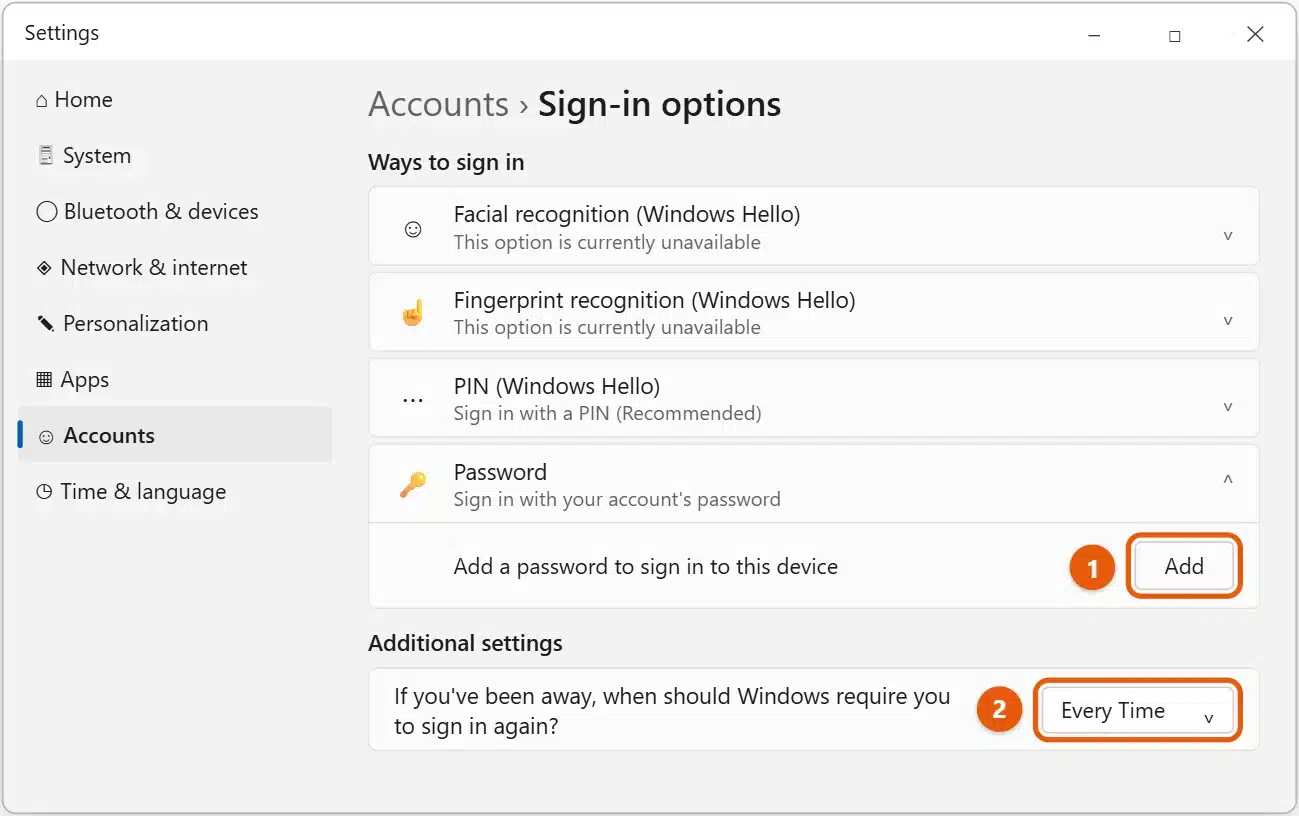
Write your password down somewhere safe, away from the PC.
Is a PIN as safe as a password?
Yes, in most cases it’s safer. A Windows Hello PIN only works on the PC you set it up on, so if someone learns it, they can’t use it to sign in to your Microsoft account from somewhere else.
Ask for the password every time
- On the same Sign-in options page, scroll to Additional settings.
- Next to If you’ve been away, when should Windows require you to sign in again?, choose Every Time. On PCs that show different choices, choose When PC wakes up from sleep.
Now Windows asks for your password or PIN whenever the screen wakes up from sleep, not just after a restart. If this setting is missing or grayed out, set up a PIN or password first. On some PCs, face or fingerprint sign-in also grays it out. To change what Windows asks for after sleep or at startup, see how to disable the lock screen in Windows 11.
Choose a strong password or PIN
- Password: use at least 12 characters. A short phrase of unrelated words, such as three or four words with a number, is easier to remember than a random string and still hard to guess. Don’t reuse a password from another site.
- PIN: Windows asks for at least 4 digits, but 6 or more is better. Avoid birthdays and patterns like 1234 or 2580. When you set it up, you can check Include letters and symbols to make the PIN stronger.
Sign in with your face or fingerprint
If your PC has a Windows Hello camera or a fingerprint reader, you can unlock it without typing anything. On the Sign-in options page, select Facial recognition (Windows Hello) or Fingerprint recognition (Windows Hello), then Set up, and follow the steps. You need a PIN first, because Windows uses it as the backup if the camera or reader can’t recognize you. Once face or fingerprint sign-in is set up, you can use it to approve passkey sign-ins on Windows 11 for websites and apps too.
If those options say they aren’t available, your PC doesn’t have a compatible camera or reader. A USB fingerprint reader that supports Windows Hello is an inexpensive way to add one.
Hide the password option for extra security
If you use a Microsoft account and have set up a PIN or Windows Hello, you can stop the lock screen from offering the account password at all. On the Sign-in options page, under Additional settings, turn on For improved security, only allow Windows Hello sign-in for Microsoft accounts on this device. Someone who learns your Microsoft account password then can’t use it to unlock this PC.
How do I let someone else use my PC without my password?
Give them their own account. Open Settings > Accounts > Other users and select Add account. They get their own desktop and files, and your account stays locked.
Does a lock screen password protect my files if the PC is stolen?
It stops someone signing in, but it doesn’t encrypt the drive. Turn on Device encryption in Settings > Privacy & security if your PC supports it, or BitLocker on Windows 11 Pro.
Already have a password you want to replace? Learn how to change your password in Windows 11. On an older PC, you can also lock your PC screen with a password in Windows 10. Every sign-in method is described in Microsoft’s Windows sign-in options and account protection.
Lock your PC
- Press Windows + L.
- Or select Start, select your account picture, and choose Lock.
- Or press Ctrl + Alt + Delete and select Lock.
Lock it automatically
- When you walk away: turn on Dynamic lock under Additional settings on the Sign-in options page. Pair your phone with the PC over Bluetooth first. Windows locks shortly after the phone goes out of range.
- After the screen turns off: set a screen timeout in Settings > System > Power & battery. With Every Time set above, you’ll need to sign in when the screen comes back on. You can change the screen timeout in Windows 11 to a shorter or longer delay.
- With a screen saver: select Start, type
screen saver, and open Change screen saver. Choose a screen saver, set Wait to a few minutes, and check On resume, display logon screen.
If Windows still doesn’t ask for a password
- Check automatic sign-in. Press Windows + R, type
netplwiz, and press Enter. If Users must enter a user name and password to use this computer is there, make sure it’s checked. - Check the sleep setting. Make sure If you’ve been away isn’t set to Never.
- Work or school PC: your organization may control these settings. Ask your IT support team.
If you forget your password
- Microsoft account: select I forgot my password on the sign-in screen, or reset it from any device at account.live.com/password/reset.
- Local account: select Reset password on the sign-in screen and answer your security questions.
- PIN: select I forgot my PIN on the sign-in screen and follow the steps. A PIN you still know is easy to change on Windows 11 from Sign-in options.
Can I remove the password later?
With a local account, you can change the password to a blank one in Sign-in options > Password > Change. That leaves the PC open to anyone, so it isn’t recommended. A Microsoft account always has a password.

Matt Jacobs writes and maintains the guides on Support Your Tech, which he started in 2017. He spent most of his career keeping small-business PCs running and still takes the occasional consulting job, so the steps here come from fixing the same problems on other people’s computers. Every guide is checked on his own Windows 11, Windows 10, Mac, iPhone and iPad before it goes up.