Word for Windows doesn’t have a one-step default shortcut for strikethrough, but Alt, H, 4 does the job: select the text, then press and release Alt, H and 4 one after another. On a Mac, press Command + Shift + X. You can also assign your own shortcut, such as Ctrl + Alt + S, in about a minute. All the options are below.
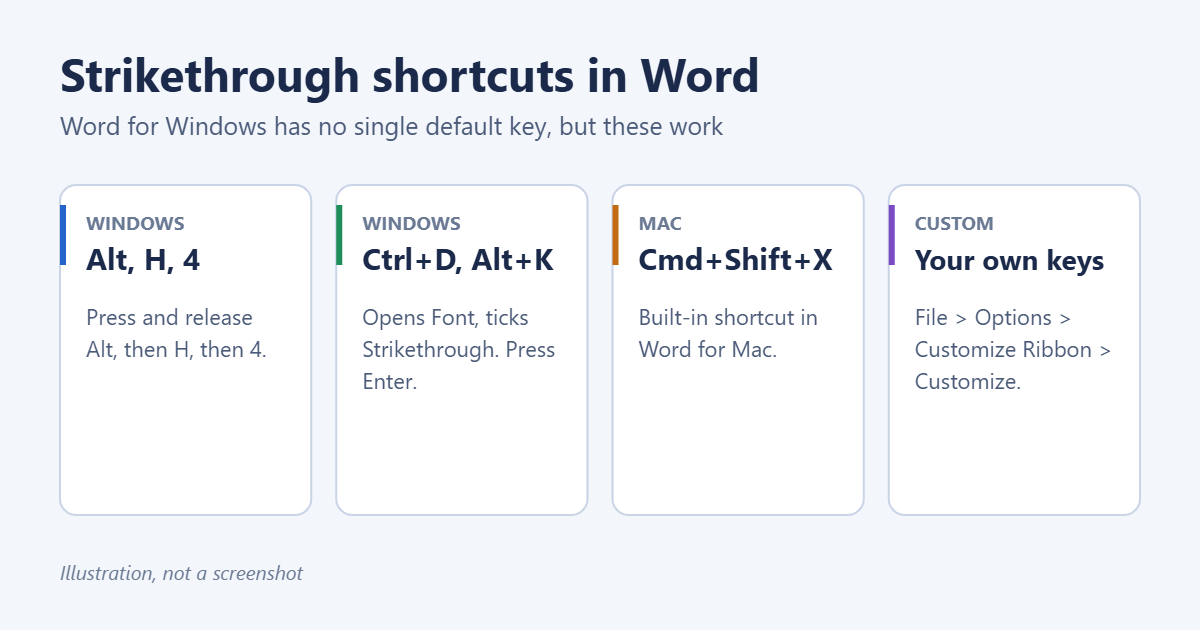
Shortcut 1: Alt, H, 4 (Windows)
- Select the text you want to cross out.
- Press and release Alt. Letters appear over the ribbon tabs.
- Press H to open the Home tab.
- Press 4 to apply strikethrough.
These are key tips, so press each key in turn rather than holding them together. Repeat the same keys to remove the strikethrough. This works in Word for Microsoft 365, 2024, 2021, 2019 and 2016.
Shortcut 2: Ctrl + D, then Alt + K (Windows)
- Select the text.
- Press Ctrl + D to open the Font dialog.
- Press Alt + K to tick Strikethrough.
- Press Enter.
The Font dialog also has Double strikethrough, which draws two lines through the text. It’s sometimes used in legal and financial documents to show deleted figures.
Shortcut 3: Command + Shift + X (Mac)
Word for Mac has a built-in strikethrough shortcut. Select the text and press Command + Shift + X. Press it again to remove it. You can also press Command + D to open the Font dialog and tick Strikethrough there.
Create your own shortcut (Windows)
- Go to File > Options > Customize Ribbon.
- Next to Keyboard shortcuts at the bottom, click Customize.
- In Categories, choose Home Tab. In Commands, choose Strikethrough.
- Click in Press new shortcut key and press the keys you want, such as Ctrl + Alt + S. Below the box, Word shows whether the combination is already used. Look for “[unassigned]”.
- Make sure Save changes in is set to Normal so the shortcut works in all documents.
- Click Assign, then Close.
Pick something that’s unassigned. If you overwrite a built-in shortcut, you lose the original command’s key.
Or add it to the Quick Access Toolbar
Right-click the Strikethrough button (ab with a line through it) on the Home tab and choose Add to Quick Access Toolbar. Press Alt to see which number it gets, then use Alt + that number as a shortcut.
If you’d rather click, select the text and click the Strikethrough button in the Font group on the Home tab. It shows ab with a line through it. This also works in Word for the web, which doesn’t support the Alt key tips the same way.
Strikethrough vs Track Changes
If you’re editing someone else’s document and want deletions to show as crossed out, use Review > Track Changes instead. Deleted text then appears with a strikethrough and can be accepted or rejected. Manual strikethrough is just formatting and isn’t tracked as an edit.
Shortcuts in other Office apps
| App | Strikethrough shortcut |
|---|---|
| Word (Windows) | Alt, H, 4 or Ctrl + D then Alt + K |
| Word (Mac) | Command + Shift + X |
| Excel (Windows) | Ctrl + 5 |
| Excel (Mac) | Command + Shift + X |
| PowerPoint and Outlook | Strikethrough button (ab) on the Home or Format Text tab |
For more detail, see how to add a strikethrough in Excel and how to strikethrough text in Outlook.
Troubleshooting
Alt, H, 4 does something else
Some add-ins or a customized ribbon can change the key tips. Press Alt, then H, and look at the small letter or number shown on the Strikethrough button. Use that instead.
The line goes through spaces I didn’t want
Strikethrough covers everything selected, including spaces. Reselect only the words, or use Ctrl + Shift + Right Arrow to select word by word.
I can’t remove the strikethrough
It may be Track Changes rather than formatting. Go to Review and accept or reject the change. Otherwise select the text and press Ctrl + Spacebar to clear all character formatting.
Frequently asked questions
Why doesn’t Ctrl + 5 work in Word?
Ctrl + 5 is Excel’s strikethrough shortcut. In Word it sets line spacing to 1.5. Use Alt, H, 4 instead.
Can I use strikethrough for a to-do list?
Yes. Many people cross off finished items. In Word, a checkbox list with Developer > Check Box Content Control is another option.
Summary
- Windows: select text, press Alt, H, 4.
- Windows alternative: Ctrl + D, Alt + K, Enter.
- Mac: Command + Shift + X.
- Custom: File > Options > Customize Ribbon > Customize.

Matt Jacobs has been working as an IT consultant for small businesses since receiving his Master’s degree in 2003. While he still does some consulting work, his primary focus now is on creating technology support content for SupportYourTech.com.
His work can be found on many websites and focuses on topics such as Microsoft Office, Apple devices, Android devices, Photoshop, and more.