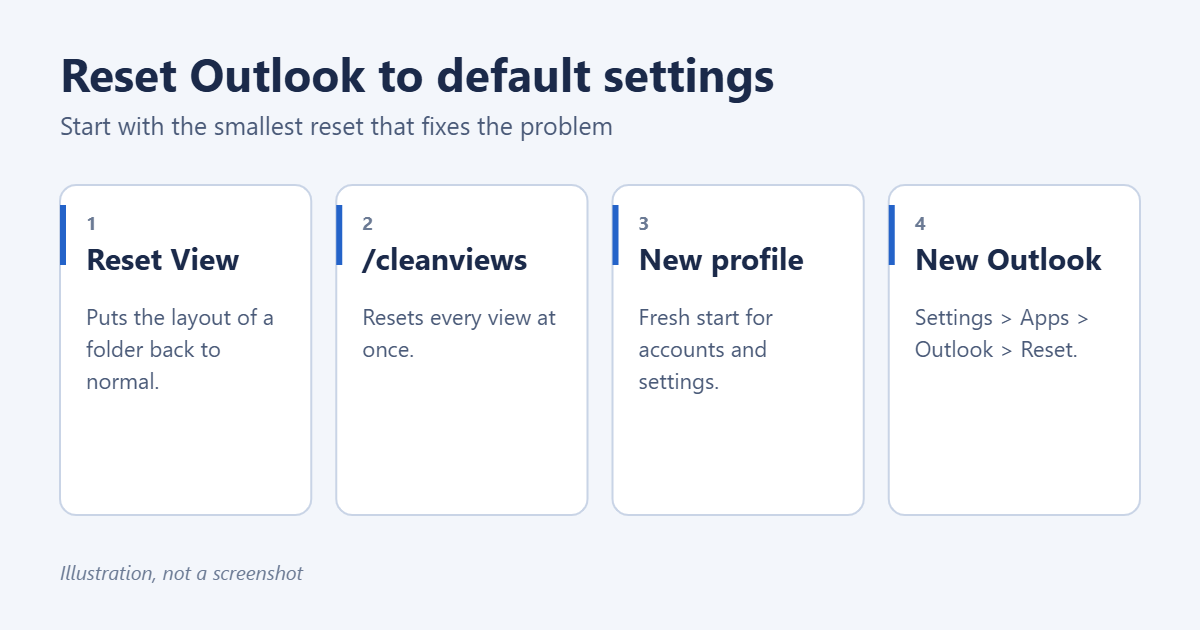
Outlook doesn’t have a single “reset to default” button. What you do depends on what you want to reset. To put the layout of your inbox back to normal in classic Outlook, select View > Reset View. To reset every view at once, close Outlook and run outlook.exe /cleanviews. To start fresh with your accounts and settings, create a new Outlook profile. The new Outlook for Windows can be reset completely from Windows Settings.
Applies to: classic Outlook for Microsoft 365, Outlook 2024, 2021, 2019 and 2016 on Windows; the new Outlook for Windows; and Outlook for Mac.
Which Outlook do you have?
Look at the top-right corner of the Outlook window. If you see a New Outlook toggle switched on, or the window looks like Outlook on the web with no File tab, you’re using the new Outlook. If there’s a File tab in the top-left corner, it’s classic Outlook.
Classic Outlook: reset the view of a folder
Use this when columns are missing, the reading pane moved or messages are grouped oddly. If the grouping you mean is emails bundled into threads, you can turn off conversation grouping in Outlook without resetting anything else.
- Open the folder that looks wrong, such as your Inbox.
- Select the View tab.
- Select Reset View.
- Select Yes to confirm.
To apply the same view to other folders, select Change View > Apply Current View to Other Mail Folders. More layout fixes are in changing the Outlook view back to normal.
Classic Outlook: reset all views and panes with a command
Outlook has startup switches that reset parts of the program without touching your email.
- Close Outlook.
- Press Windows key + R to open Run.
- Type one of the commands below and press Enter.
outlook.exe /cleanviewsresets every view you’ve customized back to Outlook’s defaults.outlook.exe /resetnavpaneresets the folder pane on the left, which helps if folders or the navigation bar have disappeared. For a missing folder list, also check where your Outlook folder list went.outlook.exe /resetfoldersrestores default folders, such as Sent Items or Drafts, if they’re missing. It doesn’t bring back folders you created yourself; for those, see how to get a deleted folder back in Outlook.outlook.exe /safestarts Outlook without add-ins, to check whether an add-in is causing the problem.
If Windows says it can’t find outlook.exe, type the full path in quotation marks, usually "C:\Program Files\Microsoft Office\root\Office16\OUTLOOK.EXE" /cleanviews.
Classic Outlook: start fresh with a new profile
A new profile resets your accounts and most settings. Use it when Outlook keeps crashing, won’t sync, or the commands above don’t help. Once the new profile is working, you can set a custom send/receive interval again if you had changed it from the 30-minute default. When the new profile opens on a Windows 10 PC, configuring Outlook in Windows 10 walks through adding each account back.
- Close Outlook.
- Open Control Panel, set View by to Large icons and select Mail (Microsoft Outlook).
- Select Show Profiles > Add, give the profile a name and select OK.
- Follow the steps to add your email account.
- Back in the Mail window, choose Always use this profile, pick the new profile and select OK.
- Open Outlook. It downloads your email again, which can take a while for a large mailbox.
Before you do this: email in Microsoft 365, Outlook.com, Gmail and other IMAP accounts is stored online and comes back. Signatures and rules saved only on your PC, and email in POP accounts or local .pst data files, don’t move automatically. Keep the old profile until you’ve checked everything, and open old .pst files with File > Open & Export > Open Outlook Data File.
Classic Outlook: repair Office
If Outlook won’t start at all, repair the installation. Open Settings > Apps > Installed apps, select the three dots next to Microsoft 365 or Microsoft Office and choose Modify. Try Quick Repair first, then Online Repair if that doesn’t help. Your email and settings aren’t affected.
New Outlook for Windows: reset the app
- Close Outlook.
- Open Settings > Apps > Installed apps.
- Find Outlook (new), select the three dots and choose Advanced options.
- Select Repair first. It keeps your settings.
- If that doesn’t fix it, select Reset. This clears the app’s data on your PC, and you’ll need to sign in to your accounts again.
Your email stays safe on the server. Settings stored with your account, such as signatures in Microsoft 365 or Outlook.com accounts, come back after you sign in.
Outlook for Mac: reset with a new profile
- Quit Outlook.
- In Finder, open Applications, Control-click Microsoft Outlook and select Show Package Contents.
- Open Contents > SharedSupport and open Outlook Profile Manager.
- Select the + button to create a new profile, then Set as Default.
- Open Outlook and add your accounts.
Troubleshooting
Reset View is greyed out
The folder already uses its view’s default settings. If it still looks wrong, choose a different layout under View > Change View, such as Compact, or run outlook.exe /cleanviews.
Outlook is slow or shows old messages after resetting
Give it time to rebuild its local cache. If it stays slow, clear the Outlook cache.
The commands don’t do anything
Outlook was still running in the background. Close it, check Task Manager for Microsoft Outlook and end it, then run the command again.
Related: repairing Outlook 365 in Windows 10.

Matt Jacobs writes and maintains the guides on Support Your Tech, which he started in 2017. He spent most of his career keeping small-business PCs running and still takes the occasional consulting job, so the steps here come from fixing the same problems on other people’s computers. Every guide is checked on his own Windows 11, Windows 10, Mac, iPhone and iPad before it goes up.